Tag Archives: AARP

AARP report: Family caregivers’ economic value reaches $1 trillion

Houser, Ari, Selena Caldera, Brendan Flinn, and Rita Choula. Valuing the Invaluable 2026: Family Caregivers’ Contribution Reaches $1 Trillion. Washington, DC: AARP Public Policy Institute, March 26, 2026. https://doi.org/10.26419/ppi.00402.001.

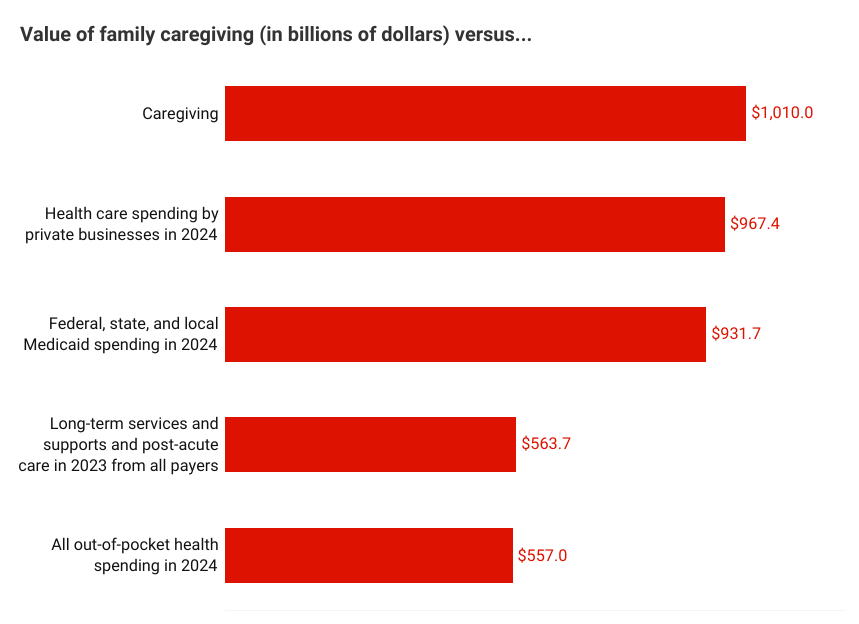
The latest caregiver report has been released by the AARP Public Policy Institute. Titled “Valuing the Invaluable 2026” the report, researchers found that the economic value of family caregiving in 2024 was worth a whopping $1 trillion.

In comments on the report, AARP CEO Dr. Myechia Minter-Jordan said, “When you look at caregiving at this scale, it becomes clear that this is not just a personal responsibility; it is a foundational part of our economy and our care system, and it is time we start recognizing it that way.”

Here are other main takeaways:

  • The $1.01 trillion amount breaks down to 49.5 billion hours devoted to family caregiving, equaling a workforce of 23.8 million full-time workers.
  • An estimated 59 million family caregivers helped an adult family member, neighbor, or friend with daily activities during the year, with 63 percent providing monthly care.
  • The economic value of family caregiving exceeded the total amount of federal, state, and local Medicaid spending in 2024 ($932 billion).
  • The cost and value of family caregiving has grown rapidly since the AARP’s first caregiving report in 2006, where the economic value of caregiving was found to be $350 billion.
  • Family caregivers now average 27 hours of care per week. This is on top of a part- or full-time job, plus for sandwich caregivers, caring for children and elder relatives at the same time.
  • More than half (55 percent) of family caregivers perform tasks typically handled by health care professionals, such as giving injections or managing a catheter. As a caregiver for my mother, I was required to care for her colostomy and after much trial and error, learned to manage her colostomy bag quite well. As I wrote in The Reluctant Caregiver, this task was well outside of my skillset and comfort zone, but as the sole family caregiver, I had no choice but to step up and take charge.

In conclusion, AARP noted: “This unpaid care generates significant public benefit, including savings for taxpayers, yet it often does so at considerable cost to caregivers’ own health, well‑being, and long‑term economic security.”

Access the full report: Valuing the Invaluable 2026: Family Caregivers’ Contribution Reaches $1 Trillion
1 Comment

Filed under Awareness & Activism

AARP: Valuing the Invaluable 2023 report

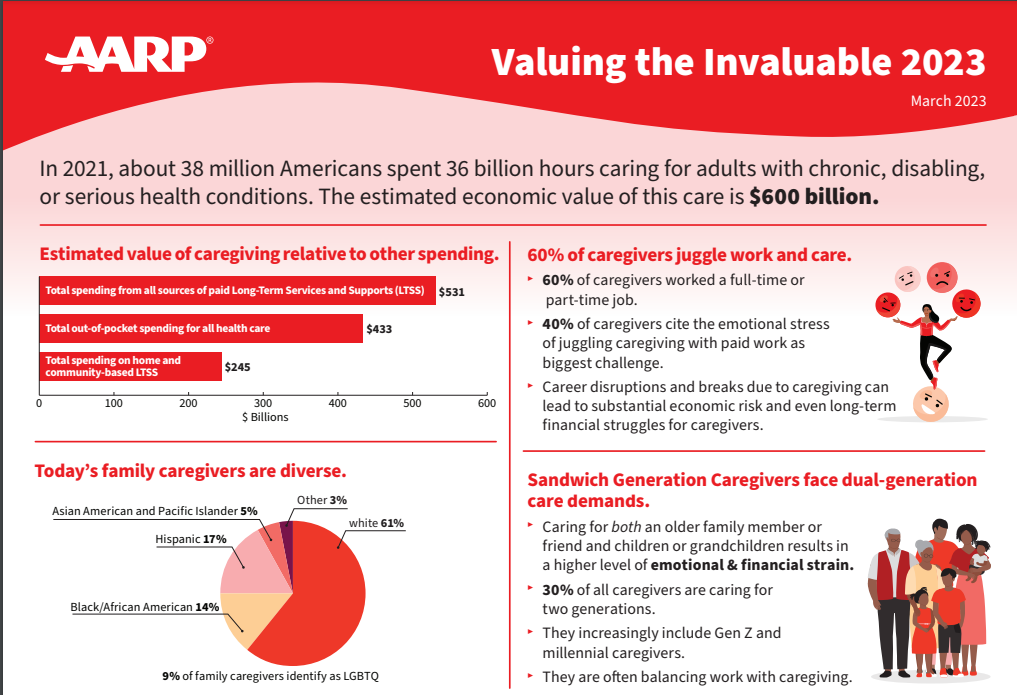
This month, AARP released a report: Valuing the Invaluable 2023 Update. While no one has to tell caregivers how much free labor they provide while caring for their loved ones, it does help to calculate a value for caregiving work and have a well-known organization like AARP broadcast how much economic value caregivers provide.

Among the highlights of AARP’s report:

  • In 2021, approximately 38 million Americans spent 36 billion hours caring for adults with a range of health conditions.
  • The estimated economic value of that care is $600 billion.
  • 60 percent of caregivers juggle a full- or part-time job and care.
  • 40 percent of caregivers say juggling a job and caregiving duties is their biggest and most emotionally stressful challenge.
  • 30 percent of caregivers are “sandwich caregivers” caring for two generations at the same time.
  • Caregivers come from diverse populations and an individual’s culture informs their caregiving experience.

In addition to the findings, the AARP report made several recommendations. The AARP advocates for the passage of caregiver support legislation and strengthening paid family leave, offering caregiver tax credits, expanding respite care options and making sure caregivers are part of their loved one’s care plan.

How many reports will have to be produced for our government to take caregiving seriously? Every year I highlight such reports and the progress we’ve made to support caregivers is frustratingly slow. Keep telling your caregiving story to whoever will listen.

Leave a comment

Filed under Awareness & Activism

When aging in place becomes stuck in place

A new AARP survey found that older Americans continue to have a strong preference to staying in their homes as they age, even if they have found themselves stuck at home for long stretches of time during the COVID-19 pandemic. Over three-quarters of those age 50 and over (77 percent) prefer to remain in their home as they age, according to the survey results. That statistic has remained steady for over a decade, according to AARP.

However, there is another way in which older people get stuck in a living situation that doesn’t meet their needs as they age. A third of survey participants said they’d need to modify their homes in order to accommodate a physical limitation. These modifications can be pricey and not feasible for those on fixed incomes. The same financial challenges apply to moving into a more aging-friendly home or moving into a senior living facility.

When my father landed in the hospital for emergency surgery, he had a difficult recovery due to his mid-stage dementia and could no longer walk. The condo that my parents had was not safe for him to return to, so the hospital would not release him home. One had to access a staircase to get to the entrance and the rear entrance was wooded land that was not safe for unsteady gaits. Any modifications would have to be approved by the HOA, a lengthy process. Instead my father got transferred to a skilled nursing facility and then, a memory care facility an hour and a half away from home.

Another solution to these housing challenges was met with support from survey participants. Sixty percent of those polled said they would consider living in an accessory dwelling unit (ADU), sometimes referred to as a “granny pad” or a tiny house. These affordable, small-footprint homes can be built adjacent to a primary home (depending upon local permitting) and allow independence and privacy while also benefitting from having loved ones nearby for help with daily chores and activities and for companionship.

According to the AARP survey, “access to clean water, healthy foods, quality health care and safe outdoor spaces” were important considerations when it came to what communities offer those aging in place. High-speed internet service was also deemed important. Developers and city planners should take note as they build communities and offer flexible, adjustable housing options that can meet the needs of an aging population.

Leave a comment

Filed under Awareness & Activism