

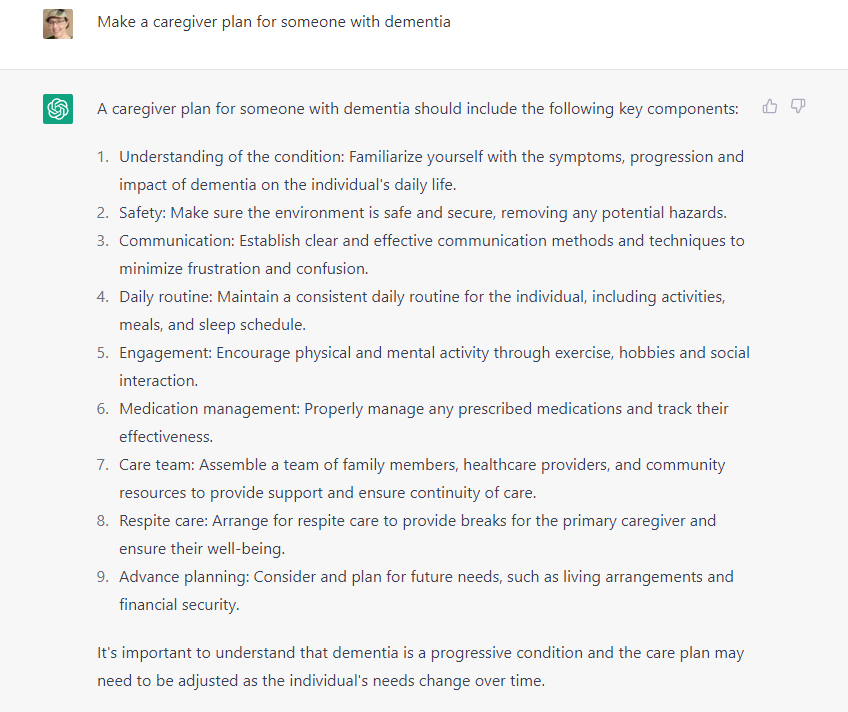
For the past year, I’ve immersed myself in the emerging generative AI technologies. Mostly for my job, but also for my personal curiosity. Every industry is being impacted by AI, including caregiving. If you’ve followed any of the AI discussion, you’ll know that while the technology offers great potential in certain areas, it also can produce errors, which are referred to as “hallucinations.”
Users of these gen AI models are given the responsibility of creating suitable prompts for whatever tasks they are asking the model to complete. There are now people being hired as “prompt engineers” solely for that purpose. The reasoning goes that the better the prompt, the better the execution.
Instead of just typing in a few keywords into a search engine bar, one has to think about a variety of details. There’s a lot of trial and error in the process, with the accompanying frustration and wonder when you get it just right.
This made me think about communicating with someone in the earlier stages of dementia. The person’s communication skills are typically not that impaired early on, but some aspects may be slightly off. The misuse of a word. The incorrect memory recall. The out of left field response. Not understanding a routine request the person’s done many times before.
I remember having conversations with my father during those early stages of the disease and it was disconcerting because our discussion was mostly normal, until it suddenly wasn’t. And that’s how it feels to me working with generative AI technology. It’s accurate a good deal of the time but there’s still something just a bit askew.
If gen AI is characterized as being almost human, we sometimes feel our loved ones with dementia are not the people they once were. Creating AI prompts reminds me to be thoughtful when assembling the building blocks of communication, and how we may be required to reconstruct our typical communication style with our loved ones with dementia, by reframing questions and devising ingenious ways to keep the conversation, and the connection, alive.
The prompt used for the blog post image: “A digital illustration of an adult daughter and her 80-year-old mother with dementia setting at the dining room table, having a conversation with each other, with hearts floating around them.”


![Pageflex Persona [document: PRS0000038_00069]](https://memoriesproject.files.wordpress.com/2014/02/reluctant-caregiver-cover.jpg)






 The Memories Project