Monthly Archives: February 2023

Do brain games offer protection against Alzheimer’s?

Every night I wind down by playing two games on my tablet: a crossword and a Jumble word puzzle. I’ve always enjoyed word puzzles. I inherited my love of the Jumble puzzles from my mother, who was a devoted player. One of the ways we bonded as she recovered from cancer surgery was working on Jumble puzzles together. My dad was an avid reader, but his love of words didn’t extend to games. It was particularly cruel when Alzheimer’s took away his favorite hobby of reading.

There are many apps and articles that promote “brain games” as a way to reduce the risk of Alzheimer’s and other dementias. While proponents of such games are enthusiastic about their potential in supporting cognitive health, the research so far is mixed when it comes to benefits.

One study that involved people diagnosed with mild cognitive impairment found that crosswords helped support cognitive health more than other games, though the positive results were not dramatic.

There’s no harm in playing such games if it brings you comfort. I do notice that if I’m tired or not feeling well, I struggle with completing the puzzles as fast as I normally do. I like to challenge myself to complete the crosswords as fast as possible. For me, this means not stopping to ponder a clue that I’m stuck on; instead I keep going and complete as many other words as possible before coming back to the ones that stumped me.

While such games may not offer protective benefits against Alzheimer’s, we do know that doctors use a series of tests which could be considered game-like to help diagnose someone with the disease, such as word memory exercises. I’ve participated in a study which has me complete a series of games along with a cognitive questionnaire a few times per year. Doing word games as part of your daily routine could help you spot a decline in your cognitive abilities earlier than you might have noticed otherwise.

Photo by Ross Sneddon on Unsplash.
2 Comments

Filed under Awareness & Activism

Supporting the caregivers in your life all year long

Friday was National Caregivers Day, but why just celebrate one day a year? Let’s keep the support flowing all year long.

AARP compiled a nice, actionable list of things one can do to support your caregivers in your life. I appreciate the “what that looks like” suggestions under each support method. It can be difficult for one to know how best to support a caregiver, so these practical options are so useful. For example, under “demonstrate support” there are suggestions like help a caregiver get organized, do research, help with housework, yardwork or other errands, and bring a meal or provide a meal delivery service.

The key in supporting caregivers is making sure the onus isn’t on them to ask for help. As a former caregiver, I know how hard it can be for some of us to ask for assistance. But I always appreciated when someone stepped up and helped me on my caregiving journey.

Photo by Hannah Busing on Unsplash.

Leave a comment

Filed under Awareness & Activism

Want to die at home? Start saving now

If you’ve followed The Memories Project blog for awhile, you know that helping families understand the complexities of dying at home is an important issue to me. I wrote an essay on the topic that went viral on The Caregiver Space: Why dying at home isn’t all that it’s cracked up to be.

Recently I read another essay that addressed the sobering financial costs that a family can incur to honor a loved one’s wishes to die at home: My grandmother died at home, just as she wanted. It cost $145,000.

In the essay, Sarah Romanelli describes a situation that will be familiar to many caregivers: “being held hostage” by a broken care system that breaks down as one becomes more fragile. In Romanelli’s grandmother case, she was too weak for rehab and too dependent to return to assisted living, who sent her back to the hospital. The family was forced to crunch numbers and develop a care plan, which involved at-home care.

The family moved the grandmother to an apartment close to family and hired 24-hour care. That cost a whopping $16,200 per month, but was still cheaper than securing a space in a long-term care facility. Keep in mind that care facilities may require families to pay out-of-pocket for private caregivers if a resident is deemed to need around-the-clock monitoring. This happens quite often for residents with dementia.

Romanelli says her grandmother received wonderful end-of-life care, but she knows that their family’s solution is not feasible for most people. My father also got passed around to various facilities and ended up being sent far away from my mother, because it was the only memory care facility with an opening. At over $4,000 a month, it quickly depleted my family’s modest resources. But 24-hour care would not have been feasible in my parents’ rural community due to staffing shortages, and definitely would have been more expensive.

Bottom line, no matter what care option you choose, it will be expensive. I want people to have the choice of dying at home, and not bankrupt their family in the process.

Photo by Alexander Mils on Unsplash.

Leave a comment

Filed under Awareness & Activism

ChatGPT: Does it have uses for caregivers?

If you’ve been online over the last few months, you’ve probably come across discussions about ChatGPT. The conversational AI-powered (artificial intelligence) tool developed by OpenAI is the latest tech fad that some experts claim could take over our jobs in the future. (If you are interested in working with images instead of words try the related DALL-E.)

You may have seen some of the program’s capabilities: it can write articles, essays, jokes and songs, debug software code, and create resumes with some input from the user. Users can have a conversation of sorts with ChatGPT while refining their requests and the tool can ingest those new points and update its responses in real time.

As someone who enjoys exploring new tools but retains a healthy amount of skepticism about such tools taking over the world, I’ve spent some time testing out ChatGPT, focusing on how the tool could potentially be of aid to caregivers.

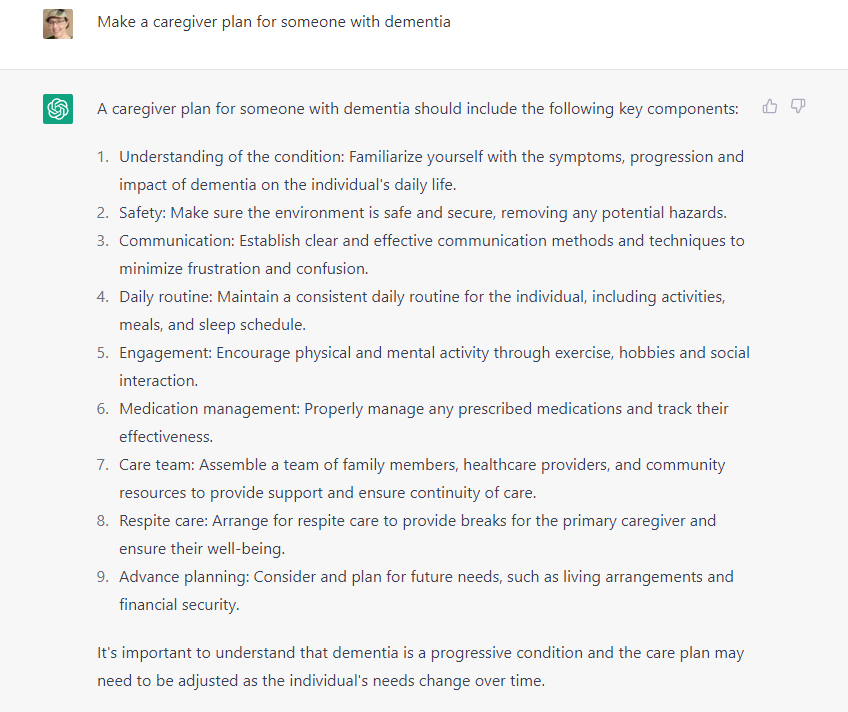
My main takeaway is that while ChatGPT can adequately provide information on a vast amount of topics, the responses are mainly generic and middling in quality, like someone reciting an encyclopedia entry. Your mileage will vary if you are asking a question on a highly technical topic or asking it to generate code for a website. But when asking for caregiving advice such as making a caregiver plan for someone with dementia or tips on aging in place, it regurgitates acceptable but basic advice that can be found across the internet. You can see a couple of examples below:

The glaring issue for me is that there is no attribution with ChatGPT responses. That could be important when you are seeking medical advice such as dementia caregiving tips. Are the pointers it is offering come from a dementia expert like Teepa Snow or a low quality resource? At this point, the responses could be used as a decent starting point, but the user would need to do additional research outside of the ChatGPT system to verify, augment, and personalize the information. Google and other search engines are seeking to incorporate attributes of such AI-based tools into their own programs which would offer a more conversational way to search for information.

I’m going to continue to explore the uses of ChatGPT and how it might be useful for caregivers. If you’ve used the tool, I’d love to hear your feedback.

Photo by Zac Wolff on Unsplash.

1 Comment

Filed under Awareness & Activism