Category Archives: Awareness & Activism

Is the media misleading the public on Alzheimer’s?

It seems to be a mixed blessing that the media is paying more attention to Alzheimer’s.

On the one hand, the spotlight on a disease that has long been kept in the shadows is welcomed. But modern journalism’s need for clicks sometimes leads to misleading headlines, which only hurts the awareness movement.

Brain

Recently, a study came out which demonstrated in a very small sample of autopsies of 8 people who had been diagnosed with the rare brain disease, Creutzfeldt-Jakob disease related to growth-hormone treatment, 6 of the 8 showed an increase in amyloid plaque that scientists believe is linked to Alzheimer’s.

It is certainly an interesting study, and the results were unexpected, but there are not any solid takeaways until larger studies can be performed. Yet, in the click-crazy world of online journalism, some outlets ran with the headline, “Is Alzheimer’s contagious?”

I’ve read accounts from those with Alzheimer’s who criticize the use of the term “Alzheimer’s sufferer” because they are doing their best to live successfully with Alzheimer’s and sufferer sounds like there is no hope with anyone with the disease.

I might be guilty of using the term “suffering” when describing my Dad’s experience with Alzheimer’s, but that’s because I truly believe he was suffering. I don’t think it should be used as a blanket term, especially for those in the early stages of the disease.

As a journalist, I try to be aware of these considerations, but I encourage everyone to politely correct those who provide misinformation on Alzheimer’s or any other disease.

The old expression of “all publicity is good publicity” may be true for Alzheimer’s, but it is the responsibility of advocates to make sure the coverage is accurate.

4 Comments

Filed under Awareness & Activism

Finding caregivers where you least expect it

I was dreading going to my dental cleaning appointment for multiple reasons. I always dread these appointments because I’m not fond of the forced chatter, especially when there are instruments in my mouth!

The main reason I was dreaded the visit was because the last time I was there, my mother was headed to the emergency room for the last time. I was already on my way to the dentist when I received my mom’s call, saying she couldn’t stand the pain anymore. I remember texting my mom’s personal caregiver from the dentist’s chair. I didn’t tell the staff about the caregiving crisis I was dealing with at the time because frankly, it was none of their business.

Photo: Freeimages.com/Olaf Knauer

Photo: Freeimages.com/Olaf Knauer

I remember sitting in that dentist’s chair over the next hour, my heart pounding, but not for fear of the tools buzzing in my mouth. After all of the ups and downs with my mom’s health over the last couple of years, was this finally it? The real beginning of the end?

In my heart, I knew it was, and it terrified me.

The very next day, I left for New Mexico to be with my mother.

I always have the same dental technician who does my cleaning. She asked the obligatory “how my summer was” question, and instead of just glossing over the question and telling a little white like like I would normally do, I told her the truth. My mother had died, and I had spent the summer dealing with post-death tasks.

She offered her condolences and asked what caused my mother’s death. When I told her colon cancer, she began telling me about her own caregiving experience that she is going through with her father-in-law.

Some of her experiences were similar to mine, in that her father-in-law’s tests came back fine, until he was diagnosed with Stage IV colon cancer. (My mom was diagnosed with Stage III.) He actually collapsed in the emergency room, and that’s what finally forced doctors to figure out a diagnosis.

She said they chose to move him into their home, so they could help take care of him and so that her husband would get to spend extra time with his father. She talked about the guilt her husband felt for not being able to help his dad more, and sooner, something I can totally relate to from my caregiving experience.

The conversation made me think about how many people we come in contact with in our daily lives that are also in a caregiving situation. It’s probably more than we imagine. If I hadn’t opened up, I would never had known that my dental technician was also a caregiver.

Don’t hesitate to share your caregiving story with strangers, if the opportunity arises. You never know what tips or support you may be able to offer each other.

3 Comments

Filed under Awareness & Activism

Today’s lesson: Don’t give up

I have some exciting news to share: I have been chosen by the Atlanta Writers Club as the 2015 recipient of the Rick Bragg Prize for Nonfiction.

AWC 2015 contest winners

The piece that I submitted, “Greetings from the Nursing Home,” was an essay that I have kicked around for a long time. I began the piece after my first visit with Dad at the nursing home. That was back in 2011.

Since then, the essay has gone through countless revisions, and has been critiqued multiple times. I have submitted the piece numerous times to contests and literary journals for publication.

Each time, it was rejected.

As any writer knows, rejection is part of the process. I kept plugging away. I’ve written other pieces that have been published, I’ve self-published essays on various online platforms, but this one essay was special to me. While finishing my book is my number one writing goal, close behind was getting this essay recognized.

I learned of the honor as I was standing in the middle of what was my parents’ condo. The living room furniture had just been removed, and donated to charity. I was standing in the empty room, considering the new possibilities, when my phone buzzed and I literally jumped for joy after opening the email with the “Congratulations” subject line.

I hope this will inspire all of you, that however you express your caregiving story, whether it is through the arts, sports, spiritually or any other form of expression, don’t give up hope. Your message is being heard, and it will find a proper home.

3 Comments

Filed under Awareness & Activism

My essay about dying at home posted on The Caregiver Space

I’ve been reading posts on The Caregiver Space for quite some time, but never had time to submit my own writing.

Now that I find myself in a post-caregiving phase of my life, I’m really trying to focus on writing a series of essays that have been stewing in my brain for awhile.

hospital bed

Last week, The Caregiver Space published my essay, “Why dying at home is not all it’s cracked up to be” and the reception has been quite positive. The post was published on The Caregiver Space Facebook page where it generated several hundred likes and many heartfelt comments.

The essay is not an attack on hospice care workers; I admire most of them and think they do a phenomenal job. Hospice care is truly a calling in my opinion, and one can see the benefit of the loving, compassionate care they provide.

My essay is a look at dying at home vs. dying in a facility from the family caregiver’s perspective. After my dad died in a skilled nursing facility, I was all for my mother dying at home. But the reality was a bit different. It was an emotionally brutal experience that I wouldn’t wish on my worst enemy. That’s not to say that her death would have necessarily been better in a hospital, it would have been difficult in a different way.

My main point of the essay is to bring awareness to family caregivers in rural areas. They may find that the local home hospice agency is understaffed and overworked, and cannot provide the around-the-clock care that is often touted by die-at-home advocates. People should be aware and prepare themselves for taking on more of the nursing duties of caregiving. If they feel they cannot do it themselves, they should seek out help from family, friends or professional caregivers.

If you have the time, please read the essay and let me know what you think. Also, please share with anyone who you think could benefit from the information.

5 Comments

Filed under Awareness & Activism

White House Conference on Aging: Great discussions, now we need to see action

Update: I was moved by many of the stories and statistics shared at the White House Conference on Aging. How little paid caregivers earn and the rallying cry to pay them a livable wage of $13/hour. A woman who juggles the demands of motherhood and her father who has Alzheimer’s, yet sits on hold or gets the run-around when calling for help from government agencies.

There were many programs and initiatives unveiled at the conference, and while many sound promising, the proof will be in the results.

Original post:

The White House Conference on Aging is happening today. I think it will be of interest to many who follow this blog.

I wish I could be in Washington, D.C. to participate in person, but I am following along with the live stream of the conference and taking part in the conversation on social media by using the hashtag #WHCOA.

whcoa logo

I hope the conference will help generate greater awareness for the issues impacting caregivers in America, both family caregivers and professional caregivers. The fact that the government is taking a day to discuss aging issues is progress, but of course, legislative action and government funding is ultimately what is needed.

If you catch any of the conference, share your thoughts below.

Leave a comment

Filed under Awareness & Activism

Glen Campbell documentary ‘I’ll Be Me’ a powerful, profound look at Alzheimer’s

I finally had the chance to see the documentary about Glen Campbell called, “I’ll Be Me.” I highly recommend seeing it, even if you are not a fan of Campbell’s music.

The documentary is an unflinching yet loving look at how Campbell and his family have managed his Alzheimer’s diagnosis. The film once again confirms the power of music. It was amazing to see how long Campbell’s music ability endured, even as he entered the late middle stages of the disease.

Embed from Getty Images

The film, made in conjunction with his family, doesn’t shy away from the ugly aspects of Alzheimer’s. Viewers witness Campbell’s temper, repeating questions, communication difficulties, wandering, discussions of incontinence episodes and paranoid outbursts.

Viewers get a behind-the-scenes look at the sometimes chaotic backstage scene before shows. As we all know, those with Alzheimer’s have good and bad days, until they end up with more bad ones than good ones. When you are performing in front of hundreds of people, the good and the bad are magnified.

Campbell is now in the final stages of the disease and lives in a residential care facility.

For Campbell fans it will be difficult to watch one of the greatest guitarists of all times deal with such a debilitating disease, but his phenomenal guitar work is on display throughout the film, as is his sense of humor and his fighting spirit.

If you’ve seen the film, please share your thoughts.

7 Comments

Filed under Awareness & Activism

Being the ‘angry advocate’ is sometimes necessary

I don’t like conflict. I like things to run smoothly and everyone to do their job. This is especially true during a crisis.

Of course, it is in these tough situations that conflicts and issues often arise.

Ironic door sign

I found out yesterday that after waiting over a week for hospice to begin, with my mom reporting an 8 out of 10 on the pain scale during every home health visit, that the hospice transition process had not even started! The home health agency told me I needed to talk to my mother’s primary care physician. But last week, when I was at the doctor’s office, I asked about starting hospice and the doctor’s staff told me the home health agency needed to fax them paperwork.

I was beyond frustrated. I don’t get angry very often but I was really furious. My mom had suffered needlessly for over a week because these two entities that work with each other all the time can’t get their acts together?

Since the local home health agency is now part of a larger corporation, I filed a complaint at the corporate level. I don’t generally like to throw people under the bus but I wanted action.

And it worked. Tomorrow a staff member is coming to transition Mom to home hospice.

I just wish I had been the angry advocate sooner.

2 Comments

Filed under Awareness & Activism

Dying with dignity shouldn’t be so difficult

The last week my mom’s health has taken a steep decline. Barring some miraculous turnaround, it is fair to say she is actively dying.

Hard to believe this photo was taken just a little over a month ago.

Hard to believe this photo was taken just a little over a month ago.

While I have prepared myself for this moment, and have seen it coming for awhile, what I didn’t necessarily expect was how difficult it would be to just allow someone to die in peace and comfort.

I literally had to run all over town just to get prescription paid medicine for my mom. I know new regulations on controlled substances took effect this year, but frankly, if an addict wants narcotic pills they are going to get them no matter what. In the meantime, those who are legitimately in pain have to suffer.

The doctor made me go in person to pick up the prescription. They said they required a family member to pick it up, even the nurses at the home care agency my mom uses were forbidden from picking it up. Guess it’s good I just arrived in town! There is no way my mom could have made it to the doctor’s office.

There are plenty of pain-ridden people who live alone, what do these poor souls do?

And while I don’t necessarily want my mother to waste away in a hospital setting, I am surprised that the doctors keep sending her home from the ER. Uncontrollable pain, emaciated, can barely ambulate … I mean, geez, what does it take to be admitted to the hospital these days? The doctor told her she didn’t qualify for an inpatient stay under the new strict guidelines.

So we are starting hospice, but her overworked doctor has to sign off on it. I’m not too hopeful that it will be done quickly. While her doctor was off last week, my mom had no pain medicine and being cut off cold turkey really sent her health reeling into a death spiral.

So much red tape and regulations are getting in the way of treating people who are suffering with some form of dignity.

Family caregivers shouldn’t be left feeling helpless and devastated as they watch their loved one suffer needlessly.

I hope we can work together to advocate for better end-of-life treatment.

3 Comments

Filed under Awareness & Activism

Guest article: The Disease of Forgetfulness

By Jami Hede of Exploring Dementia

Embed from Getty Images
In 1901, German neuropsychiatrist Dr. Alois Alzheimer took up a position at the Institution for the Mentally Ill and for Epileptics, in Frankfurt, Germany. One of the first patients he examined there was a woman named Auguste Deter, who was 51 years old. Just a few years previously, Frau Deter had been a happy wife and mother, living a normal life for the time period. But then she began showing symptoms of memory loss, trouble sleeping, delusions, temporary vegetative states, dragging sheets around the house, and screaming for hours in the middle of the night. Poor Karl Deter had no choice but to admit her to the institution, because he just couldn’t care for her any more, and also continue to work to support their daughter.

In 1996, Frau Deter’s actual medical records were discovered, written in Dr. Alzheimer’s own handwriting (and her own, at times). The neuropsychiatrist made careful and accurate transcriptions of his interviews with his patient, and a short excerpt of them is given here:

“What is your name?”
“Auguste.”
“Family name?”
“Auguste.”
“What is your husband’s name?” – she hesitates, finally answers:
“I believe … Auguste.”
“Your husband?”
“Oh, so!”
“How old are you?”
“Fifty-one.”
“Where do you live?”
“Oh, you have been to our place”
“Are you married?”
“Oh, I am so confused.”
“Where are you right now?”
“Here and everywhere, here and now, you must not think badly of me.”
“Where are you at the moment?”
“We will live there.”
“Where is your bed?”
“Where should it be?”

Dr. Alzheimer asked Frau Deter many questions, including a test of her memory, and also asked her to write her name. She attempted the latter, but repeated, “I have lost myself.” She was then put into an isolation room, and when released ran out screaming, “I do not cut myself. I will not cut myself.”

In subsequent writings, Dr. Alzheimer described his patient as having no sense of time or place, and poor recall for details of her life, made frequent irrelevant and incoherent statements, had rapid and sudden mood changes, and often “accosted” other patients (who would then assault her). He indicated that he had previously seen patients who showed similar behaviors, but they were much older than Frau Deter. He used the term “presenile dementia” to describe her, and stated that she had the “Disease of Forgetfulness.”

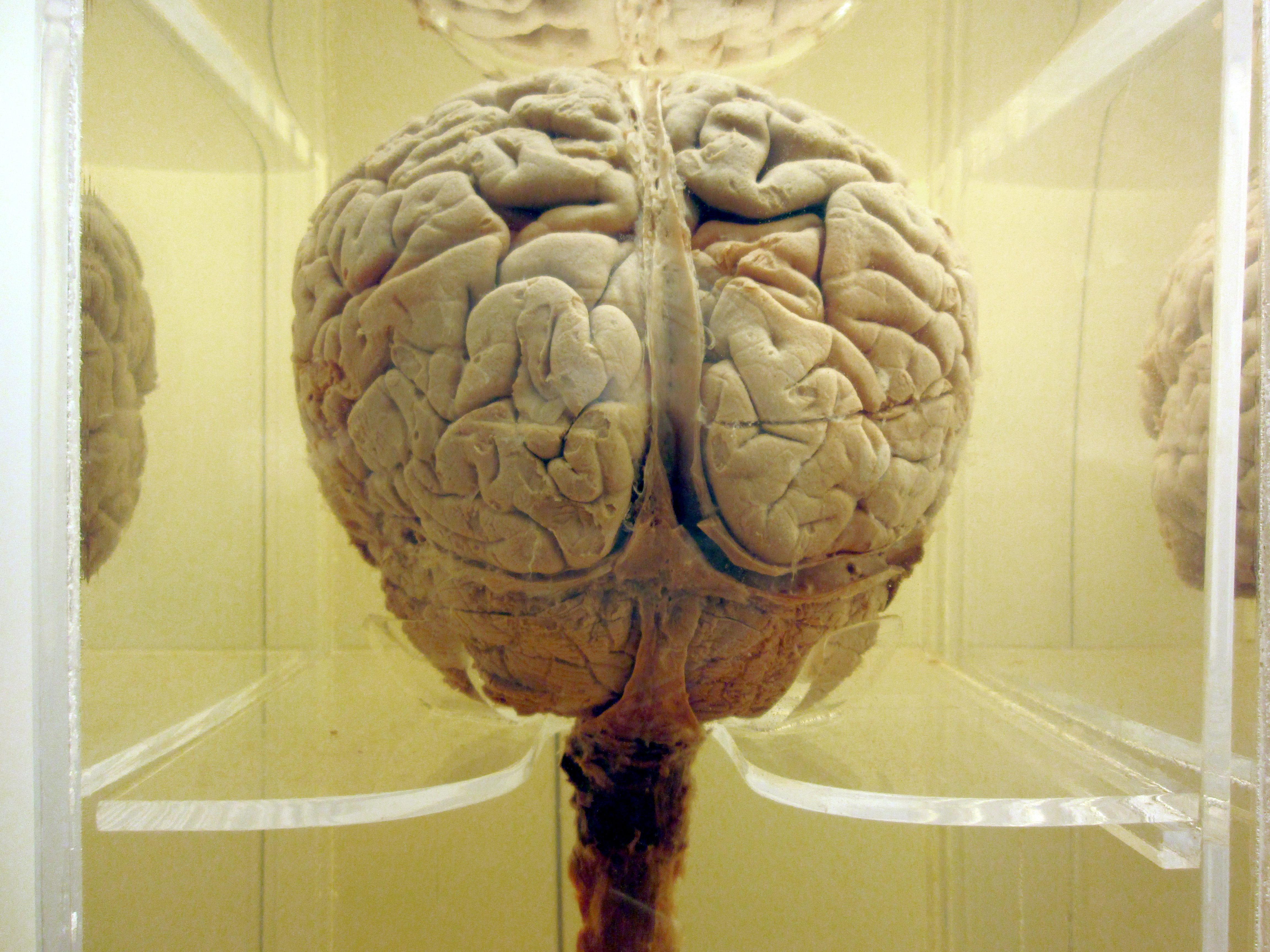
In 1902, Dr. Alzheimer took up a position in Munich, where he worked with another neuropsychiatrist named Dr. Emil Kraepelin. (Dr. Kraepelin is quite well-known, in his own right, for work in the area of schizophrenia and other disorders.) He continued to follow Frau Deter’s case, however, and in 1906 was notified of her death, apparently due to sepsis related to an infected bedsore. He requested that her medical records and her brain be sent to him for further study. It was upon examining her brain that he discovered the neurofibrillary tangles and plaques which are now considered characteristic of the disease.

Dr. Alzheimer gave a very significant presentation to the 37 Conference of South-West German Psychiatrists, in November of 1906, in which he discussed the case of one Auguste D. The following year, he published an article in which he described “A serious disease of the cerebral cortex.” However, the person who first coined the term “Alzheimer’s Disease” was Dr. Kraepelin, and not Alzheimer. He first did this in writings published in 1910.

And the rest is history, as they say. Now, the disease which bears Alzheimer’s name is the most common of many different forms of dementia which have been reported since his time.

Source material is from Wikipedia, “The Lancet,” and others. For more informative articles about dementia, visit Exploring Dementia.

3 Comments

Filed under Awareness & Activism

A simple act of kindness is often greatly appreciated

Recently, I visited my mom. It was the first time I would be meeting her personal caregiver. I’ll call her Debbie (not her real name.) Mom had raved about how wonderful Debbie was and how much she liked her.

hands

We’ve all heard horror stories about the other kind of caregivers, those who steal from clients or abuse them. I was relieved that Mom was happy with her caregiver. I think the service has lifted her spirits and helped take the burden off of her when it comes to housekeeping and grocery shopping. In short, personal attendants can help my mom live independently longer.

Debbie made me comfortable immediately. She is warm and kind and doesn’t let Mom get down on herself. But she also isn’t fake in her positive thinking, instead she is encouraging. She is an ideal match with my mom, who is set in her ways and finds changes in routine stressful. Debbie knows how to keep my mom on the right track.

I thought the least I could do was get Debbie a thank you card, to let her know I appreciated her taking good care of my mom. Apparently it’s a struggle to keep gas in the car on her wages, and she doesn’t get reimbursed for mileage. She was one of the few people who was almost looking forward to jury duty, because it would pay the same/better than what she earns normally!

So I gave Debbie the card and she told my mom later that she was so touched that she cried after reading it.

Caregiving is a job where you may not receive much thanks or positive feedback. Showing a bit of appreciation can go a long way.

1 Comment

Filed under Awareness & Activism