Today is World Alzheimer’s Day. This year will mark 14 years since my father’s death from complications of this terrible disease. There has been a great deal of promising research and the development of a few medications that may help slow the progress of the disease in some people, but pinpointing the exact cause of Alzheimer’s and a cure remain elusive.
While I appreciate all of the tireless work of researchers, scientists, and the Alzheimer’s advocacy organizations, I’m not that hopeful that a cure or even an effective treatment will be discovered in my lifetime. More likely, the treatments that are on the market now may be improved upon, delaying disease progression and preserving cognitive functioning for longer. Now that I’m in my 50s, with one copy of the APOE4 gene and the disease prolific on both sides of my family tree, I have to be realistic about my risk and do what I can to reduce that risk and plan financially and logistically for any future care needs.
I would love nothing more than to be proven wrong.
The Alzheimer’s Association recently released the results of a trial they funded, called the U.S. Study to Protect Brain Health Through Lifestyle Intervention to Reduce Risk (U.S. Pointer) which found that “Positive, everyday actions can make a difference in brain health, and when combined into a program that targets multiple factors like physical activity, improving nutrition, cognitive and social challenge and health monitoring, we now know it can have an even more powerful impact.”
Following a similar study that was conducted about a decade ago in Finland called the FINGER study, the Alzheimer’s Association wanted to see if that study’s findings of lifestyle changes positively impacting cognitive health could be replicated for the U.S. population. To conduct the study, participants aged 60-79 who did not exercise regularly and who were at increased risk for cognitive decline were recruited and followed for two years. Participants were located near one of the study’s site locations: Chicago, Houston, Providence, Sacramento, and Winston-Salem.
The participants were placed into one of two groups: structured lifestyle intervention and self-guided lifestyle intervention. The structured group attended nearly 40 meetings over a 2-year period while receiving a prescribed program for physical activity, diet, and cognitive training with goal setting and regular reviews and support. The self-guided group six peer team meetings and were encouraged to implement lifestyle changes that best suited them. General support was provided by staff, but no direct goal-setting or coaching was provided.
What surprised me the most about the study results is that both groups demonstrated an improvement in cognition. This is a key finding because it shows that such programs could offer benefits for those in rural, isolated areas where ongoing support services are limited or non-existent. Those in the structured program did exhibit further cognitive health benefits than the self-guided group.
Another positive finding in the study was that the benefits of the lifestyle intervention were not limited by sex, ethnicity, genetic risk or heart health status. I’ve seen studies where benefits may be more apparent in men vs. women, for example, so this is a key takeaway.
So what is the “recipe” of lifestyle interventions that was used for the study? The infographic at the top of the post captures the components:
Exercise: 30-35 minutes of moderate-to-intense aerobic activity four times a week, plus strength and flexibility exercises twice a week. (Strength and flexibility exercises are also critical in fall prevention for elders.)
Cognitive exercise: The study used a computer-based brain training program which participants used three times a week in 30-minute sessions. Regular engagement in intellectually challenging and social activities was encouraged. I’m not sure which brain training program was used, but I’m enrolled in an ongoing study which used a computer-based program to assess changes in cognitive performance. It involves activities like memory retention by recalling patterns.
Nutrition: The MIND diet was prescribed, which emphasizes dark leafy greens, berries, nuts, whole grains, olive oil and fish, and limits sugar and unhealthy fats.
Health monitoring: Regular vital check-ins on blood pressure, weight, and lab work.
Engaging in regular exercise, performing mentally stimulating activities and eating healthy is a common-sense approach for overall good health. One important follow-up to the study will be to see if people can stick with the lifestyle changes once they are no longer part of the study’s structured program. Another analysis that I’d like to see is how many of the study participants go on to form Alzheimer’s or another form of dementia. Do the lifestyle changes prolong cognitive health thereby delaying a dementia diagnosis or do they offer further protective effects? An extension of the study has been funded and may answer some of these key questions.
Infographic image courtesy of the Alzheimer’s Association.
While a cure or effective treatment for Alzheimer’s continues to remain elusive, there have been promising research developments this year. Recently, the results of a drug trial found that lecanemab helped to slow the progression of Alzheimer’s.
These breakthroughs wouldn’t happen without trial participants. It’s vital that researchers have access to a sufficient pool of volunteers. There are a variety of ways people can participate in Alzheimer’s research and you don’t have to have a specific diagnosis or be a certain age to participate in some programs. I take a battery of online brain tests and answer a health questionnaire a few times per year. Other areas of research may require in-person interviews, a blood draw, following a specific diet or taking medication.
Participating in a drug trial can come with risks, such as side effects from the medication. For example, aducanumab led to brain bleeding or swelling in 41 percent of clinical trial participants.
Study participants are closely monitored, so side effects are documented and treated quickly. Those willing to take this risk help determine a drug’s safety profile and whether a drug’s benefit outweighs its side effects.
Another important point to remember when it comes to drug trials is that there is typically a group receiving the trial drug and another group receiving a placebo, but “blind” trials don’t inform participants which one they are receiving.
If you are interested in learning more about participating in Alzheimer’s research, visit TrialMatch from the Alzheimer’s Association and the Brain Health Registry.
More than 6 millions Americans are living with Alzheimer’s
Over 11 million Americans provide unpaid care for those with Alzheimer’s and other dementias
1 in 3 American seniors die with Alzheimer’s or other dementia
This year, Alzheimer’s and other dementias will cost the nation $355 billion
The value of the care unpaid Alzheimer’s caregivers provide is $257 billion
One other important statistic to note is the racial disparity in care. Discrimination in the health care setting can prevent or delay people getting the care they need. Half of Black Americans report such discrimination. Over 40 percent of Native Americans reported discrimination. Over a third of Hispanic and Asian Americans reported discrimination. I would also add to this the discrimination that women face in healthcare settings. Discrimination can take many forms, including a doctor not taking complaints of pain as seriously and assuming a symptom is emotional vs. physical in nature. I remember my own mother suffering at the hands of doctors who did not take her cancer pain seriously, instead assuming she was drug seeking.
As caregivers, we must be vocal and tireless advocates when faced with such discrimination. Don’t be afraid to ask for a different doctor if you are uncomfortable or dissatisfied with the care being provided. I’ve read many accounts from adult children who sought treatment for their elder parents with signs of dementia but the doctors shrugged off symptoms as the elder was able to present well for the duration of the appointment. Be persistent. While there is no miracle treatment for Alzheimer’s or other dementias, there are medications and treatments which may help in the earlier stages. That is why receiving a correct and timely diagnosis is crucial.
The Alzheimer’s Association released their annual report around the time the coronavirus pandemic was ramping up, but I did not want to overlook the latest findings. I thought it was especially appropriate to post this today, on what would have been my father’s 88th birthday.
Alzheimer’s is the sixth leading cause of death in the U.S. 1 in 3 seniors die with Alzheimer’s or another dementia. The death rate from Alzheimer’s has skyrocketed. Between 2000 and 2018, the number of deaths from Alzheimer’s disease has more than doubled, increasing 146%.
More than 5 million Americans live with Alzheimer’s disease. Women make up two-thirds of that number; African-Americans are about twice as likely to be diagnosed with Alzheimer’s or other dementias compared to whites in the same age group; Hispanics are about 1.5 times as likely to develop Alzheimer’s or other dementias compared to whites in the same age group.
Unless significant medical breakthroughs are made, by 2050, the number of Americans age 65 and older with Alzheimer’s dementia may grow to a projected 13.8 million.
16 million unpaid dementia caregivers provide care valued at $244 billion annually. One in three caregivers are 65 and over, and two-thirds are women. One-quarter of dementia caregivers belong to the “sandwich generation,” caring for both an aging parent and minor children.
The cost of Alzheimer’s care to the nation is staggering. In 2020 alone, Alzheimer’s and other dementias will cost the nation $305 billion. What’s even more sobering is that half of primary care physicians believe the American healthcare system is not prepared for the growing number of those with Alzheimer’s and other dementias.
While these reports highlight the challenges we face in providing care for our loved ones with Alzheimer’s and other dementias, the Alzheimer’s Association proposes an action plan focused on education and recruitment to build up a corps of geriatric providers who understand the unique challenges that those with dementia and their caregivers face. The Alzheimer’s Association also encourages greater funding in the areas of rural healthcare and telemedicine.
The Alzheimer’s Association released its 2019 Alzheimer’s Disease Facts and Figures report, and the statistics are sobering. Almost 6 million Americans are living with Alzheimer’s disease, and it is the sixth-leading cause of death in the U.S.
On the caregiving front, more than 16 million Americans are providing unpaid care for people with Alzheimer’s and other dementias. The value of their work is approximately $234 billion.
While the numbers are grim, the 2019 report makes crystal clear that we need bipartisan support at the federal level in addressing what is a health care crisis. Alzheimer’s disease is so costly, yet lags in research funds. Alzheimer’s caregivers need far greater support, both financially and in respite care.
In addition to being National Alzheimer’s Disease Awareness Month, November is National Caregiver Month. It’s only fitting for those of us who have cared for a loved one with dementia that these two recognition events occur in the same month.
While caregiving, both family and professional, needs much more recognition than just a designated month, this is a good time to get the conversation started about how important caregiving is to our society.
My mom, who was a wonderful caregiver for my father who had Alzheimer’s.
The Alzheimer’s Association is marking the month by allowing people to write a personal tribute on their website.
I’m marking the month by making a visit to my mother, who has been dealing with some recent health setbacks. Caregiving in action!
To all of you in the blogosphere who have shared your caregiving stories, thank you. Together we can raise awareness and help each other through this challenging journey that is always full of surprises.
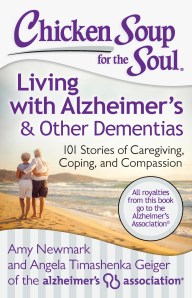
I am very excited to announce that a story that I wrote about my father, called “French Toast,” will appear in a special edition of the popular “Chicken Soup for the Soul” series. This edition features stories about living with Alzheimer’s and other dementias and is a joint project with the Alzheimer’s Association. All royalties from this special edition will go directly to the Alzheimer’s Association. The book will be released on April 22, 2014.
I am thrilled to be a part of this upcoming book, especially for a publisher as popular and well-respected as the “Chicken Soup for the Soul” folks. From thousands of submissions, 101 stories were chosen to appear in the book. I look forward to reading all of the inspirational stories.
If you’re wondering how I came about submitting my story, it was really just by chance. I was doing my daily “looking for paid writing gigs” web search and was on the Work-at-Home Moms website. Now I’m not a mom (unless you count the pets) but I find that their website sometimes posts opportunities I don’t see elsewhere. It was on their website that I saw the “Chicken Soup for the Soul” callout for Alzheimer’s and dementia stories. I said to myself, “Why not?” I submitted two stories: a depressing one and a funny one. The funny one was accepted. 🙂
One of the main goals I had in mind when starting The Memories Project blog was to raise awareness, not just for Alzheimer’s but for family caregivers as well. I’ve virtually met so many wonderful people through my modest but loyal following. The dialogue we have has educated and inspired me and lifted my spirits. Yet I know so many others are struggling silently and I hope by being able to get out the word on a larger platform, more people can get the support they need.
To prepare for the upcoming release of the book, I’ve added a couple of pages to my blog: media appearances and publishing credits. If you or someone you know would be interested in a copy of the book, an interview or a guest blog post, feel free to contact me directly at joyjohnston.writer@gmail.com.
This year I actually have the opportunity to participate in the Alzheimer’s Association campaign, The Longest Day. Since this is the day it stays light the longest, today is the perfect opportunity to shine a light on Alzheimer’s awareness from dawn to dusk. Last year I was at work so I couldn’t fully participate, but I had no excuses this year!
Walking the Beltline in Atlanta for Dad on The Longest Day 2013.
People do all sorts of things to honor their loved ones for The Longest Day campaign. People hike, run, swim, ride a bike, just anything to get out there and spread awareness. I chose to walk because Dad loved to take long walks and I do too! I decided to walk the Beltline, which is an exciting project here in Atlanta that is repurposing the long abandoned railroad tracks that still exist around the city and converting them into a walk/run/cycling trail that links up many intown neighborhoods. I was skeptical about the project at first I have to admit, but now that I have experienced one of the first phases of the project, I feel like it’s coming along nicely.
Piper the Beltline Kitty came out to greet me on my walk for Dad!
Today I walked the Eastside Trail from Piedmont Park in Midtown to Inman Park. Driving that route is almost a five mile trek. But thanks to the Beltline, you can walk there in half that distance. I made it to my destination in about an hour and am writing up this blog post at a neighborhood coffee shop. I’m going to keep spreading Alzheimer’s awareness throughout the day by staying active on social media and doing more walking!
I would love to hear how others are honoring their loved ones and spreading Alzheimer’s Awareness on The Longest Day. To follow the action on Twitter, use the hashtag #thelongestday.
The Alzheimer’s Association Advocacy Forum will host its 25th national conference this year in Washington, D.C. from April 22-24. Check out this timeline of Alzheimer’s advocacy over the last quarter of a century. So many people have come together and broadened awareness of this terrible disease over the last 25 years. Certainly I know most advocates would hope we would be further along with treatment options or even, daresay, a cure, but awareness has grown greatly. Unfortunately, as Alzheimer’s cases have grown in numbers, the U.S. and the world have had to take notice and take action.
I hope to get to attend this year. For those on a budget, registration fees are being waived in honor of the 25th anniversary. You can find out more about the event and the agenda details on the registration page.
Sometimes, caregivers and family members can feel so alone, so isolated in their family’s struggle with Alzheimer’s. Meeting others who share similar experiences can be a moving, yet rewarding experience.







![Pageflex Persona [document: PRS0000038_00069]](https://memoriesproject.files.wordpress.com/2014/02/reluctant-caregiver-cover.jpg)






 The Memories Project