Tag Archives: Alzheimer’s

My 100th memory of Dad

I can’t believe I’ve already reached the 100th post milestone but today is the day! This project is truly a labor of love, and I’ve met (virtually, anyways) so many great people in the blogosphere, many who are caring for a loved one with Alzheimer’s. My deepest thanks to all of the advocates out there and my deepest admiration for all of the tireless caregivers around the world.

An image has been on my mind this week, and it is of my dad’s hands in the last years of his life. They were bony, with veins poking out just beneath the thinly stretched skin. There were age spots mottling the flesh and his fingers were cool and clammy to the touch. I doubt that I had held my dad’s hands, or even taken notice of them, since I was a little girl who needed help crossing the street.
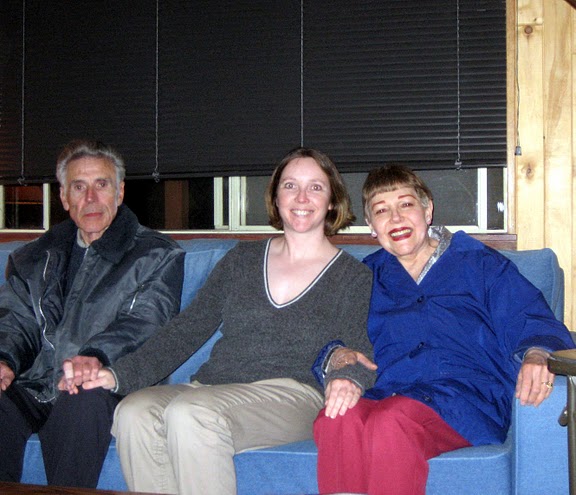
Dad holding on to my hand, trying to hold on to his sanity.

When dementia began to creep into our family, there’s a photo of us on the couch at my parent’s house, and my dad is gripping my hand so tightly, as if he’s afraid of letting go in more than just a physical sense.

In that final year of my dad’s life that was spent in the nursing home, my dad couldn’t say much, so holding his hand was one of the only ways I could still connect to him. I remember watching his hands, twitching with a bit of a tremor, lift a cup of hot coffee to his lips and sip tentatively. Then he reached out the cup to me.

“Do you want some,” he asked, with a polite innocence that was heartbreaking.

Of course, being me, my mind raced with the thoughts of germs and how I would be able to get out of this awkward moment. I thanked him and held on to the cup, until he was ready for his next sip. It took him so much effort to do something he once received great enjoyment out of. Alzheimer’s strikes again.

There’s a tenderness that many caregivers offer those with Alzheimer’s and it can greatly improve quality of life. I just wish that I had shown a little more tenderness while my dad was still aware enough to appreciate it.

Leave a comment

Filed under Memories

Happy birthday Dad

My dad would have turned 80 years old today. It would have been nice if he could have reached that milestone, but not with Alzheimer’s.

He spent his last birthday at the assisted living facility. The staff bought him a McDonald’s meal as a birthday treat. My mom had visited him shortly before his birthday and I called from Atlanta. I have never felt so dishonest as when I mustered up whatever cheeriness I could find in my voice to wish him a happy birthday.

I knew there was no way that it would be a happy day for him. By his 79th birthday, Dad’s dementia, along with the increased medication being fed to him at the care center, had left him an emotionless shell. He wasn’t necessarily sad or angry; he just didn’t seem to be feeling anything at all.

But I always felt that there was this lingering despair that my dad somehow was clinging to, that somewhere deep below the fog of Alzheimer’s, he was aware of his condition and how hopeless his future was.

I hope I was wrong.

Even when he was well, Dad never made a fuss about his birthday. A card, a small gift like cologne and dinner was about all he wanted. I think birthdays in his mind put him closer to death, which he always feared, so he approached the day with trepidation, instead of a spirit of celebration.

Leave a comment

Filed under Memories

Life in the dementia ward

I finally had he chance to see You’re Looking at Me Like I Live Here and I Don’t, a PBS documentary by Scott Kirschenbaum. It’s the first documentary filmed completely from the perspective of a person with Alzheimer’s. It’s a powerful, heartbreaking film and reminded me so much of my dad’s experience in a care facility. It’s highly recommended viewing.

Like Lee, who tries to relate the fragments of her life that are forever escaping her, my dad resided in the “memory unit” of an assisted living facility for the last year of his life. He resided with a small group of other residents who suffered from dementia, in a secure wing of the facility. As the documentary shows, Alzheimer’s affects people of all kinds, and having a group of strangers who are suffering from a mental condition live with one another is a challenge. My dad, like Lee, kept mainly to himself, though he did have a roommate he got along with initially. The two would talk about “breaking out” and heading to the Midwest. Like Lee, Dad would set off the alarm on the security door. He knew he wanted out of the facility, but he did not remember where home was.

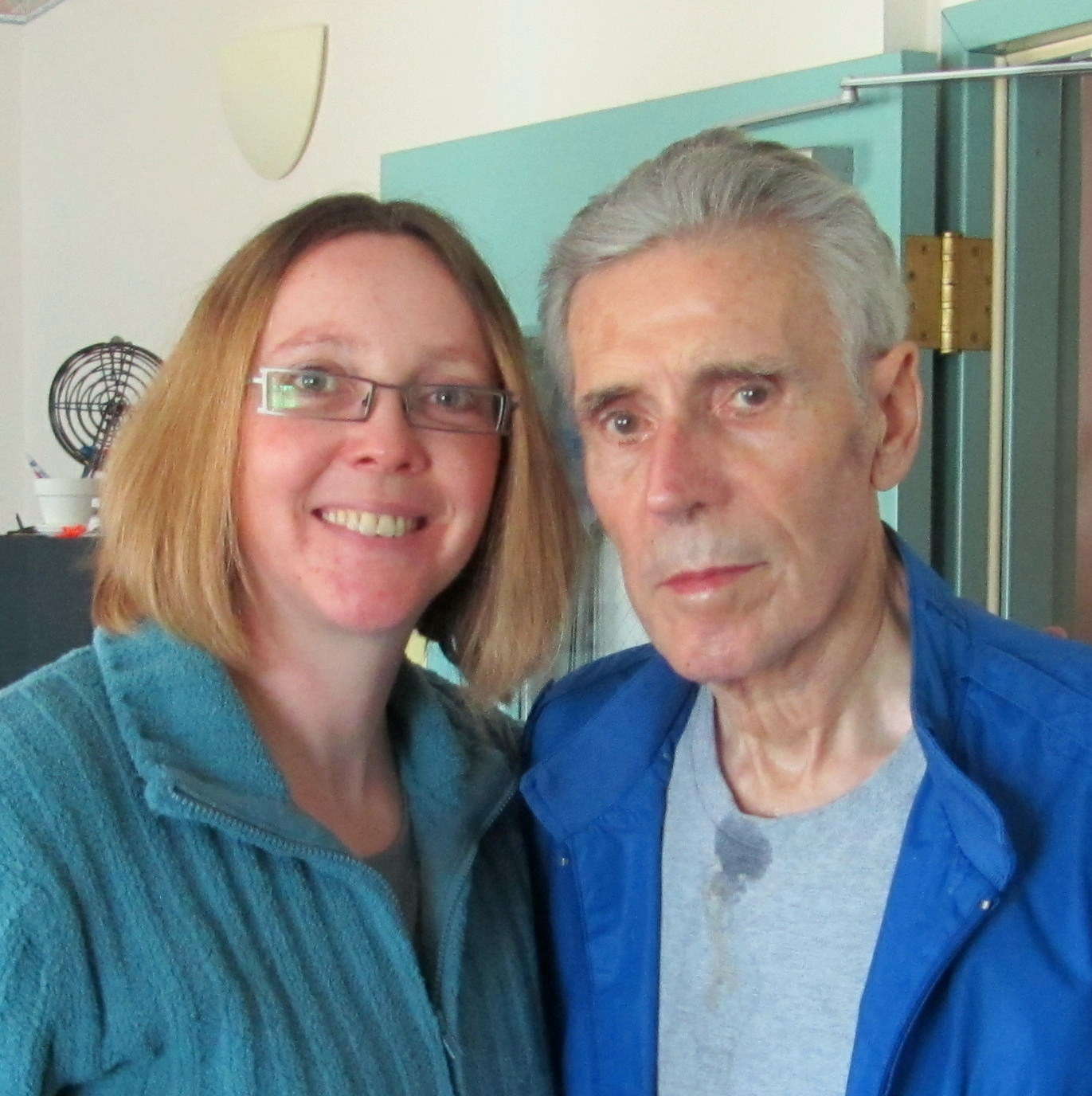
Dad and I at the assisted living facility, March 2011.

My visits to the nursing home where my dad lived were similar to what is portrayed in the documentary. The staff try to make residents comfortable, but the disease is not easy to manage. Available medications can put residents in a constant slumber, but without some medications, residents might be a danger to themselves or others. Yet there are also moments of humor and heartbreak, which are so tenderly depicted in the documentary. This is life in the dementia ward.

And just as I wondered about all of the other residents at the care center my dad was living at, I wondered about the other residents at the facility depicted in the documentary. Who were these people before Alzheimer’s took over their lives? What are their stories? I hope their families have recorded their memories in their own special way so their stories are not forgotten.

Leave a comment

Filed under Memories

What’s under the sofa cushion?

I was talking to my mom yesterday and she was telling me about how she flipped over the sofa cushions. (Yes, bless her heart, she describes her life to me in this kind of micro-detail.) When she lifted up the cushions, she found a blue pen that belonged to Dad and an old photograph. My ears perked up at the mention of a photograph.

My mom said it was a wallet-sized black-and-white photograph taken at a wedding. My dad is on the end, perhaps the best man. My mom didn’t recognize the other people in the photograph, the apparent bride and groom, and a woman on the opposite end of my dad, probably a bridesmaid. My mom broke out the magnifying glass to see if she could read the printing on the back of the photograph. It was some photography studio in Belfast, so at least the location is known, but no year could be found.

Of course, the big question is, what in the world was this photograph doing under the sofa cushion in the living room of my parents’ condo? It’s common for those with Alzheimer’s to drift to their past, as those memories seem to be left intact longer than trying to deal with the confusing present. So maybe Dad stumbled across this photograph in a drawer and decided to hang on to it. Maybe he slipped it into one of his many wallets when he went through his money hoarding phase and it fell out. We’ll never know for sure, but it does make me want to turn the rest of the house upside down to see what treasures are hidden.

One of the last things my father said in my presence was about three weeks before he died. He had been moved from CCU to the regular medical floor at Presbyterian Hospital in Albuquerque. After watching him narrowly escape death, I had to head home to Atlanta. He seemed a bit brighter and more coherent.

He said, “I’m going to go see Maureen and Kathleen.” (Those are his sisters, both still living. They live in Northern Ireland and Australia, respectively.)

I said okay and he replied, “Sure, why not?”

Why not indeed? If memories of happier family times brought him some sense of comfort, if it offered him a brief respite from the dementia, then so be it. Even if he could only see his sisters and relive these memories captured in old photographs in his rapidly disintegrating mind, so be it.

Leave a comment

Filed under Memories

Looking for Dad on the hill

Even after my dad had to stop driving due to his increasing dementia, there was a period where he could still do errands on his own. This gave my mom some much-needed quiet time, and kept dad from getting cabin fever. But as he declined further, mom would worry about him returning safely more and more. I think I’ve mentioned before how he would wander off on his own sometimes, saying he was going to the bank on Sundays even though it was closed.

The hill in front of my parents’ property became a focal point of these journeys. My mom (and I when I was visiting home) would stare out the window in the guest bedroom, praying silently that we would see the tall, lean figure of my dad, his long legs pumping strongly up that hill, returning home safely. So even though my mom should have been able to enjoy that time alone, she was still constantly fearing she would get the phone call that all families dealing with dementia dread. She would worry that he would be hit by a car because he would ignore the crossing signal. She worried that he would forget where to go or how to return home.

That hill was one of the markers of my dad’s independence, and how quickly it was fading. Soon, he would only be allowed to stand on the porch to smoke, with my mom or I peeking out to make sure he didn’t slip down the stairs and wander off. The porch overlooks the hill, and I don’t know if dad could reason at that point that Alzheimer’s was robbing his independence, or if everything surrounding him seemed like a foreign land that he had never seen before.

1 Comment

Filed under Memories

Trying to hold on to Dad

In many ways, caring for someone with Alzheimer’s can be like tending to a toddler going through the “terrible two’s.” The caregiver has to keep track of them at all times, 24/7, because you never know what they might get into next.

Recently, in the town where my mom now resides alone, a man who had Alzheimer’s wandered off while his wife, his primary caregiver, was getting a shower. He ended up getting caught in debris in a ravine and died of exposure. I always feared my dad would end up like this when he still lived at home.

I took the photo seen here for a a MedicAlert device I bought for dad that had GPS built in so it could track a wandering Alzheimer’s patient. You can see the confusion, that constant state of being startled, that my dad was going through at the time. He was beginning to wander and it scared my mom to death. But shortly after getting the device, and before even having time to try it out on dad, he suffered a physical health crisis that landed him in the hospital for two weeks to have a kidney stone removed.

Following the hospital stay, he went to live in an an assisted living facility that had a secure dementia ward. We didn’t have to worry about him wandering anymore, but he also never returned home.

2 Comments

Filed under Memories

Dad’s eyes reflected Alzheimer’s

A family photo from March 2008 illustrates the beginning of my dad’s mental decline. There is a vacancy in his eyes, as if he’s not quite there with us on the couch, even though he’s gripping my hand tightly.

Dad most likely started showing symptoms of dementia in late 2007. It’s difficult to pinpoint dementia’s starting point, because often the symptoms at first are vague and not of concern until you step back to look at the bigger picture. He seemed more forgetful, conversations were a bit more awkward, but for the most part, he was still there.

I remember this photo clearly. Dad’s driving days were numbered, and we had just returned from a stressful, harrowing ride into town. We went to dinner and he was still able to order his meal and pay the bill at this time. Soon, my mom would have to place all orders and pay for them. Dad almost ran off the road as we were turning into the condo community my parents called home.

I was leaving the next day and wanted to take a couple of photos. Dad still had his bulky jacket on, a sign he was about to go outside for a smoke. At the time, I had no idea that this photo would be so revealing. It was the beginning of long, painful journey as my dad’s mind was destroyed by disease. We were still a family unit, but one of our members was vanishing, slowly but surely.

1 Comment

Filed under Memories

Dad’s inability to swallow, the final insult

I think most people probably associate Alzheimer’s with memory loss and other manifestations of mental decline. And while certainly those would be the hallmark symptoms, the physical impact of this disease cannot be forgotten.

Despite being a lifelong smoker, dad was in pretty good physical health when his mental state began to decline. Sure, he had been diagnosed with COPD and emphysema, and he was having some mild prostate issues, but he had always been a lean man who enjoyed walking as a form of exercise. Frankly, I always expected lung cancer would be what claimed my dad’s life. But it was a cardiac arrest, along with pneumonia and dementia that secured that spot on the death certificate.

Dad had been put on medication for a bladder infection and that’s supposedly what knocked him out when he was transported to the new nursing home. We will probably never know what truly happened. What was quickly determined at the hospital where he ended up was that he was having difficulty swallowing. The palliative doctor explained to us that the act of swallowing actually consists of many complex processes that the brain must execute, even though to us, it seems automatic. As anyone who has dealt with Alzheimer’s and dementia knows, difficulty swallowing can lead to aspiration pneumonia.

Before the hospital was able to conduct the swallow test, the dietary staff would still bring dad full meals, which just set there on the tray, growing cold and congealed. Turkey medallions and mashed potatoes and carrots. All things dad would have loved if he had been more lucid and able to eat properly. Instead, he was given water mixed with honey, and he struggled to suck up the sugary dredge in the straw.

I actually watched one of the swallow tests performed on dad. There was a cup of water, a cup of juice, and a small container of applesauce. Dad struggled physically to swallow, but also most importantly for rehabilitation purposes, failed to follow directions. That’s the irony for those with dementia. Some of their physical symptoms might be alleviated via rehab, but they make poor rehab candidates because they can no longer follow simple commands.

Once the ability to swallow is lost, then the discussion of the feeding tube comes. Dad had one for a short amount of time, but we then opted for the palliative approach, which was focused on hand feeding. Yes, this increases the risks of aspiration pneumonia, but if it can give the patient a moment of faint, if fleeting pleasure, then so be it in my opinion. I’m not sure if dad enjoyed the bits of scrambled eggs and other soft foods that a stranger fed to him over the last weeks of his life, but a tube would have just been prolonging the inevitable, a cruel extension of a life that had already been stolen by this terrible disease.

Leave a comment

Filed under Memories

Expecting the unexpected with dementia

While certainly my dad’s death did not come out of the blue, his sudden decline did catch my mom and I off guard. From most of the accounts I had read about Alzheimer’s, patients seemed to usually experience a slow, but steady decline. For my dad, his overall health took a nosedive over the course of just a few fateful days. He would never recover.

When you have a loved one suffering from dementia, you have to adjust your expectations greatly. While at the nursing home, my dad suffered from repeated falls and had to have a catheter placed because he was having difficult urinating, but he also had a great appetite and was fully ambulatory. He stayed in this fairly stable condition for several months, and mom and I adopted an uneasy new sense of “normal.”

The last photo of Dad and I together, July 2011.

There was finally an opening at an assisted living facility much closer to my parent’s home, so dad was to be transferred there on Nov. 1st. In mid-October, my mom went to see my dad and he bumped her as she was talking to one of the nurses. He was fairly alert and totally ambulatory. He had a doctor’s visit that day and did well there. My mom had lunch with my dad and he ate everything on his plate, and had some of mom’s food as well. She felt like it was one of the best visits she had with him in quite awhile.

On Oct. 26th, I had talked to the staff at the facility he had been at, to thank them for their care. I clearly remember the update the nurse gave me that day: Dad set off the alarm when he tried to leave the unit, but she was able to coax him to take a walk in the facility’s garden by giving him a lollipop. And he had a huge bowel movement that morning and they had to put him in the shower to clean him off. In the alternative world of Alzheimer’s, this is considered a good day. While the pessimist in me had doubts about the move, I held out a bit of hope that things would go well and mom would get to visit dad more, which would have meant so much to her.

But alas, it was not meant to be. On the day he was transferred, my mom and the director of the facility he was being moved to went to pick him up. He was asleep, more like knocked out, and had to be helped into the van. He supposedly had a bladder infection, and then was diagnosed with pneumonia. He spent the last two months of his life almost exclusively in the hospital. If there is one thing that this disease taught me, it’s to expect the unexpected around any corner.

Leave a comment

Filed under Memories

Dad’s obsession with the $20

Well after my dad lost the ability to make change at the store or pay for a meal, he became obsessed with money. In particular, it was always $20 that someone owed him, usually my mom. She would play it off and say she was holding it for him. He became increasingly distrustful and paranoid. At one point, he started carrying around a huge wad of bills (mainly dollar bills) that would precariously jut out of his shirt pocket, ready to fall to the ground at any moment. He also would carry multiple wallets (he ended up losing most of the contents in those wallets over time.) My dad was never that organized but now he was a mess.

The altered relationship with money is a common manifestation of Alzheimer’s. I can only fathom dad was desperately trying to stay in control of something in his life, even if it was only reclaiming an imaginary $20 bill or carrying about a sweaty, crumpled wad of bills all the time. Even when he moved to the assisted living facility, he still talked about that $20.

On my last visit home while dad was still living there, he was fixated on collecting change. He would “count” it, or at least arrange it in various formations before putting it back in his pocket. I remember sitting in the guest room, listening to my dad’s mind unravel in the bedroom next door, the constant jingle-jangle that my mom tried to drown out with the radio as she cooked dinner. I wanted to go to dad, talk to him, take his troubled mind off the obsession with change. But I felt uncomfortable and awkward in the face of such odd behavior. So I left him alone, and the tense house continued to be filled with the maddening sounds of dimes and nickels and pennies and quarters colliding with one another. I regret not attempting to ease his distress, even if just for a moment.

4 Comments

Filed under Memories