Tag Archives: caregiving

Marking National Family Caregivers Month

mom-joy

I learned a lot about caregiving from my mother.

Before November slips away, I want to recognize that this is National Family Caregivers Month. I love this year’s theme: “Take Care to Give Care.” Supporting family caregivers is something I believe strongly in, and I am grateful I have the opportunity to give back.

My development of the Respite Care Share concept continues, and I’m working on the poster presentation that will take place at the 2017 Aging in America conference. Along the way, I’ve met many dedicated family caregiver advocates. We have a long ways to go, but as with most things, a grassroots-level, community-based approach will generate quicker results than waiting for government action.

The Caregiver Action Network offers good tips for family caregivers on managing their own health.

  • Stress: Family caregivers often face a tremendous amount of stress, yet ignore their own mental and physical health. I was certainly guilty of this when I was a caregiver. It’s important to take steps to minimize and manage stress, and promptly address any health issues that arise.
  • Healthy lifestyle: It’s easy to throw out healthy habits like a nutritious diet and regular exercise when you are overwhelmed with family caregiving duties. But a poor diet and sedentary lifestyle can make one feel sluggish, and more vulnerable to experiencing health consequences from stress. There was a walking trail adjacent to my mother’s condo, so I went almost daily for walks, which helped relieve stress.
  • “Rest. Recharge. Respite.” I love this mantra from the Caregiver Action Network. My sleep was disrupted every day when I was caregiving for my mother, and there was no way to avoid that (leaking colostomy bags always seem to occur at 3 a.m. and will not wait!), but I tried to make sure I got a set amount of hours of sleep each day. I did take breaks when Mom was stable enough, and that really helped.

A big thank you to all of the family caregivers out there, who are facing another hectic holiday season. There are many people focused on providing greater support for family caregivers, so don’t give up hope.

Leave a comment

Filed under Awareness & Activism

Aging in place not just about home’s interior

condo-water-heater

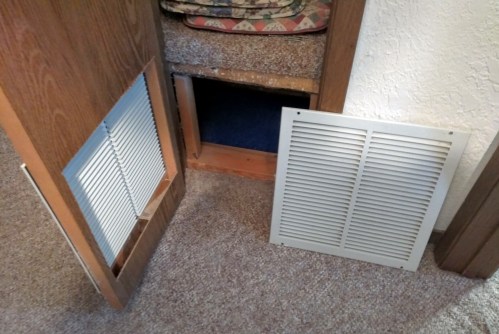
The “portal to hell” aka the crawlspace where the water heater is located.

As I wrote about in my last post, caregiving can give you tunnel vision, and while I was busy tending to my mother’s every health need, I overlooked some basic household duties, like changing that darned furnace filter.

But another thing I had to deal with on my recent visit to what was my parents’ condo made me realize that aging in place is not just about retrofitting a home’s interior. When I arrived and turned on the kitchen faucet, I immediately noticed that the hot water had a very strong sulfur odor. I Googled the issue and found that it is common in cabins and other kinds of vacation rental homes, where the water sits unused for long periods of time. Basically, the water sitting in the water heater tank is an ideal incubator for bacteria, which, while harmless to humans, creates that godawful rotten eggs smell.

The simplest solution involves flushing out the water heater with bleach or hydrogen peroxide, which kills the bacteria.

As I searched for plumbers, I began to wonder, where the heck is the water heater?

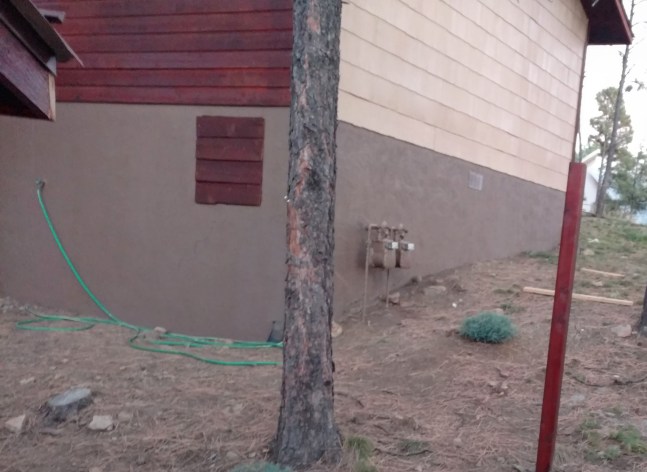
By process of elimination, I figured the square door underneath and to the side of the condo must be where the water heater was located. The photo above is actually a neighbor’s unit, but it looks just like mine. What I couldn’t picture was how a water heater fit in such a small space.

When the plumber came out, the mystery was solved. The wood door had to be unscrewed with a power tool, and then the plumber, a pretty tall guy, angled his way through the portal. I stuck my head inside and saw that the crawlspace was quite large, the entire length of the two condos that are connected together. There were several discarded water heaters under there, a virtual graveyard. The plumber wanted to show me how the water heater was leaking, which required me to climb inside.

I wasn’t sure I was going to be able to do it; I’m not claustrophobic and am in decent shape but I am clumsy, and this was a very awkward hole to crawl through. Somehow, I managed to squeeze through without injuring myself, then was immediately concerned about how I would get back out.

The plumber told me I could flip the breaker on the water heater when I was headed out of town so I didn’t have to crawl back down there. That was another adventure, finding the circuit breaker. It was located in a storage closet outside the condo, and inexplicably placed in the back corner, meaning you had to be careful about what you stored in the closet so you could squeeze your way to the back and reach the breaker panel.

The entire debacle made me think about aging in place, and how important it is to examine the exterior and the interior of the home your aging loved ones are residing in or wish to move to, and look for red flags like this bizarre water heater setup. Take into account things like stairs, crawlspaces and anything else that is difficult for someone with limited mobility to access. Ideally, a homeowner would have convenient access to things like the furnace, the water heater, air conditioner, circuit breaker, etc. in case of emergency.

It’s definitely something I’ll think about when looking for a retirement property. No creepy “portals to Hades” for me!


Leave a comment

Filed under Awareness & Activism

A caregiver oops moment

furnace

While I was thrown into caregiving with zero experience and even less confidence, I was proud how over time, I became even good at some aspects of caregiving. Changing a colostomy bag, for example. I give myself a gold star for becoming a pro in that area.

However, I recently realized that I let some basic things slip. It didn’t cause any damage but I did feel like a big dummy.

My mother got sick in 2012 and I spent the entire fall and part of winter with her at her condo. In that time, and in subsequent visits, both before and since she died, never did I stop to consider changing the furnace filter.

I didn’t even know where the darn thing was located.

At my townhouse, I change out the filters every 2-3 months, because we have pets and the dust and dander builds up fast. Never did it remind me to check out the filter at my parents’ condo.

The only thing that alerted me to my dereliction of household maintenance duties was when I was finally able to open the outdoor storage room connected to my mom’s condo. It can stick with the weather changes and become near impossible to open. After a few tugs it popped open this time, and the first thing that jumped out at me was a bag of blue furnace filters, which Mom had neatly labeled.

That’s when my heart skipped a few beats. Uh-oh, when was the last time that was changed?

I figured out where it was and had to pry off a vent cover to get to it. I was afraid to pick up the filter, figuring it might disintegrate before my eyes into a cloud of dust. Well, it was pretty bad, but since Mom didn’t have pets, it wasn’t as bad as it could have been. Also, there is no air conditioning at my parents’ condo, so the filter only saw use in the winter months. I could make out a faint outline of the original filter under the years of dust accumulation.

If I had to guess, it’s probably been at least five years since it was changed.

Of course, I had some moments of guilt, but a dusty air filter isn’t what took Mom’s life, cancer was. And because I was so focused on taking care of her, I let some maintenance duties slip. I’m OK with that.

But if you do find yourself caring for a loved one and you are not familiar with the home, it is wise to learn where things are: the furnace, water heater, breaker, in case you need to access it. For example, you’ll never guess where the water heater is at my parents’ condo. I’ll save that for another post.

Leave a comment

Filed under Memories

Ways to battle wandering

caregiver-guide-to-wandering

One of the most frightening aspects of my dad’s dementia was his tendency to wander. It is unfortunately a common symptom of Alzheimer’s and other dementias. It can place people in life-threatening situations. In fact, a gentleman with Alzheimer’s in the same town where my parents retired wandered away from his home one winter and died from exposure. He’d fallen into a ditch and had gotten tangled in some weeds and brush.

Fortunately, my father’s wandering never led to physical danger, but it did scare my mom and I. On a few occasions, my mother had to call the police, who were wonderful about tracking my father down, but it was nerve-wracking until he was home. It also became impossible for my mother to take my dad on any errands, because she couldn’t trust him to wait for her. One time he wandered away while she was in the dentist’s chair, and ended up at a fast food restaurant a few doors down, which he claimed was full of spiders. Another time, he wandered away from McDonald’s while my mother was in the restroom. The police found him near the drive-thru.

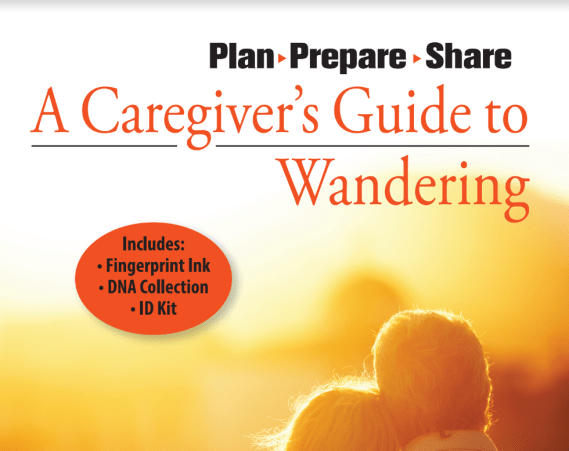
When I was contacted on Twitter about A Caregiver’s Guide to Wandering, I was interested in learning more. The guide was inspired by Sergeant Jacqueline Fortune of the Harris County Sheriff’s Office in Houston, Texas, who’s department was using Boerner, Inc.’s McGruff Safe Kids ID Kit to address wandering calls in the area they serve. The company decided to create a guide to help caregivers cope with the specific wandering issues associated with dementia.

The 12-page guide offers innovative, concrete tips on preventing wandering as well as developing an action plan to implement when a wandering incident occurs. The guide is designed to be used by agencies — it is in use in the VA Hospital in Palo Alto, California and in agencies in thirteen other states, including several Area Agencies on Aging.

I believe this guide could be useful to every dementia caregiver. If you know of an organization that works with the aging in your community, recommend A Caregiver’s Guide to Wandering as a resource for dementia caregivers.

Full disclosure: I received a complimentary copy of the guide for this review.


1 Comment

Filed under Awareness & Activism, Memories

Writing about caregiving

IMG_20160814_144747513

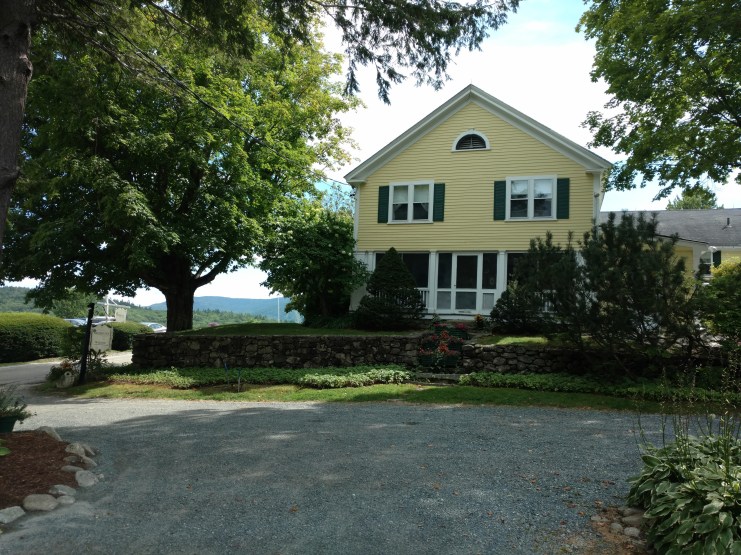
I spent last week at a writer’s retreat in New Hampshire. It was a wonderful experience, and just what I needed, to unplug and at the same time, recharge my writing inspiration.

I turned off social media, and turned inward to focus on what I really want to share about caregiving and how I should present that in written form. I also opened myself up to others who were going through their own painful experiences. But there was also plenty of laughter and great stories shared among the group.

Even for caregivers who don’t fancy themselves writers, taking a writing workshop can offer them a supportive stage to share their thoughts and feelings about the caregiving experience, giving a voice to those who are often forgotten or fade into the background.

Our teacher commented at the end of our time together that caregiving will eventually touch most, if not all of us, and that is so true. Even in our small group of memoir writers, there were people who had served as family caregivers and who were dealing with the deaths of spouses, parents and other loved ones after lengthy, debilitating illnesses.

Even if you don’t plan on writing a book, consider taking a writing workshop. There are plenty of one-day or weekend workshops, so no need to make it a full-fledged vacation (though it was a wonderful indulgence for me.) If you enjoy blogging, you may be surprised what the writing prompts at a workshop can bring out. You may be challenged to look at an event from a different perspective, and the feedback you get from fellow writers and instructors can be insightful and useful.

While I know talk therapy works for some people, I’ve never been a big fan of it personally, mainly because I don’t like to express myself verbally, especially when forced to talk about myself. But through writing, I’m able to do that with a greater comfort level. I also like the added bonus that I get some writing done while working through tough situations.

The most important thing of all though is that if you enjoy writing, keep it up! Whether you make it to a workshop or your writing ever sees the light of day, just the physical act of expressing your feelings is so beneficial.

Do you do any writing outside of blogging? I would love to hear about it.

6 Comments

Filed under Awareness & Activism, Memories

Don’t underestimate the power of a fall

hospital

Admittedly, I used to laugh at those “I’ve fallen and I can’t get up” LifeAlert commercials. What can I say, I was young and the commercials were done in an over-the-top manner. But as my parents aged, I discovered that falling is no laughing matter.

My father’s love of walking made him a dangerous dementia patient. When he was at the memory care center, we got several calls over the course of a year that my father had fallen. The care center’s policy required them to inform us each time Dad took a spill, even if he was not injured or was not taken to the hospital. Sometimes he was taken to the hospital, and I can only imagine how an ambulance ride and an ER visit must seem to someone with dementia.

Even though Dad took multiple spills, he never ended up with more than bruises. My mother, on the other hand, took one bad fall and broke her shoulder. She lived with pain from the injury for the rest of her life. When she first became ill with cancer, her mental status changed and the home health staff suggested I get a monitoring system for her. I signed up for the one they offered, which was Philips Lifeline. Overall, I was satisfied with the service. There was a billing issue upon returning the equipment after her death, but the service while she was alive was good.

ReviewsBee rates the Top 10 Medical Alert Systems, placing Philips Lifeline at #5. I mainly agree with the review. My mother was skeptical of technology, but because Philips is such a well-known and trusted brand, she was more comfortable using the product. The fall-sensor technology was sometimes oversensitive, thinking my mother had fallen when she just turned over in bed, but it was still reassuring to know that a live person would check on my mom immediately via intercom if a fall was detected.

All systems have their pros and cons, and I only had experience with the one brand, so make sure to read reviews from different sources and think about the features that are most important to your family. Keep in mind that some monitoring systems require landlines and make sure to read your contract so that you don’t get stuck with fees when returning the equipment when it is no longer needed.

If you have tips on preventing falls, I would love to hear about them.

3 Comments

Filed under Awareness & Activism

What’s the best support a caregiver could receive?

thank-you-1238361-1919x1516

I am participating in the OpenIDEO’s end-of-life challenge and my idea made the top 50 cut.

The challenge is to reimagine the end-of-life experience for ourselves and for our loved ones. I focused on the end-of-life experience as a caregiver, and the importance of respite care. When caregivers become burned out, everyone suffers. Everyone needs a break, and the end of life can be a longer road than expected. That’s why I submitted the idea of Respite Care Share, which would offer free or discounted vouchers that caregivers could use at hotels and on vacation rental services like Airbnb. Caregiving assistance while the caregiver is away would also be part of the package.

While Medicare covers an allotment of respite care days, and will place a patient in a facility during the respite care period, I found that respite care can be restricted depending upon if there are available beds in a participating facility. Even if you can place your loved one in a facility or find appropriate home care, a nearby weekend getaway can help clear the mind and renew the spirit.

Now I need your help in propelling the idea forward.

The idea as it stands now is that the caregiver respite vouchers would be presented as the centerpiece of a caregiver care package. These packages would include vouchers for respite care and other services, such as massage and other spa services, yoga classes and other personal enrichment services that focus on relaxation.

If you would be so kind as to respond to this 3-question survey, I would greatly appreciate it:

Caregiver Appreciation Survey

Feel free to leave comments on this post as well and share the survey link with other caregivers.

Bottom line, whether you are a current, former or future caregiver, how likely would you be to use respite care vouchers? Is there another form of caregiver support you would rather receive? What else would you want to know about the program?

1 Comment

Filed under Awareness & Activism

How the dying teach empathy to today’s youths

While some may feel empathy is not something that needs to be taught, but is something that should come naturally to human beings, I do think people need opportunities to experience empathy.

A unique class for high school seniors in New York is doing just that. Simply called “hospice,” the students learn how to take care of the dying and a whole lot more.

hands

I was moved by the students’ experiences, and how they learned to cater to the resident’s needs, both physical and emotional.As anyone knows who has cared for a dying person, it is usually the smallest of actions that mean the most. A student helps a woman who was a speech pathologist but now ironically battles frontal lobe syndrome do a word puzzle. Another student rook time to read a memoir that a resident had written about his life, to get to know him better.

Sometimes the students experience death, up close and personal. It even hits close to home sometimes, as one student enrolled in the class has to deal with her dying grandmother who has been admitted to hospice.

The students shared what they gained from this most unusual of courses. They liked the fact that it was non-competitive, and it was a reality check that we are all going to die someday. Another student liked the class because it wasn’t competitive like most of his other courses; it’s simply about helping other people.

While I say kudos to The Harley School for maintaining such a course, and there may be similar classes elsewhere, I would like to see this become a more widespread movement. We’ve heard about the “scared straight” classes that send troubled teens to the morgue, and while that may shock some into choosing a better path in life, I think being around those who are one step away from death is far more valuable.


1 Comment

Filed under Memories

The gift of taking a break

It has been so long since I have taken a real vacation that I can’t even remember where I went the last time.

The last several years, taking a real vacation was simply not an option. When you are a caregiver, you are on call 24/7. This is true even if you are a long-distance caregiver. Any time I went away for a few days, I was concerned if I lacked a cell phone signal. Wonder if Mom needed me? Wonder if Dad took a turn for the worse? While I found some enjoyment in weekend trips to the mountains, I never truly could tune out of life’s responsibilities.

beach

This time, in a trip that was postponed for several years, I took a full week off to visit Florida, stopping in Sanibel Island, Key West and St. Augustine. Sure, it was expensive. Yes, I don’t need any more debt.

joy beachBut if I’ve learned anything over the last several years, it’s that life is unpredictable. Over the last year, several bloggers I follow have lost a parent or other loved one, just like I have. After we have served as dutiful caregivers, the future opens back up for us, and that can be both beautiful and intimidating, like the ocean I viewed over vacation.

I’m trying to be mindful of not putting life’s pleasures on indefinite hold. We don’t know how long we have here, and how long our health will hold up to allow us to enjoy traveling.

Whether you are a caregiver or not, we all need respite from the daily grind. It’s not always feasible to take a trip, but taking a break can come in many forms. I encourage everyone to take time out just for themselves, whether it’s an hour, a day or a week. It’s not selfish to do things for yourself; it’s crucial to your mental, emotional and physical health.

I would love to hear how you recharge, even if you can’t take a traditional vacation.

1 Comment

Filed under Memories

Like it or not, change is constant

bump-1445004-1280x960

Photo credit: Mark Brannan/FreeImages

While I knew my mother’s death would be difficult to process, one thing I secretly looked forward to was the idea that my life would settle down once I was off the caregiver roller coaster.

For several years, a phone call could turn my world upside down. I seem to remember a time when life was not so unpredictable. My early twenties was filled with some standard life changes, graduating college and moving to a big city to begin the working girl phase of life. Certainly there were ups and downs throughout the rest of my twenties and early thirties, but I had established a relatively drama-free domestic life.

I thought once Mom was at peace, I would be able to reestablish a comfortable routine in my life. I would have welcomed a period of boredom.

Maybe it’s just the demands of middle age, but the six months since Mom’s death have been anything but boring. There have been some good moments and some bad ones, but the one constant thing is change.

For example, this week a coworker of mine had to take emergency medical leave and I find myself working overnight shifts for the time being. I volunteered, finding myself not as resistant to change as in the past.

I still find myself getting stressed out by the potholes and roadblocks of life, but begrudgingly I have to admit that for the most part, while unwelcome changes can be temporarily annoying, life has a way of working itself out.

The bumps in the road may seem endless at the moment, but things will smooth out eventually.

If you wait for life to settle down, it may pass you by.


4 Comments

Filed under Memories