Category Archives: Memories

We Have Now

A beautifully written piece reminding us caregivers to find joy whenever possible in the present. I also love the idea of using past positive memories to connect with our loved ones with dementia.

alzga's avatar Georgia Chapter Blog

IanDKeating_MotherandChildWalkingDownaPath Courtesy of Flickr/Ian D. Keating

Faithful readers may have noticed there’s been a lot more talk of goodlifery than homesteading lately. There’s a good reason. Two reasons, actually. My Mom and Dad.

Both are battling their own long-term illnesses, and I feel fortunate that my sisters and I are able to look after them. While caregiving can be all-consuming, I never cease to be amazed at the lessons my parents are still teaching me. Especially my mother, whose Alzheimer’s has stripped life to its very essence.

  • There is no past or future. Only the present. Your previous successes or failures don’t matter. Regret and guilt are a waste of time. There is only this moment, maybe sitting in a swing, holding the hand of someone you love, someone you suddenly realize won’t always be here. Savor each moment and live in it fully. Memorize it. The rest of the world…

View original post 529 more words

Leave a comment

Filed under Memories

“Person-Centered Matters” is a beautiful and compelling 16-minute video

I’m a strong believer in person-centered care for those with dementia as I’m sure many of you are. Please share this video with your readers to help spread awareness.

Alzheimer's Speaks's avatarAlzheimer's Speaks Blog

Dementia, Including Alzheimer’s

Has Become A National Challenge

In The U.S.!

Over 5 million Americans are currently living with dementia – or one in nine people age 65 and older – and the number will escalate at an alarming rate as the baby boom generation ages. It’s very likely you know someone in your extended family or community with this condition.

Dementia costs now exceed those for cancer or heart disease. Despite the high expenditures, dementia care in the U.S. is fragmented, the quality of paid care is uneven, and most services and supports are NOT following the gold standard of person-centered practices. Person-centeredness nurtures well-being by supporting one’s dignity, individuality, personal preferences, and choices.

Person-centered care is the gold standard and can help make life better for people living with dementia and for those who care about them.     “Person-Centered Matters” is a beautiful and compelling 16-minute video produced by the…

View original post 189 more words

Leave a comment

Filed under Memories

Slow Dancing with a Stranger: Lost and Found in the Age of Alzheimer’s by Meryl Comer

Another book to add to our reading list. There is always something to learn in the experiences of others.

Christine's avatarSociological Ruminations

Book Review: Slow Dancing with a Stranger: Lost and Found in the Age of Alzheimer’s (HarperOne, 2014) by Meryl Comer

Slow Dancing with a Stranger was published earlier this month, and all proceeds will be donated to Alzheimer’s research.  In this memoir, Meryl Comer writes about taking care of her husband, Dr. Harvey Gralnick, who developed early-onset Alzheimer’s and has been living with the disease for the last nineteen years.  slow dancingMy dad has been living with Alzheimer’s for ten and a half years, so I was very surprised by how long it took for Comer’s husband to initially be diagnosed and receive treatment after he started showing signs of Alzheimer’s.  It took at least 4 years.  This was due, in part, to denial and pride — her husband was a doctor and researcher who worked for the National Institutes of Health.  Alzheimer’s was also not really part of the…

View original post 1,457 more words

Leave a comment

Filed under Memories

Long-distance caregiving sucks

Mom has had a mysterious health setback, despite getting good results on all of her tests.

Trying to manage a health crisis from over a thousand miles away is beyond stressful. I know many of you understand.
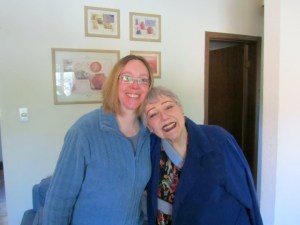
Mom is tougher than she looks!

Mom is tougher than she looks!

On Labor Day, Mom called me to tell me she was calling 911. The pain in her back was just too much for her to endure any longer. After several stressful hours, I called the hospital and they said they were sending her home, that she just had a lumbar sprain and constipation.

Frankly, I didn’t believe their diagnosis then and I still don’t. Mom continues to feel lousy, though her back is a bit better. Her digestive problems continue, and I fear there is something going on with the colostomy reversal.

The next step will be more invasive tests, like a colonoscopy (ugh, she just had one done in December) or an endoscopy.

These tests usually require someone to be present with the patient. So now I’m looking at a last-minute plane ticket close to $1000 and who knows if the test will get us any closer to a true diagnosis, when the other battery of tests didn’t show anything? By no means am I saying that spending the money isn’t worth it if I can help Mom get the treatment she needs. It is just another sober truth of caregiving from afar. It is costly, both in the financial and emotional sense.

I know patient advocates exist but in my mom’s area, they seem to work mainly in the hospital setting, answering questions and dealing with paperwork. I wish there was a service where I could hire a professionally trained caregiver to actually go with my mom to the hospital, and be there with her during tests and procedures. The advocate would ask pertinent questions and then be able to report back to me what is going on.

In an ideal world, I would be there with my mom in all of these situations. But we don’t live in a perfect world, and I know there are many other seniors living independently who do not have family members or relatives living close to them. With our rapidly aging population, I feel this will become an even greater issue.

Every time these situations arise, someone always asks, “Why don’t you just move your mom in with you?” or “Why don’t you move closer to your mother?” These people mean well, but these are huge, life-changing decisions to make, and frankly sometimes it is simply not feasible. That being said, feelings of guilt and doubt linger.

One thing I am immensely grateful for: my new job can be done completely remotely, and my boss has given his blessings that I can work wherever and however I need to if I need to go care for my mom.

If you’ve had experience with long-distance caregiving, what resources did you find most helpful?

4 Comments

Filed under Awareness & Activism, Memories

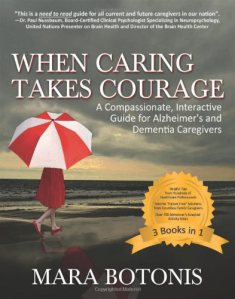
When Caring Takes Courage: A MUST HAVE Caregiving Guide

So agree about dementia caregivers needing info, but not having time to read it. I look forward to checking out this interactive book designed with that in mind.

Ann Napoletan's avatarThe Long and Winding Road...

As I sit down to write this long overdue piece, I can’t help but be struck by how many wonderful people I’ve met through dementia advocacy. It’s safe to say that as a whole, these are some of the most gifted and compassionate human beings on the planet. Each has a unique story, but those stories are the common thread that creates such a bond between us.

Mara Botonis falls into that category. To be honest, I don’t recall exactly how we first crossed paths; however, I do know we were instant friends. I’m grateful that social media provides an avenue for meeting people all over the country – and the world, for that matter.

A Caregiver’s Handbook

But, I digress. The intent of this post is to introduce you to what I believe is the best resource in existence for Alzheimer’s and dementia caregivers. I know that’s a lofty…

View original post 847 more words

Leave a comment

Filed under Memories

Caregiver Grief, Mourning, and Guilt

As caregivers, we spend a lot of time trying to understand the emotional changes our loved ones with dementia are experiencing. But just as important to understand is the emotional upheaval we as caregivers are going through.

trusso599's avatarCaregiver 2.0

27607spt

It’s normal to feel loss when someone you care about has Alzheimer’s disease. It’s also normal to feel guilty, abandoned, and angry. It’s important to acknowledge these emotions and know that you may start to experience them as soon as you learn of the diagnosis.

Alzheimer’s gradually changes the way you relate to the person you know and love. As this happens, you’ll mourn him or her and may experience the stages of grieving: denial, anger, guilt, sadness, and acceptance. These stages of grief don’t happen neatly in order. You’ll move in and out of different stages as time goes on. Some common experiences in the grieving process include:

Denial

  • Hoping that the person is not ill
  • Expecting the person will get better
  • Convincing yourself that the person hasn’t changed
  • Attempting to normalize problematic behaviors

Anger

  • Frustration with the person
  • Resenting the demands of caregiving
  • Resenting family members who can’t…

View original post 523 more words

1 Comment

Filed under Memories

The Layperson’s Guide to Palliative Care for Our Loved Ones with Dementias and Alzheimer’s Disease

Sadly, I did not fully understand what palliative care offered until it was too late for my dad. This post is a great primer about what services palliative care offers and where it fits in with the care plan for your loved one.

Going Gentle Into That Good Night's avatarGoing Gentle Into That Good Night

In the post “The Layperson’s Guide to Home Health Care for Our Loved Ones with Dementias and Alzheimer’s Disease,” we discussed what home health care is, when it should and can be used, and what services it provides.

In this post, we will discuss what palliative health care is, when and why it should and can be used, and what services it provides at home for our loved ones with dementias and Alzheimer’s Disease.

Although, as any caregiver can tell you, dementias and Alzheimer’s Disease are always on the radar with our loved ones who have these neurological diseases, there are often other health-related and age-related illnesses that our loved ones are also dealing with, especially if they’re elderly.

Home health care services are available – and should be used – when there is an acute medical condition that needs to be monitored and resolved (if possible) after our…

View original post 619 more words

Leave a comment

Filed under Memories

Dodging the health crisis bullet … for now

Recently, I wrote about my mom experiencing a mysterious pain in the same general area of her colostomy surgery. She had a few other vague symptoms that warranted further testing. The oncologist ordered CT scans of the abdominal area and the chest.

Unfortunately I had to get back to work so Mom had to manage the scan prep on her own. Even though Mom certainly has her eccentric ways, it is such a blessing knowing that she is still fully capable of handling things outside of her routine, such as going for medical tests. Yes, it was stressful for her, but at 77, she managed quite well.

mom-77-bday

The tests were done right before my birthday, with the results coming back the next week. I admit I spent a pretty good chunk of my birthday weekend mulling “worst case scenarios.” The colon cancer was back. The cancer had spread to another region. What would I do this time? I cannot afford to quit my job again. How would I afford Mom’s care.

Mom had a followup appointment with the oncologist on Wednesday afternoon. I was both eager to hear the results and dreading them at the same time. Finally, Mom calls. For once, she didn’t beat around the bush. (If it had been bad news I had a feeling she would have delayed the announcement.)

All of the tests came back normal. No cancer was detected. Mom was given a clean bill of health. Now of course that doesn’t solve the mystery of Mom’s pain (she insists on calling it a “discomfort.”) But the pain has not increased in intensity so far and it doesn’t stop her from going about her life.

So a sigh of relief, for now. As caregivers we are always ready for the next health crisis. But we also learn to appreciate those good days a bit more.

Leave a comment

Filed under Awareness & Activism, Memories

“I Can’t Do This!”

No matter how tough you think you are, caregiver burnout is a real condition. Know the signs and don’t be afraid to ask for help!

alzga's avatar Georgia Chapter Blog

Caregiver Stress Caregiver Stress

By Theresa Bayman, Program Director Coastal Region

Recently, a member of one of my support groups (with whom I have become very close),  reached her caregiver “breaking point.” Most, if not all caregivers, find themselves at this point at least once throughout their experience. This particular caregiver is a retired nurse – which you might think would give her a leg-up when it comes to care-giving for a loved one at home – but you’d be wrong about that.

When it comes to caring for someone we love, especially a parent or a spouse, the playing field is leveled.  Dementia care-giving is unlike most other care-giving experiences because of the ever-changing needs and limitations of the person receiving care.  With many illnesses, a caregiver can ask the patient “Are you in pain?; Are you hungry?; Would you like some company?”  With a dementia diagnosis, caregivers do not always have…

View original post 250 more words

1 Comment

Filed under Memories

Turning 40: My hopes for the next decade of my life

This Saturday, I turn 40. I’m not one to worry about wrinkles or grey hairs. My recent physical showed that I’m in good health for now.

But considering the health issues that have impacted my family over the last several years, I can’t help but worry.

ttronslien-8721

It is somewhat ironic that if you had asked me before my parents became sick, I would have chosen Alzheimer’s and cancer as the diseases I dread most. Little did I know that I would have to face both diseases head-on, with dementia striking my dad and colon cancer striking my mom. I always figured Dad would get cancer, being a smoker since he was 16. Mom doesn’t smoke and eats a mainly vegetarian diet, and she gets colon cancer. Go figure.

With Mom’s health in the balance again, it’s not really feasible to make concrete plans for my 40th year, let alone the next decade of my life. But then again, if life has taught me anything over the last few years, it is to live in the here and now.

Still, there are a few wishes I have that I hope I can make come true over the next decade of my life.

  • I want to write a book. Whether it be memoir, fiction, or self-help, I’m not sure yet. Maybe one of each! I’ve lit my creative flame again over the last few years, but I know it will take hard work and focus to keep it glowing. And yes, I do want to publish the book, even if I have to go the self-publishing route. I plan on signing up for a writer’s workshop this fall.
  • I want to visit my father’s homeland, Ireland. I had planned on doing this in my 30s, or as a special gift on my 40th birthday, but alas, that is not going to happen. But I can still make it happen over the next few years. Making that family connection is important, and I think will hold greater meaning for me now than ever before.
  • I want to continue and expand my Alzheimer’s awareness work. In particular, I would like to do more hands-on advocacy work.

I’ve been through many life-changing events over the last decade, and I’m sure I will face more moments, both good and bad, over the next decade. My 40th birthday wish is that I approach these moments with a bit more wisdom, and much more compassion.

5 Comments

Filed under Memories