The many benefits of weightlifting for older adults

BenefitsWeightliftingSenior_Title

We know as caregivers that keeping elders active is important to support physical and mental health. But when we think about exercise for elders, we may picture a nice walk versus pumping iron. As it turns out, there are many science-supported benefits of weightlifting for older adults.

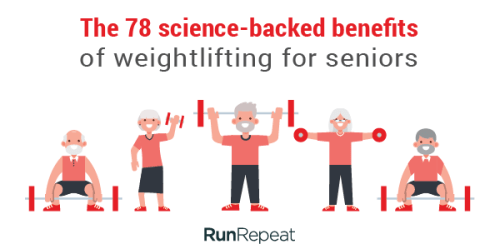
According to Nicholas Rizzo’s article on RunRepeat, there are 78 science backed benefits of weightlifting for seniors, to be exact. This excellent resource, along with the accompanying infographic, is useful for anyone caring for an aging relative who needs a jump-start in their fitness routine. Dementia caregivers will want to note the section on the mental health and cognitive functioning benefits of weightlifting. Studies show that weight training can help relieve depression, which is commonly seen in dementia patients. Weightlifting can also improve memory functioning, even in those with dementia.

Of course, safety is paramount when it comes to physical activity. Before beginning any kind of exercise regimen involving older adults, make sure to consult a health professional who can assess the person’s health and determine if there are any limitations. A weightlifting routine should begin with a proper warm-up, involve a safe progression of weights as tolerated and always focus on proper range of motion. When performed correctly, weightlifting can actually help prevent injuries in older adults and reduce their fall risk, by increasing balance, flexibility and mobility, relieving arthritic pain and increasing bone mineral density.

Reading this article makes me want to add some weight training to my exercise regimen and I’m not quite an “older adult.” I’m a walker and stay in decent shape that way, but neglect activities like weight-based exercises which are also important for overall health.

Do you have any weight training tips for older adults?


Leave a comment

Filed under Awareness & Activism

Caregivers facing tough financial times need better options

credit-card-2308179_640_edited

No one likes to talk about money and that’s why so many of us have money issues.

Caregiving can leave one financially devastated. I found myself in this position over the last few years, and I finally took concrete action to rectify my situation. Why did I put it off so long? I thought I could fix it on my own, pay down my credit card debt the old- fashioned way, through dogged dedication and hard work.

The one thing I’ve learned in the post-caregiving phase of my life is that life doesn’t go on pause while you are tending to an ill loved one or grieving over a family member’s death. In my case, I’ve had legitimate expenses like replacing a rotting porch and replacing a busted water heater (that my home warranty wouldn’t cover unless I replaced the pipes in the ENTIRE house.) I took a few trips, but no fancy overseas adventures. I didn’t live on rice and beans, but I wasn’t slurping down caviar, either.

I’ve always been pretty good at managing my debt, but things were not going in the right direction, and I had to set aside my ego and look at my options. I decided on a personal loan, to consolidate my credit card debt and establish one reasonable monthly payment. I had a lot of trepidation about doing it, but the process went fairly smoothly and I feel more in control of my financial situation. In hindsight, I probably should have done it sooner.

In an ideal world, caregivers would have greater access to financial support, so they wouldn’t have to go virtually bankrupt just because they are taking care of a loved one. It’s insane that the government thinks the average, middle-class person can be a full-time or even part-time caregiver and still earn enough to pay the bills without sinking into debt. And that’s if you are able to care for your loved one at home. Facility care can run thousands of dollars per month, and only the wealthy can afford that on a long-term basis.

There are no easy answers, but as more people find themselves taking on the caregiving role, we are going to have to find some practical solutions. Finances are one of life’s most stressful issues and the last thing a caregiver needs is any more stress!

Leave a comment

Filed under Awareness & Activism

How genetic testing helped me learn about potential, serious health issue

dna-163466_640_edited

Pixabay

There is a lot of buzz these days about genetic testing. Companies like 23&Me have come under fire as critics fear the genetic data could be used by health insurance companies to deny coverage, along with other privacy rights issues.

While I understand these arguments, for me personally, the information I have learned via genetic testing has been very valuable. The following isn’t an endorsement; I’m just sharing my experience.

I did the 23&Me genetic testing years ago. It flagged conditions I already knew I was at risk for, such as Alzheimer’s disease, and what I already have, such as Celiac disease. But the most curious result was the high risk I had compared to the general population for hereditary thrombophilia, which is a predisposition to developing harmful blood clots. I didn’t know what to make of the result (which indicated I had roughly a 60% higher risk than the average person) because blood clots have never been an issue in my family and I’ve never experienced one.

Then my mother became ill, and after her surgery, developed multiple blood clots. Those clots complicated her recovery, so instead of being able to return home post-surgery, she had to spend two months in a rehab center. She required an additional surgical procedure to address her blood clot, which led to its own complications, in which she began to bleed out. She eventually recovered, after spending months on blood thinning medication, which requires strict oversight.

Recently, 23&Me updated their genetic health risk results system and unveiled a new interface in which to interpret the results. By viewing this, I saw that I carry two major genetic variants linked to blood clotting issues: Factor V and Prothrombin G20210A.

So what does this mean for my health? It means that I am aware that because of my genetic makeup, I should alert medical staff before having surgery and I should be vigilant about maintaining leg movement when traveling for long distances. Fortunately, I don’t smoke and I’m not obese, two risk factors, though risk increases as one ages. With precautions, many blood clots are preventable. The problem is, people usually don’t know they are at risk until it’s too late. Just read these stories from the National Blood Clot Alliance.

Let’s face it, my risk for blood clots is not something that would have been uncovered during an annual physical. I have no idea if my mother had the same genetic variants that I do, but I know she would have wanted to know before going through the medical setbacks that the blood clots caused her.

Have you done any form of genetic testing? If so, did you find it helpful or not?


2 Comments

Filed under Awareness & Activism

Food And Alzheimer’s: How To Maximize Nutrition And Make Mealtimes Easier — The Diary of An Alzheimer’s Caregiver

Good tips here! While my dad retained a remarkable appetite when he was in the memory care center, when he landed in the hospital, his appetite dissipated. Caregivers should be prepared to “bend the rules” and let dessert be eaten first, etc. In the end, it doesn’t matter about the order of consumption, as long as your loved one is happy and eating.

Sign up to get these posts and a whole lot more delivered right to your inbox! The Diary of An Alzheimer’s Caregiver – Appreciate the good, laugh at the crazy, and deal with the rest! 97 more words

via Food And Alzheimer’s: How To Maximize Nutrition And Make Mealtimes Easier — The Diary of An Alzheimer’s Caregiver

Leave a comment

August 21, 2018 · 8:35 pm

A son’s moving musical tribute to his mother with Alzheimer’s goes viral

If you’ve spent time on social media over the past month, you may have seen a video of a touching performance by a young country musician from Iowa named Jay Allen. While Allen may not have been a household name before, he certainly is now.

Allen now lives in Nashville but on July 28, he was performing at Dubuque County Fair in his home state. He had a special guest, his mother, who has early-onset Alzheimer’s. Sherry Rich was diagnosed at just 53 years old, and it has been devastating for the entire family. It prompted Allen to write a song, “Blank Stares.” It includes such moving lines as, “If I could only seal the cracks you’re slipping through,” and “Deep down somewhere I swear I still see you/Between the blank stares.”

Allen performed “Blank Stares” at the fair with his mother by his side. A fan captured the touching moment on video, and it was posted on Facebook, where it quickly went viral. The video has been viewed over a million times.

While heartbreaking, it’s wonderful to have young people like Jay Allen raising awareness about this terrible disease. I so appreciate him talking about the financial hardship that Alzheimer’s can cause, because that’s a topic that is not discussed enough. He has touched many people, and proceeds from “Blank Stares” are raising money for Abe’s Garden, a memory care center in Nashville.

If you’ve seen the video or heard the song, I’d love to hear your thoughts.

Leave a comment

Filed under Awareness & Activism

“Into the Night: Portraits of Life and Death” a fascinating documentary

Leave it to me to find the heartbreaking, gut-wrenching yet powerful documentaries. While films about dying are always an emotional experience for me, I also find them thought-provoking, which is why I keep watching them and sharing with others.

The latest film I watched is titled, “Into the Night: Portraits of Life and Death.” It aired on PBS earlier this year, but I caught it on Netflix. What I liked most about the film was the diverse range of subjects who were interviewed about their perspectives on death. From people of faith to scientists to a former member of an Islamic extremist group, those interviewed were candid about their thoughts on the meaning of life, death and the afterlife.

I loved the imagery captured in the film, such as a son finding an acorn in the pants pocket of his recently deceased father, or a favorite family photograph of a parent and child on the shore of the beach. There was also an interesting discussion of near-death experiences.

One of my favorite death positive advocates, Caitlin Doughty, is also interviewed for the film. A traumatic brush with death as a young child greatly influenced her life.

The most moving segments were with those who were actively dying. Anyone who has spent time with a dying person knows they often offer an insightful take on their imminent demise. Some people fight death until the very end, but others make their peace with death in order to better appreciate the time they have left.

The overall message I took away from the film is that each of our lives are unique stories, and all stories must come to an end eventually.

Watching such a film made me reflect upon my own views of death, as well as those of my parents. My father, a staunch Catholic, had an intense fear of death. Did his dementia offset that fear, or intensify it? There is no way for me to know. My mother, on the other hand, had a more positive end of life view. She thought we “go to a good place, and a right place,” based upon whatever our views are of the afterlife.

For me, I’m more afraid of terminal disease and the dying process than death itself. I dread the idea of pain, misery and loss of self-control. I also dread the loss of mental faculties, but know that is a distinct possibility, as Alzheimer’s is all over my family tree. I admire those that make peace with death, as I think it is the best way to go. At some point, the fight to live is over, but I don’t see that as giving up. I see that as focusing remaining energy on the life you have left.

If you’ve seen the documentary, I’d love to hear your thoughts.

2 Comments

Filed under Awareness & Activism

Alzheimer’s and agitation: How caregivers can cope

hand-s-words-1438401-639x349_edited

Photo by Gabriella Fabbri/Freeimages

Among the most disturbing and difficult behaviors for caregivers of those with Alzheimer’s to manage is agitation and aggression. Unfortunately, agitation and aggression are quite common symptoms, with almost half of those with Alzheimer’s exhibiting such behaviors, according to a 2008 study.

infographic-4_editedI witnessed the effects my father’s aggressive behavior had on my mother. Even though my dad was slim, when agitated he proved to be far more than my mother could handle. He still could pack a punch, literally, as when he hauled off and hit my mother in the chin with his fist. He claimed he was shadow boxing and she got in the way.

My father was eventually placed in a memory care center, in part due to his aggressive behavior.

Over the years, I’ve learned tips on how to best manage Alzheimer’s agitation and aggression. The key is that not every solution works for every patient; each case is unique. Here are some suggestions I found helpful:

  • Determine if agitation follows a pattern: For some people with Alzheimer’s, they become more agitated at dusk (sundowning) or during specific tasks, like getting a bath or taking medication. (For my dad, it was the bedtime routine.) Consider that the task may be frustrating to complete for the person with Alzheimer’s. If a certain event is a known trigger, it can be helpful in reducing agitation. Distract with an activity to reduce the effects of sundowning. Have an aide help with bathing. Try to disguise medication in food or a smoothie if possible.
  • Create a calm environment: Those with dementia tend to do best in calm environments that reduce the risk of overstimulation. Noise in particular can be overwhelming. Try soothing, familiar music and lights that are bright enough to maintain safety in the home but that don’t create a harsh glare. Limit caffeine if that is determined to increase agitation. Natural remedies, such as soothing teas and herbs may be helpful, but always check with a doctor first.
  • Stay active: For those with Alzheimer’s who are ambulatory, exercise can help reduce aggression and agitation. My dad loved to take long walks, and as his dementia progressed, he spent more time indoors, which was a source of frustration for him and increased his agitation. For those who have difficulty walking, doing simple household tasks like folding towels can be useful in preventing boredom, as can activities like simple jigsaw puzzles and coloring books.
  • Medication: While medication is not effective for some patients, it can be a useful tool when combined with the above suggestions. Consult your loved one’s physician to learn about options. Consider enrolling your loved one in a drug trial if they qualify.

One important factor to keep in mind is that agitation that appears suddenly may be related to a physical ailment your loved one is experiencing but cannot communicate their discomfort. For example, urinary tract infections are common in those with dementia, and can create very uncomfortable symptoms, which can increase agitation. A new medication can also increase aggression. Share any concerns with your loved one’s doctor.

What methods have you found to curb aggression and agitation in those with Alzheimer’s disease?

Leave a comment

Filed under Awareness & Activism

6 Skills You Need to Have as a Caregiver

Great list, these are definitely important skills to have as a caregiver. I struggled with a few, but excelled at organization and problem solving.

Christopher MacLellan's avatarThe Purple Jacket

Whether it’s a career you want to pursue or something you want to do to use your time to give back, being a caregiver is both a challenging and rewarding experience. People do it every day all over the globe to make sure their loved ones and others get the care and help they need. It’s a selfless job for anyone who wants to take it on, and like all other jobs, you should have certain skills before you step into the role.

Beginning your journey as a caregiver before you know if you’re ready for it would be a major problem. Not only would you be putting yourself in a bad position, but you’d be preventing someone from getting the quality care they need. Read on to see which skills are most important for you to have as a caregiver.

Find out what you can do to improve those…

View original post 674 more words

Leave a comment

Filed under Memories

Bittersweet birthday memories

birthday-cake-380178_640

Pixabay

For me, July will forever be associated with birthdays. My mother’s birthday was July 6 and my birthday is July 19.

While birthdays should be filled with happy memories, ever since the death of my parents, I’m left with bittersweet memories. There’s a profound quote in the Netflix documentary, End Game, which is about end-of-life care and hospice, that touches upon what I’m feeling this week.

“Suffering is the wedge, the gap between the world you want and the world you got.”

Even though I didn’t spend my birthday with my parents as an adult, they always sang Happy Birthday to me over the phone. It was a fun tradition, and each year Mom would tell me how they practiced all week to make it special. My parents both had some musical talent, with Dad especially fond of singing in the style of his favorite crooner, Bing Crosby.

The year before my father was placed in the memory care center, my parents performed the best rendition ever of Happy Birthday. My dad was in high spirits that day, and even though he was in the middle stages of Alzheimer’s by then, he hadn’t lost his ability to sing or to ham it up. He continued singing, performing a medley of classic show tunes before Mom was able to get the phone back from him. At the time I thought, “I wish I had recorded this!”

As my birthday approached the next year, I was visiting my parents and Mom and I made the trek to the memory care center to see Dad. He was mobile but heavily medicated. I didn’t expect any birthday singing, but Mom insisted. I was torn about recording it, but I knew in my heart that it would be my last birthday with my father alive. Little did I know then that my mother would be in a care center a year later recovering from cancer surgery.

Even though I knew it would be painful, I decided to record it. I’m glad I did, even though it is heartbreaking to watch. (I rarely share this video, but am making an exception here.)

As to the quote about suffering, what I wanted was the sublime Happy Birthday performance from the year before. What I got was my father, addled with medication and his brain ravaged by Alzheimer’s, trying his best to perform one final time, with my mother trying desperately to be upbeat.

Ultimately, both memories are gifts. They are both filled with love.


4 Comments

Filed under Memories

Stay or move, that is the question

I was recently introduced to a resourceful website called StayorMove.org. The site focuses on what is are the most crucial questions as we grow older, such as do we stay put in our current homes or do we move on to a different location or live in an assisted living facility?

It’s questions we all should ask ourselves, but many people wait until a health issue makes the decision for them. That’s why I like the approach found on the StayorMove website, which is easy to navigate and uses a series of videos to address the pros and cons of a variety of housing options.

>>READ MORE: Can America afford to age in place?

I also appreciated the fact that growing old in a rural environment was addressed. Those who follow this blog know this is an issue that’s important to me, because my parents’ health care was compromised by living in a small town with limited medical resources. They have a series of videos on the Village movement, which seeks to connect neighbors and volunteers to help elders age in place, while valuing the contributions of elders to the community. I’d love to see this concept expand.

The videos are brief but informative, and hopefully will encourage the “stay or move” conversation to continue. The more people are educated, the better decisions they can make about their own aging and housing choices.

Leave a comment

Filed under Awareness & Activism