Sharing a loving memory on Father’s Day

A recent survey found that dads often get the short end of the stick when it comes to gift-giving on Father’s Day. It seems most of us spend more on our mothers than our fathers. Many people say mothers are easier to shop for, and seem to appreciate gifts more than fathers.

joy-dad-2002

But for those of us who have lost our fathers, or are losing them slowly due to dementia, it is too late to worry about something as trivial as gift-giving. The best we can do is share a loving memory of our fathers, to offer to the world a glimpse of what this special person meant in our lives.

Two loving memories come to my mind this Father’s Day. The first is the lengths my dad went to in confronting the family of the bully who pushed me down at a preschool Halloween party. Dad wasn’t going to let anyone hurt his little girl! The second was just a year or so before Dad began his battle with dementia. He had filled out a prayer card for me, relating my struggles with Celiac disease. I had no idea he was paying attention when I discussed my condition.

After all of those years, Dad was still looking out for his little girl.

What are your favorite memories of your father? How do you honor him on this day?

6 Comments

Filed under Memories

Let’s talk about guns and dementia

Here’s an important topic for family members to discuss: gun ownership and seniors, especially those who have been diagnosed with dementia. While there is quite a bit of awareness of the need to take the car keys away from those with dementia when their driving skills become impaired, there is little discussion about another deadly weapon found in many households. As part of the “caring for our aging parents” #Blog4Care blog carnival, please spread awareness about this topic so that families can have discussions about the proper precautions needed in their homes. Perhaps we can help prevent injuries and save lives.

If you’ve been following the news in America recently, there has been a slew of tragic shootings that have once again ignited the gun debate. The issues surrounding gun ownership and gun violence are being passionately debated right now. But one angle of this issue I never thought about before involves seniors and guns.

gun

An intriguing post on Alzheimer’s and Dementia Weekly made the point that more seniors own guns than any other age group. With the increased risk of dementia as one ages, this could create a dangerous situation. The article quotes Dr. Ellen Pinholt, who wrote in the Journal of the American Geriatrics Society that as family members, we should think about seniors and guns the same we do about seniors and driving. While there is no maximum age limit for owning a gun or driving, mental health status should be taken into consideration for both situations.

Dr. Pinholt recommends asking “the 5 L’s” when it comes to gun ownership and seniors. The questions include if the gun is locked, if it is loaded, if there are children present where the gun is located, whether the senior is depressed, and whether the senior has been diagnosed with dementia.

Sounds like simple and sane advice for an issue that is so complex and controversial. Still, I think it is just as important to consider the issue of having a gun in the house as it is allowing a person to drive once they’ve been diagnosed with dementia. It is yet another question to add to the all-important discussion with your elderly parents and the rest of your family.

While stereotypically, these random mass shootings tend to be perpetuated by young men, anyone who has a condition that impairs the brain and impacts judgement and emotions should probably have their access to a gun restricted, to protect themselves and others. I’m not a fan of legislative restrictions on personal liberties, but when someone’s safety and society’s safety is at risk, smart and limited restrictions may be appropriate.

While there is not a good substitute to driving a car, seniors with dementia may be able to handle a replica gun that either shoots a safe-type pellet or even better, a replica gun without ammunition. Of course, immediate supervision would be necessary. As caregivers, we should try to allow our loved ones with dementia to enjoy their hobbies as long as possible, if safety measures can be taken.

What do you think about the issue of gun ownership and seniors, especially those with dementia? Should guns be immediately removed from the household upon a diagnosis of dementia or are there alternative and less drastic solutions to consider?

1 Comment

Filed under Awareness & Activism

Read This Book If You Have Older Parents

Wanted to share this. I can’t wait to read this book and hope it helps others as well as we make our way through this family caregiving journey.

2 Comments

Filed under Memories

How should we deal with the unfiltered versions of our loved ones?

I wrote previously about the rumors that the least favorite man in professional sports, Clippers owner Donald Sterling, had Alzheimer’s. It appears that those rumors have been confirmed. USA Today reports that Sterling exhibited symptoms consistent with Alzheimer’s disease after undergoing an extensive neurological examination.

man speaking outline

On the one hand, this development places Alzheimer’s disease in the national spotlight, where it belongs. Unfortunately, because the disease is now associated with a man that so many find morally reprehensible, there is bound to be some backlash.

As I followed the news on Twitter, I found many people who found the Alzheimer’s diagnosis all too convenient, a way to look for sympathy from a public that was left aghast by his vehemently racist remarks that were secretly recorded by his much younger girlfriend. Others simply equated Alzheimer’s with crazy, saying “duh” of course Sterling is a crazy old man.

I hope in the days and weeks to come, as this dirty sports saga plays out in the American media, we can have an honest conversation about Alzheimer’s and behavior. This case raises many interesting questions for me. First of all, I think many of have experienced how those with Alzheimer’s lose their conversational filters, saying whatever comes to mind, whether it is offensive or just strange. Some begin to use profanity when they never did before. Generally I think those of us in the Alzheimer’s and dementia communities understand that this is the disease talking, and those afflicted should not be held responsible for their harsh words. For physically abusive actions, we can try behavior modification techniques and medications.

But the Sterling case is a bit different. There are numerous reports that Sterling had been a virulent racist his entire life, despite winning awards from the NAACP. Has the disease just erased his filter? Should the Sterling family be forced to sell the team for what a mentally ill man said, when he was allowed to be an NBA owner all of this time, even with his racist views?

I’m not raising these questions to defend Sterling; certainly he is a very wealthy man who can afford the best of lawyers and doctors to serve his best interest. But it is interesting to debate how much we should hold those with Alzheimer’s and dementia accountable for their words and actions.

Leave a comment

Filed under Awareness & Activism

Want a free copy of a new Alzheimer’s book?

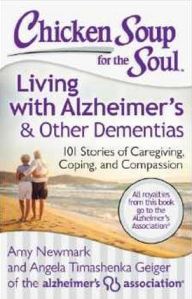
It has been just over a month since “Chicken Soup for the Soul: Living with Alzheimer’s and Other Dementias” was released. So far, the demand has been overwhelming, the reviews extremely positive, and a second printing has been ordered!

Chicken Soup For the Soul: Living With Alzheimer's and Other Dementias

Since I was fortunate enough to be selected as a contributor, I have a few extra copies available. Starting today at noon ET, through Friday noon ET, you can enter a raffle for a chance to receive a complimentary copy of “Chicken Soup for the Soul: Living with Alzheimer’s and Other Dementias.”

Note: You must click on the Rafflecopter link below to be registered for the contest. Rafflecopter is a popular, safe contest platform. You can login through Facebook or with an email address. Follow the prompts on the form to enter the raffle.

Enter the book giveaway

1 Comment

Filed under Awareness & Activism

There is NO excuse for elder abuse

An important topic that needs to be discussed!

trusso599's avatarCaregiver 2.0

sad senior man

As the population ages, the issue of elder abuse becomes more and more prevalent. Elder mistreatment (i.e. abuse and neglect) is defined as intentional actions that cause harm or create a serious risk of harm (whether or not harm is intended) to a vulnerable elder by a caregiver or other person who stands in a trust relationship to the elder. This includes failure by a caregiver to satisfy the elder’s basic needs or to protect the elder from harm.

Unfortunately, we simply do not know for certain how many people are suffering from elder abuse and neglect. It appears that female elders are abused at a higher rate than males and that the older one is, the more likely one is to be abused.

Signs of elder abuse may be missed by professionals working with older Americans because of lack of training on detecting abuse. The elderly may be reluctant…

View original post 286 more words

Leave a comment

Filed under Memories

A moment of feeling lost

As I mentioned recently, I just finished the excellent novel, “Still Alice” which is told from the perspective of a woman with early-onset Alzheimer’s. One facet of the book that seemed very realistic and frightening to me is how the character gets lost on her travels through her neighborhood. I love to walk around my neighborhood (the character in the book loves to run or ride her bicycle). I have lived in my neighborhood since 1997, and like to think I know it like the back of my hand.

blank street sign

But an experience last week gave me just the tiniest insight into how disconcerting feeling lost amidst the familiar can be.

I was going to a dentist appointment, and my dentist had moved his office to a condo building just off the park that is in the center of my neighborhood. I made a note of the new address, and then made an assumption of where I thought it was located. Ironically, I was actually reflecting on “Still Alice” as I was walking to my appointment!

So I reached the corner where I thought the office would be, and no condo building. Then I realized that I was probably a couple of blocks off. But in my mind, I could not picture where this condo building would be along the street that matched the address. I started walking hurriedly, not wanting to be late. A car honked, and a co-worker of mine shouted out my name and waved to me, distracting me further. I was about halfway down the street and thought for sure that there was no condo building at the end of the street. But there had to be! It was hard to see the house numbers so I couldn’t use that as my gauge. I finally broke out Google Maps on my phone but the sun was shining bright and it was hard to follow the arrow to see if I was walking in the right direction.

I was reaching a mild panic at this point, and also felt embarrassed. How could I be lost in my own neighborhood?

Suddenly, like magic, the condo building appeared. It is newish, and I don’t walk down this street very often, but as it turned out, I went out of my way to get to it because of my careless planning. My heart was pounding a bit as I stepped into the dentist’s office, with a few minutes to spare.

The experience gave me a better understanding of disorientation, a common symptom of Alzheimer’s. It also reminded me how often we put ourselves on auto-pilot as we go about running errands and performing daily tasks. We take so much for granted. Alzheimer’s shows us how much we have to lose when our brain function falters.

Leave a comment

Filed under Memories

What about dementia in the workplace?

This week, there has been much talk about the Donald Sterling interview on CNN. The Clippers owner continues to make outrageous statements and accusations. It is easy to dismiss him as a crazy, racist old man who has not embraced modern civilization.

office blurry

But then his wife, in another interview, stated that she thinks Sterling has dementia. Now, the wife is desperately trying to retain her stake in the team, so she may just be doing damage control and trying to drum up sympathy. Still, it raised an interesting question for me.

What do we do about dementia in the workplace?

I wrote an article asking the same question on LinkedIn. I am curious to know what laws or regulations exist in the area you live in, or if the company you work for addresses the topic of dementia in any way. Dementia isn’t a new disease, obviously, but my guess is that in past generations, older people who started having difficulties on the job were just encouraged to retire sooner. Most probably did. But in today’s economy, retirement isn’t an option for many older people, or at best, they delay their retirement by several years. There is also the growing number of early-onset Alzheimer’s cases to contend with, so those in their career prime, in their late 30’s and 40s, could also have to tackle this issue.

I’d also like to know what policies you think should be put in place to deal with this sensitive issue. I’m trying to gather perspective from both sides, from the more business-focused people on LinkedIn, to the dementia awareness advocates that I follow here on WordPress.

1 Comment

Filed under Awareness & Activism

To my mother, a wonderful caregiver

My mom and I don’t always see eye-to-eye, and sometimes she drives me crazy. But while these last several years have been difficult for our family, they have also highlighted my mom’s wonderful qualities.

mom-sketch

So on Mother’s Day, I want to honor my mom, who was such a tireless and loving caregiver for my dad. I took for granted all of the things she did for Dad. It was not until I became my mom’s caregiver that I appreciated all of the sacrifices she made.

This is a sketch of my mom done while she was in the Navy, in the early 1960’s. It was then burned/engraved into a wood canvas. It is really a unique work, and captures my mom’s cheerful spirit.

Leave a comment

Filed under Memories

Alzheimer’s from the inside out

I finally read “Still Alice” by Lisa Genova. The book came out over five years ago and has been sitting on my must-read list for almost that long. After recently hearing about the upcoming movie adaptation starring Julianne Moore, one of my favorite actresses, I put aside my other reading selections and immediately dived in to the novel.

still-alice-2

“Still Alice” is unique because it attempts to capture the Alzheimer’s experience from a character with early-onset Alzheimer’s as she experiences the early to middle stages of the disease. This is Genova’s first novel, but as a neuroscientist, she has another important angle to add to the book.

While the main character, Alice Howland, is a respected Harvard professor, I still connected with her and could imagine my reactions being very similar to hers if I should ever be cursed with this dreaded disease. Genova does a great job of showing how those in the earlier stages of Alzheimer’s work so hard to cover up their symptoms and appear “normal.” Then one day, even their best efforts are not enough. Genova also illustrates how much fear and dread those with Alzheimer’s experience, most of it retained in an internal dialogue that their loved ones may be completely unaware exists. Some readers may be turned off by how the husband is presented in the book, but I think his response to his wife’s disease is pretty realistic, if unfortunate.

The story immediately draws you in and the main character is well-developed. She is a witty, sensitive intellectual which makes her mental decline all the more heartbreaking.

I highly recommend the book if you haven’t read it yet. If you have, let me know what you thought about the story.

1 Comment

Filed under Awareness & Activism