September has arrived and I’m ready for summer to be over! One of the best things about cooler weather is that it encourages me to be more active outdoors.
It’s no secret that middle age ushers in physical changes to the body, many unwelcomed. I’ve already had to address elevated cholesterol levels and I just turned 50. Fitness is something that I’ve taken for granted, because for most of my life, walking has been part of my daily routine. It still is, but the only downside in working from home is that my built-in exercise of walking to and from work has been eliminated. I walk my senior dog twice a day, but while our slow meanders around the block are good for my emotional well-being, they don’t offer the same physical benefits.
Good physical health as one ages isn’t just about weight, though you may have noticed that as you get older, it’s harder to lose a few extra pounds. Staying active can help reduce the risk of dementia, as well. Health.gov has an initiative called “Move Your Way” which encourages one to engage in physical activity they enjoy. Instead of forcing yourself to the gym if that’s not your cup of tea, take a walk in nature, or a dance class. I like this approach as it makes being active more accessible to everyone.
For me, yardwork is an effective, whole body workout that offers a mix of cardio, strength, and flexibility training. Don’t overlook the power of household chores! Sweeping, mopping, scrubbing, etc. all count as physical activity. Aim for a healthy mix of exercise that will help you maintain a healthy weight, as well as muscle strength, flexibility, and balance to prevent falls. The key is to find physical activity that you enjoy, so you’ll have an incentive to make it part of your health routine.
Image courtesy of U.S. Department of Health and Human Services.
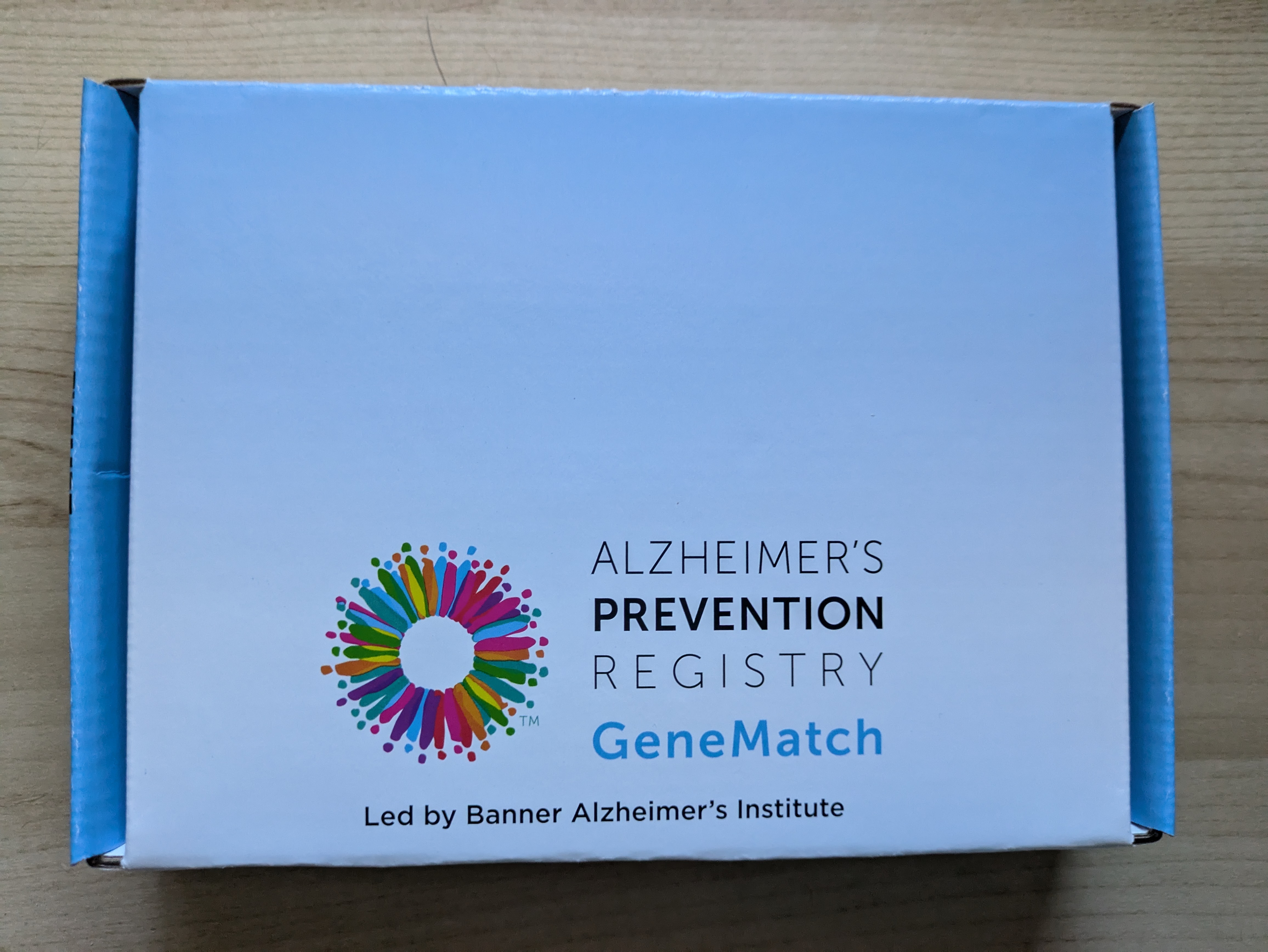
One of the tasks that has been on my to-do list since turning 50 is registering for GeneMatch, a program led by the Banner Alzheimer’s Institute. The program uses genetic testing to recruit people age 50-90 for Alzheimer’s prevention studies.
After what seemed like little activity for years when it comes to treatment options for Alzheimer’s and other dementias, in the past few years, new drug treatments have emerged that are offering some hope. These new medications have also been accompanied by controversy, as I’ve written before about Leqembi and Aduhelm. But one thing that isn’t in dispute is that effective treatments cannot be developed without a sufficient amount of study participants. According to the Alzheimer’s Prevention Registry, 80 percent of studies are delayed because of lack of qualified participants.
Joining GeneMatch is simple and free. Those who meet the basic requirements will be sent a cheek swab test that can be completed in the comfort of your home, and then returned in a postage-paid package. One thing to keep in mind is that you won’t necessarily learn the results of the genetic testing, but some studies may offer the opportunity to learn APOE results. Since I’ve had genetic testing done previously, I already know I carry one copy of the APOE e4 gene, which increases my risk for Alzheimer’s disease. With the disease appearing on both sides of my family tree, I’m eager to do whatever I can to find effective treatment.
For caregiver tips, check out my Caregiver Product Recommendations page, with a list of products that I used while caring for my parents.
As an Amazon Associate I earn from qualifying purchases.
Is it just me, or are you inundated with pharmaceutical ads about shingles? The Shingrix vaccine ad blast is virtually in constant rotation on the streaming channels I watch. At this point, anyone 50 and older should have gotten the message about the threat of shingles as one grows older.
The commercial came on again as I was writing this blog post!
Now that I’ve turned 50, shingles is officially on my radar. I had chicken pox as a kid, so I’m at increased risk. The two-dose Shingrix vaccine is effective, but can trigger adverse reactions so those interested should consult their doctor.
A new study that suggests there could be a link between shingles and cognitive decline.
The latest study conducted by researchers at Brigham and Women’s Hospital analyzed data from three large independent studies that have been collecting data since the mid-1970s and mid-1980s. Researchers determined from their analysis that an episode of shingles was associated with an approximately 20% higher long-term risk of cognitive decline. The risk was greatest for men who are APOE ε4 carriers, a significant genetic risk factor for Alzheimer’s disease.
What could be the link between shingles and cognitive decline? The connection is not fully understood and will require further research, but inflammation may play a role. Vaccination may help reduce the risk of shingles-related cognitive decline, but more research is needed, according to the study.
Even without a potential link to dementia, shingles is a painful condition that can lead to significant, long-term symptoms. But for those of us already at increased genetic risk for Alzheimer’s, understanding how other conditions may trigger cognitive decline is worth monitoring.
For caregiver tips, check out my Caregiver Product Recommendations page, with a list of products that I used while caring for my parents.
As an Amazon Associate I earn from qualifying purchases.
Elaine shares a tender reminder for all caregivers, past, present, and future: don’t forget your self-worth and be kind and forgiving of yourself when making tough decisions as a caregiver. Much time has passed since I cared for my parents, but I still feel pangs of guilt over some of the decisions I made.
I read another post recently about grief and guilt and that some researchers feel that the sharp pain of guilt may be the way some people attempt to maintain a strong emotional connection to their departed loved ones. I think there is some truth in this from my experience. Certainly the pain of guilt can overshadow more positive memories. Over time, we can make a conscious effort to let go of the guilt and accept the new relationship we have with those who have departed.
Digital estate planning has become an essential part of end of life considerations. In our tech-driven society, you may spend more time and have more information stored in digital form than you do physical form.
As a Gen X member, I’m one of the last generations to have a foothold in both worlds. For example, my diaries from junior high and high school were kept in physical journals, and photos from that time period were physical prints. As an adult I’ve fully embraced technology and have most of my writing and photos, along with my financial and household information, are stored digitally. I will need to select a person comfortable with both physical and digital documents to handle my estate.
There’s no official method when it comes to digital estate planning. 1Password offers a guide with helpful tips. Maintain a list of your digital accounts with access information, and store that information somewhere secure. If you prefer, you can grant access to your online password manager to your digital estate executor. Only the person you choose to manage your digital estate should have access to that information and understand your wishes as to what to do with your accounts, personal writings, etc. Be very clear about what to do with potentially sensitive information that could be hurtful to others if discovered after your death.
Digital estate planning action steps (from Perplexity AI):
Take Inventory: List all your digital assets and account details.
Decide Asset Fate: Determine what should happen to each digital asset.
Appoint Executor: Choose a trusted digital executor.
Create Digital Will: Document your wishes legally.
Store Securely: Keep your digital estate plan in a safe and accessible place.
Update Regularly: Review and update your plan periodically.
Communicate: Inform your loved ones and executor about your plan.
Also something to consider are any messages, social posts, or works you would like shared after your death. Many social media services allow accounts to be converted to a memorial account. Dementia awareness advocate Wendy Mitchell wrote a final farewell blog post that she instructed her daughters to publish after her death.
Where digital estate planning can get tricky is when a person has dementia. If the person had no digital estate plan, it may be a challenge for family members to gain access to accounts, because login information may be stored haphazardly or be unintentionally discarded. Those who did create a digital estate plan may change details as their dementia progresses. My father was not digitally-minded at all, but I remember how I came across important account information mixed with junk mail stuffed in plastic shopping bags under the bed.
For those who need assistance, check out the resources offered by Memory Banc. Founder Kay Bransford, who also manages the Dealing with Dementia blog, was a caregiver for her parents who were diagnosed with two different forms of dementia, so she understands the challenges firsthand.
Every person with a digital presence should create a plan on how they wish for their digital information to be handled after their death. Communicate with those who will be handling your digital estate to make sure they are comfortable with the role and the responsibilities. If you find yourself designated as the executor for a digital estate, organize and process accounts by type and importance, and reach out to estate officials or the estate attorney if you have any questions.
For caregiver tips, check out my Caregiver Product Recommendations page, with a list of products that I used while caring for my parents.
As an Amazon Associate I earn from qualifying purchases.
My 50th birthday was memorable in the best and worst of ways. The day before I turned 50, I traveled to Las Vegas and did the SkyJump at The Strat. It’s an 855-foot plunge from a platform on the 108th floor. Jumpers are attached to a cable and guide wire system for a controlled descent. It’s described as a vertical zip line.
It’s important to note that I’m terrified of heights. I can’t climb a ladder more than a few rungs without my knees shaking. It’s for this reason that I wanted to challenge myself and face one of my biggest fears. Letting go and stepping into the sky is a sensation like no other.
You can watch the video of my SkyJump below. Yes, I screamed all the way down, a mixture of fear and exhilaration.
It’s a good thing that I was still running on the high from the SkyJump because when trying to return home, I ran into the flight software issue that plagued airlines over the past week. I ended up spending early Sunday morning sleeping on the floor of the Las Vegas airport, only to have my flight canceled Sunday afternoon. There was a lot of sitting and waiting, which reminded me of all the times I spent with Mom in doctor’s offices and hospital waiting rooms. It’s a mixture of anxiety, dread, and boredom but my past caregiver experience has built up a reservoir of resilience for such situations. My main concern was not for myself but for my pets, and fortunately I was able to find a pet sitter to fill in at the last minute for my extended absence. I finally made it home Tuesday morning.
It’s not the way I would have preferred to end my birthday trip, but as one gets older and experiences the highs and lows of life, one learns how to better adapt to challenging circumstances.
For caregiver tips, check out my Caregiver Product Recommendations page, with a list of products that I used while caring for my parents.
As an Amazon Associate I earn from qualifying purchases.
I’m turning 50 this week. Age may just be a number, but 50 feels like a significant milestone.
While I’m very grateful for my good health, I’m eager to move beyond the worst decade of my life. Within a year of turning 40, my mother died. A few years later, my nearly 20-year relationship ended in divorce. A year later, the coronavirus pandemic shut down the world and left us fearing for our lives and sanity. Just before Thanksgiving 2022, I was laid off from my job. I said a heartbreaking farewell to several beloved pets over the last decade of my life. My 40s was witness to a political firestorm in the U.S. that to my horror, gets worse with each passing day with no resolution in sight.
As I was reminiscing, I came across a blog post that I wrote when I turned 40, and what I hoped to accomplish during this decade of my life. I was prepared for cringeworthy commentary, but in fact, I accomplished all three of the items on my 40s list! I wrote and published a book (a total of 3 in fact!), I went to Ireland and N. Ireland, and I’ve grown my Alzheimer’s awareness advocacy efforts.
It reminded me of the worthy accomplishments that I achieved during my 40s, even if those things are often overshadowed by the barrage of difficult times. Reflecting on the good and the bad, I see a pattern emerge: good often follows the bad. For example, I was able to replace a job that was draining my energy with one that has allowed me to grow and gain new skills. I’ve been able to welcome new rescue pets into my life. Caring for my parents taught me many things about the healthcare system and the resilience of caregivers.
I’m not making a to-do list for my 50s. Instead I’m focusing on challenging myself to face my fears and be open to new experiences. I hope good will follow the bad for me this decade.
For caregiver tips, check out my Caregiver Product Recommendations page, with a list of products that I used while caring for my parents.
As an Amazon Associate I earn from qualifying purchases.
ICYMI: I’m participating in the Smashwords Summer/Winter sale. Get the e-book version of my award-wining collection of personal essays, The Reluctant Caregiver, for half-off (just 99 cents!) during the entire month of July. Enter the code SSW50 at checkout.
Recently I had the pleasure of being a guest on the Caregiver SOS podcast. We discussed the financial impact of caregiving, and I shared my own insights from caring for my parents.
The “p” word really is the key word here. We discussed how to prepare financially before a family healthcare crisis strikes. This is a topic that I feel is vital to discuss as a family and I’m grateful for the opportunity to share my story.
You can find Caregiver SOS on your favorite digital audio platform, or via the WellMed Charitable Foundation website.
For more caregiver tips, check out my Caregiver Product Recommendations page, with a list of products that I used while caring for my parents.
As an Amazon Associate I earn from qualifying purchases.
ICYMI: I’m participating in the Smashwords Summer/Winter sale. Get the e-book version of my award-wining collection of personal essays, The Reluctant Caregiver, for half-off (just 99 cents!) during the entire month of July. Enter the code SSW50 at checkout.
Mom would have been 87 today. While Mom and I were opposites in many ways, I did gain an appreciation of music from her. She loved her Martin guitar and it survived several moves with her. She taught me to play a bit when I was a kid; it kept me occupied over those long, hot summers in California. After she died, the guitar was one of the mementos that I cherished the most, so it’s now in my home. I’ve attempted to play it again sporadically, and hope one day I can dedicate enough time to be able to play casually again.
I also inherited an appreciation of a wide range of music from my mother. She loved listening to everything from Mozart and Beethoven to Johnny Cash and Willie Nelson. She even tried to appreciate the music I loved growing up, and the music video craze of the 1980s. I think Cyndi Lauper was probably her favorite, because she was so fun and colorful.
Mom would be proud knowing I was still sharing our family caregiving story with others. You can listen to my appearance on the Caregiver SOS podcast on Spotify or your preferred podcast hosting service. I’ll write more about the appearance in my next post.
A reminder: I’m participating in the Smashwords Summer/Winter sale. Get the e-book version of my award-wining collection of personal essays, The Reluctant Caregiver, for half-off (just 99 cents!) during the entire month of July. Enter the code SSW50 at checkout.
Check out my summer book recommendations for caregivers for even more books to help you on your caregiving journey.
As an Amazon Associate I earn from qualifying purchases.
It has been sweltering in Atlanta for the past month, and summer just began. When it’s too hot to be outside for long, I’m going to turn to one of my favorite pastimes that often gets pushed to the side: reading. I read all day as part of my job, but reading for pleasure is something that I wish I did more. My Kindle is full of books I haven’t started yet, and I have plenty more on my wish list. Reading is something that makes me feel close to my dad, and I feel I inherited my love of books from him.
I could write a book about the many amazing books available for dementia caregivers, but here are my top recommendations:
I’m honored to have “At the Crossroads,” a poem about my father, included in Poetry for the Dementia Journey: An AlzAuthors poetry Anthology. This new collection was published in June and is available on Amazon. Check out AlzAuthors for a large and impressive library of books that inform and support dementia caregivers.
I’m participating in the Smashwords Summer/Winter sale. Get the e-book version of my award-wining collection of personal essays, The Reluctant Caregiver, for half-off (just 99 cents!) during the entire month of July. Enter the code SSW50 at checkout.
If you’d like to honor the memory of dementia awareness advocate Wendy Mitchell, who died earlier this year, consider one of her books. One Last Thing is aptly titled as her final work. Somebody I Used to Know is her best known and highly acclaimed book.
Finally, another shameless plug: Chicken Soup for the Soul: Living with Alzheimer’s and Other Dementiasis a wonderful collection that captures the highs and lows of the dementia caregiving journey. I’m honored to have a story about my father, “French Toast,” included in this edition.
What books are on your summer reading list?
For more suggestions beyond books, check out my Caregiver Product Recommendations page, with a list of products that I used while caring for my parents.
As an Amazon Associate I earn from qualifying purchases.








![Pageflex Persona [document: PRS0000038_00069]](https://memoriesproject.files.wordpress.com/2014/02/reluctant-caregiver-cover.jpg)






 The Memories Project