Monthly Archives: June 2017

‘Driving Miss Norma’ teaches valuable lessons on aging, caregiving, dying

I haven’t been shy about my professed loved and admiration for “Miss Norma” Bauerschmidt, who at 90, became an internet sensation when, instead of undergoing grueling treatment for uterine cancer while dealing with the recent death of her husband, she told her doctor, “I’m hitting the road.”

Driving Miss Norma: One Family’s Journey Saying “Yes” to Living, a book about the final, amazing year of Norma’s life, is now available, and I highly recommend it.

Norma joined her son and daughter-in-law in a motor home for an epic trip around the U.S., where she was welcomed like a celebrity everywhere she stopped. While Norma’s symptoms were managed quite well on the road, her cancer progressed and she died on September 30, 2016.

Her story has touched millions around the world, and I couldn’t be happier about that.

Norma’s story touches upon many topics that are near and dear to my heart. First, the “treatment without question” mentality that pervades the American health care system got turned on its head here. The doctor was taken aback by Norma’s reaction at first, but admitted that his own treatment recommendation would have set up Norma on a long road of recovery that she may not have survived. Instead of spending months in a skilled nursing facility recovering from major surgery and being sick from chemotherapy, Norma chose quality over quantity for the remainder of her life.

The highs and lows of caregiving are poignantly and honestly discussed in this book. Norma’s son and daughter-in-law don’t shy away from the challenges that family caregiving poses, which are only complicated when mixed with an unpredictable life on the road. Norma’s son and daughter-in-law weren’t experienced caregivers before taking on Norma, and their “nomadic by choice” lifestyle had to be adapted to Norma’s abilities and health challenges. Ultimately it was an experience that they wouldn’t trade for all the world, but I appreciate their openness in discussing their caregiving experience.

What was most surprising to me was how, according to her son, Norma was not known as the “wild gal” that we saw on Facebook who would make funny faces for the camera or who took delight in quirky tourist spots. Norma, a quiet, stable presence in the family, had been content to live in her husband’s shadow. But once on the road, a new side of Norma emerged. This may be the most important lesson of all in the book. It is never too late to find oneself.

By late summer, it became apparent that Norma’s trip through this life would be coming to a close soon. Being on the road presented some unique challenges, but Norma passed on as comfortably as is possible, surrounded by love and fulfilled in a year’s worth of joyous sights and experiences. For everyone seeking that elusive “good death,” I think after reading this book you will conclude that Norma had a good one.

Obviously, not all of us have adult children who could accommodate such an epic life’s end journey. What we can take from the book is that when faced with what could have been an overwhelmingly depressing moment in her life, coping with the death of her husband and a cancer diagnosis, Norma chose to embrace optimism. Norma chose adventure, to let go of any old grievances and open her heart to new people and experiences. One of the catchphrases for Norma’s journey is, “Say yes to living.”

That’s a lesson we could all take to heart.

3 Comments

Filed under Awareness & Activism

A bookmark from the past

My dad loved books, but he hated bookmarks.

Even though the library included free ones in every book, Dad insisted upon “dog earing” pages. My mother would nag him about it, saying the books were the library’s property and they probably didn’t appreciate him returning books with creased page corners. But Dad continued to do it, and to be fair, I never heard him getting chewed out at the library about it. Certainly he wasn’t the only person who dog eared books.

bookmark

As I was going through some books and sorting them for donations, I came across one of those library bookmarks. The bookmarks served dual purposes: marking your place in the book and reminding you when the book was due.

The bookmarks, with the sketch of the Downey City Library at the bottom, are so ingrained in my memory, having checked out hundreds of books from the library during my childhood.

The due date on this one was Aug. 29, 1981. I would have just turned 6 the month before. It would’ve almost been time for school to start, as we started just after Labor Day. I would’ve been entering first grade.

What’s even more interesting is that I found the bookmark in an old, worn copy of East and West, a collection of short stories by Somerset Maugham. That book is from the New Orleans Public Library and had a due date of Sept. 2, 1959. (Dad lived for a brief period in the Big Easy.) The next time I visit I may return the book just to see the reaction of the librarian!

Sorting through Dad’s book collection was the ideal task to mark Father’s Day.

1 Comment

Filed under Memories

Heat waves a hot topic when caring for older loved ones

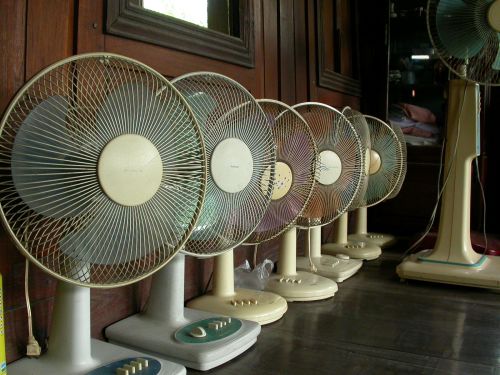
fans

Photo by komgrit/Morguefile

Whether or not you believe in global warming, every year there are deadly heat waves across the U.S. Many of those who succumb to the heat are seniors. Some cities have annual initiatives to make sure low-income seniors have fans in their homes and some cities offer cooling centers, air-conditioned venues that are open during the day free of charge for people who want to escape the heat.

No one should die from the heat because they can’t afford a fan, air conditioning, or are afraid of running up their electricity bills on a fixed budget. But a HealthCentral article I read by Carol Bursack pointed out another reason that is not often discussed.

Bursack told a story about her mother-in-law, who turned off the air conditioning she had in her condo every day after Bursack would visit and turn it on to a low setting just to keep the air circulating. This was in the middle of a heat wave, and Bursack would discover every window shut, the A/C turned off and it would be sweltering inside. When she discovered her mother-in-law suffering serious disorientation symptoms from the heat, she knew her days of independent living were coming to an end.

Bursack’s story reminded me of my mother. In her case, it was the heat during winter. My parents retired to a mountain town that usually receives a decent amount of snow and the temperatures often drop into the 20s and 30s overnight in the winter. Mom would insist on turning off the heat every night before going to bed, then getting up in the middle of the night, shivering, to turn it back on for a few minutes, then turning it off again until the morning. This was totally nuts to me. Mom thought she was saving energy (and perhaps Bursack’s mother thought the same thing) but keeping a home at a steady, moderate temperature is most efficient. So yes, by all means, turn down the heat when you will be bundled under the covers overnight, but don’t turn it off!

Mom also insisted, even on the most frigid of nights, in leaving the windows in the living room and bedrooms open a crack, because she thought she’d suffocate or die of carbon monoxide poisoning if she closed everything. Of course, this caused the furnace to have to work more and threw the whole energy-efficient argument out the window.

As a caregiver, I had to pick my battles. I never convinced Mom to close the windows, but by using a bit of reverse psychology, one night, she mentioned that it might be nice to just keep the heat on through the night, and I told her that was an excellent idea. From then on, she didn’t turn off the heat overnight.

The point here is that even if your elder loved one has access to fans or air conditioning, check to make sure they are actually using them. Whether they are just set in their ways or are beginning to develop dementia, we cannot take the use of such things for granted.

[Addendum: Just after I wrote this post, I went to stay at what was my parents’ condo for 2 weeks. The condo doesn’t have air conditioning, because it’s located in a mountain town where the average temperature this time of year is around 80. Not this year … it’s been in the 90s and hit 93 yesterday. I’m dealing with a summer cold on top of the heat, with only fans to offer relief, and it’s pretty miserable. I’ll be fine, but I’m 42. In 20-30 years, this situation might be more of a health risk.]

3 Comments

Filed under Awareness & Activism

Is dying at home best for everyone?

bed

Photo by Lillian Nelson/Freeimages

In recent years, a growing movement has embraced the concept of dying at home, versus a hospital or nursing home. In general, I support the idea, after my father had a difficult death in a skilled nursing facility while I was 1,300 miles away. But having experienced the challenges of being a primary caregiver for my mother, who died at home, I also understand just how traumatic such a death can be for family members. The latter is a viewpoint that is not often discussed.

Ann Brenoff, who covers aging topics for Huffington Post, interviewed me last week to discuss the potential consequences for the family caregiver when a loved one chooses to die at home. The article, When Loved Ones Die At Home, Family Caregivers Pay The Price, offers an important perspective on the subject. The article references my 2015 essay, Why dying at home is not all it’s cracked up to be. Brenoff discusses how financial concerns are behind the government’s desire for people to die at home. While it’s cheaper for people to die at home, caregivers pay the ultimate price.

In many cases, family caregivers shoulder the burden of care duties. Some have to quit their jobs or reduce work hours, impacting their financial status. Chronic stress can affect their own health. The emotional toll can be devastating.

To achieve a good death at home standard, we must offer greater support to family caregivers.

There are pros and cons to everything, including dying at home. The more we learn about each other’s caregiving experiences, the better informed we will be when we face a family health crisis or end-of-life care situation.


2 Comments

Filed under Memories