It’s Read an Ebook Week. While I’ll always love the feel of pages in a physical book, I do almost all of my reading using my Kindle. It’s just more convenient for my lifestyle.
If you are an electronic book fan, this is a great week to take advantage of special deals. I’m participating in the Smashwords promotions. You can get The Reluctant Caregiverand CBD for Caregivers for just 99 cents today through March 11. Note: It looks like the promotion is so popular that the Smashwords website is experiencing some technical difficulties. If you get a broken link, check back later.
If you are looking for a digital children’s book, you can get Slow Dog for just $2.99 on Amazon.
Every night I wind down by playing two games on my tablet: a crossword and a Jumble word puzzle. I’ve always enjoyed word puzzles. I inherited my love of the Jumble puzzles from my mother, who was a devoted player. One of the ways we bonded as she recovered from cancer surgery was working on Jumble puzzles together. My dad was an avid reader, but his love of words didn’t extend to games. It was particularly cruel when Alzheimer’s took away his favorite hobby of reading.
There are many apps and articles that promote “brain games” as a way to reduce the risk of Alzheimer’s and other dementias. While proponents of such games are enthusiastic about their potential in supporting cognitive health, the research so far is mixed when it comes to benefits.
One study that involved people diagnosed with mild cognitive impairment found that crosswords helped support cognitive health more than other games, though the positive results were not dramatic.
There’s no harm in playing such games if it brings you comfort. I do notice that if I’m tired or not feeling well, I struggle with completing the puzzles as fast as I normally do. I like to challenge myself to complete the crosswords as fast as possible. For me, this means not stopping to ponder a clue that I’m stuck on; instead I keep going and complete as many other words as possible before coming back to the ones that stumped me.
While such games may not offer protective benefits against Alzheimer’s, we do know that doctors use a series of tests which could be considered game-like to help diagnose someone with the disease, such as word memory exercises. I’ve participated in a study which has me complete a series of games along with a cognitive questionnaire a few times per year. Doing word games as part of your daily routine could help you spot a decline in your cognitive abilities earlier than you might have noticed otherwise.
Friday was National Caregivers Day, but why just celebrate one day a year? Let’s keep the support flowing all year long.
AARP compiled a nice, actionable list of things one can do to support your caregivers in your life. I appreciate the “what that looks like” suggestions under each support method. It can be difficult for one to know how best to support a caregiver, so these practical options are so useful. For example, under “demonstrate support” there are suggestions like help a caregiver get organized, do research, help with housework, yardwork or other errands, and bring a meal or provide a meal delivery service.
The key in supporting caregivers is making sure the onus isn’t on them to ask for help. As a former caregiver, I know how hard it can be for some of us to ask for assistance. But I always appreciated when someone stepped up and helped me on my caregiving journey.
In the essay, Sarah Romanelli describes a situation that will be familiar to many caregivers: “being held hostage” by a broken care system that breaks down as one becomes more fragile. In Romanelli’s grandmother case, she was too weak for rehab and too dependent to return to assisted living, who sent her back to the hospital. The family was forced to crunch numbers and develop a care plan, which involved at-home care.
The family moved the grandmother to an apartment close to family and hired 24-hour care. That cost a whopping $16,200 per month, but was still cheaper than securing a space in a long-term care facility. Keep in mind that care facilities may require families to pay out-of-pocket for private caregivers if a resident is deemed to need around-the-clock monitoring. This happens quite often for residents with dementia.
Romanelli says her grandmother received wonderful end-of-life care, but she knows that their family’s solution is not feasible for most people. My father also got passed around to various facilities and ended up being sent far away from my mother, because it was the only memory care facility with an opening. At over $4,000 a month, it quickly depleted my family’s modest resources. But 24-hour care would not have been feasible in my parents’ rural community due to staffing shortages, and definitely would have been more expensive.
Bottom line, no matter what care option you choose, it will be expensive. I want people to have the choice of dying at home, and not bankrupt their family in the process.
If you’ve been online over the last few months, you’ve probably come across discussions about ChatGPT. The conversational AI-powered (artificial intelligence) tool developed by OpenAI is the latest tech fad that some experts claim could take over our jobs in the future. (If you are interested in working with images instead of words try the related DALL-E.)
You may have seen some of the program’s capabilities: it can write articles, essays, jokes and songs, debug software code, and create resumes with some input from the user. Users can have a conversation of sorts with ChatGPT while refining their requests and the tool can ingest those new points and update its responses in real time.
As someone who enjoys exploring new tools but retains a healthy amount of skepticism about such tools taking over the world, I’ve spent some time testing out ChatGPT, focusing on how the tool could potentially be of aid to caregivers.
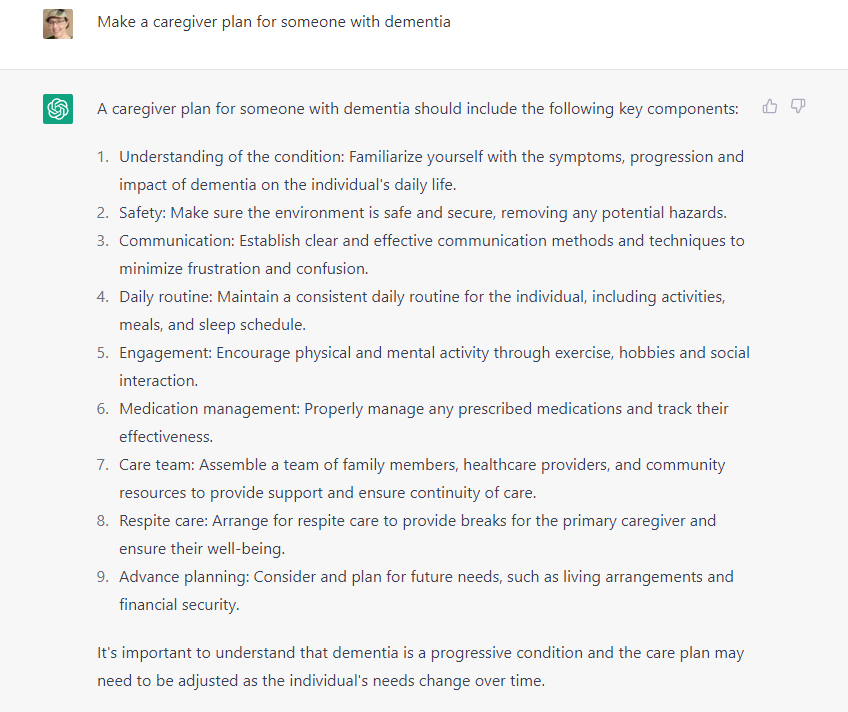
My main takeaway is that while ChatGPT can adequately provide information on a vast amount of topics, the responses are mainly generic and middling in quality, like someone reciting an encyclopedia entry. Your mileage will vary if you are asking a question on a highly technical topic or asking it to generate code for a website. But when asking for caregiving advice such as making a caregiver plan for someone with dementia or tips on aging in place, it regurgitates acceptable but basic advice that can be found across the internet. You can see a couple of examples below:
The glaring issue for me is that there is no attribution with ChatGPT responses. That could be important when you are seeking medical advice such as dementia caregiving tips. Are the pointers it is offering come from a dementia expert like Teepa Snow or a low quality resource? At this point, the responses could be used as a decent starting point, but the user would need to do additional research outside of the ChatGPT system to verify, augment, and personalize the information. Google and other search engines are seeking to incorporate attributes of such AI-based tools into their own programs which would offer a more conversational way to search for information.
I’m going to continue to explore the uses of ChatGPT and how it might be useful for caregivers. If you’ve used the tool, I’d love to hear your feedback.
Dementia caregivers who are juggling careers and care duties will appreciate how director Alex Berg depicted the caregiving experience with empathy and accuracy in his short film, “Ruth.” The film was released in 2022 but is receiving renewed interest due to an Alzheimer’s Association interview with the director that was published this month.
In just 9 minutes, “Ruth” beautifully depicts the frustrations and joy of a mother with dementia and her middle-aged daughter who is trying to balance career demands with caregiving. Berg told the Alzheimer’s Association that his grandfather was an inspiration for the project. The confusion and repetition of questions is something many dementia family caregivers will relate to. The frustration that bubbles over for the daughter is also familiar. “I wanted the daughter-caregiver in the film to be just as central as the mother character, going through personal challenges of her own, ones that don’t go away just because she is a caregiver,” Berg said.
The acting and direction is heartbreakingly beautiful. Family caregivers will finally feel seen after viewing “Ruth.”
In a move that family caregivers feel is long overdue, the federal government is launching an investigation into the inappropriate use of antipsychotic drugs in nursing homes. Specifically, the government will be looking at the suspicious rise in schizophrenia cases and determine if the spike is being used as a workaround to use antipsychotic drugs to sedate difficult patients and make them more manageable for staff.
This is not a new issue, especially for family caregivers of those with dementia. I’ve written about it multiple times on this blog in relation to my father’s experience. My father was given risperidone, a drug used to treat schizophrenia and bipolar disease, at the memory care facility he resided in during the last year of his life. The doctor didn’t deny when I confronted him about the drug and how it was used to make dementia patients zombies and more compliant for staff.
After my father’s death, I reported the issue to the appropriate state agency, but never received a response. The federal government claimed in 2013 that antipsychotic use in nursing homes was on the decline. That remains true but only for the population not diagnosed with schizophrenia. There is also a troubling racial disparity, with Black nursing home residents being diagnosed with schizophrenia at higher rates than their white counterparts.
CMS will conduct audits and nursing homes showing a pattern of diagnosing schizophrenia incorrectly may see their public ratings impacted. CMS will monitor the nursing homes not in compliance to make sure corrections are implemented. It’s not known at this time if fines will be implemented for those nursing homes who continue to be out of compliance. Also, patients’ families will not be informed if their loved one was incorrectly diagnosed. Make sure to request a list of the drugs your loved one has been prescribed and question any medications that don’t seem appropriate.
Highlighting the challenges that come with caring for a family member in which you have a difficult relationship dynamic is an issue that is important to me. I discuss my own challenges when caring for my mother in my book, The Reluctant Caregiver.
Lori Grinker has created a moving, powerful photo essay, “All the Little Things,” which is about caring for her mother Audrey. The mother and daughter faced a trifecta of challenges: Audrey was already dealing with dementia when she was diagnosed with cancer at the beginning of the COVID-19 pandemic. Grinker and her mother had always had a strained relationship, but the pandemic delayed a move into an assisted living facility, so mother and daughter lived together for three months. Grinker not only captures images of her mother, but of objects in her mother’s apartment. Those objects sparked memories and discussions that allowed the pair to open up the lines of communication more.
One of the objects that jumped out at me was the worn baking sheet. I remember my mother having a similar favorite baking sheet that she never wanted to discard no matter how discolored it became.
Life isn’t a Hallmark movie, so one shouldn’t expect an “all is forgiven” ending. Grinker told NPR that she and her mother were able to find some love for each other and most importantly, Grinker says she no longer harbors anger for her mother’s actions. She told NPR even if she cannot forgive her mother for some things, she now understands some of her mother’s life choices better.
Audrey died in March 2021.
“My mother agreed that I could share her story so that it might become a little easier for someone else to navigate their own journey with a loved one.“ – Lori Grinker, 2022 Bob & Diane Fund grantee.
This week, the U.S. Food and Drug Administration approved a new drug to treat those in the early stages of Alzheimer’s disease. The approval of lecanemab was welcomed by the Alzheimer’s Association, who urged the Centers for Medicare & Medicaid Services to cover the cost for its members. Some members of the medical community have a more guarded view of this latest Alzheimer’s treatment, encouraging families to talk to their providers to understand the benefits and risks.
Here are some facts to know about lecanemab:
The drug, made by Eisai in collaboration with Biogen, is for those diagnosed with mild cognitive impairment or mild dementia stage of disease and confirmed presence of amyloid beta pathology, according to the FDA.
In a study cited by the FDA, those who took the drug experienced a statistically significant reduction in brain amyloid plaque versus those in the placebo group. While the connection between the presence of amyloid plaque in the brain and Alzheimer’s is still up for scientific debate, the study also showed that lecanemab resulted in moderately less decline on measures of cognition and function than taking a placebo.
There are potentially serious side effects that need to be considered before beginning the medication. In addition to infusion reactions, there were reports of brain swelling and bleeding (what the drugmakers call ARIA: amyloid related imaging abnormalities.) Three deaths of those in the study have been potentially linked to lecanemab.
The drug costs $26,500 per patient annually. As stated above, CMS has not approved payment for the new drug yet, meaning that only those who can afford to pay for it out of pocket will have access to the treatment for now. The Alzheimer’s Association has formally requested that CMS “remove the requirement that Medicare beneficiaries be enrolled in a research study in order to receive coverage of FDA-approved Alzheimer’s treatments.”
What you should ask your doctor: Before starting lecanemab, it is advisable to get genetic testing to determine whether the patient has the APOE4 gene, because the study showed that ARIA events were more common in those with that gene. Those on blood thinners should also talk to their doctor about increased risks.
A doctor interviewed by CNN said that lecanemab is another tool that he can add to his toolbox for treating Alzheimer’s disease. Families considering the drug for their loved one should understand that overall the drug’s benefits were modest and weigh that benefit to the potentially serious risks of taking the drug. For some families, the potential to slow down the cognitive decline of their loved ones will be worth that risk.
Just like with cancer, we all wish for a miracle drug or other form of treatment that would offer an instant and complete cure for Alzheimer’s. The reality is more like taking baby steps in the treatment development process, but those small steps can grow into better care and results over time.
It has been 11 years since my father died. The weather is similar as it was on that day, a chilly rain, which in turn is typical Irish weather and reminds me of my father’s homeland.
The moment I received the call from my mother that my father was gone is forever embedded in my memory. The death of a parent is one of those world-stopping moments. It’s not something you get over, but the tide of life will continue to push you forward.
Witnessing the devastation of Alzheimer’s disease first-hand in my family prompted me to become an advocate for finding effective treatments and for better support of family caregivers. I join many others in those causes and I’m grateful for the connections I’ve made through the years.
Sharing your dementia caregiving stories is important and I hope you will continue to do so, whether it’s through a blog or other outlet. I know it’s not always easy to share such personal details, but putting a real face on a disease that has long been kept behind closed doors is essential in raising awareness and building public support for better treatments and services.
My father mattered and so do your loved ones. When those difficult anniversaries come, embrace the good memories and use the tough ones to inspire you to push for change.










![Pageflex Persona [document: PRS0000038_00069]](https://memoriesproject.files.wordpress.com/2014/02/reluctant-caregiver-cover.jpg)







 The Memories Project