Category Archives: Awareness & Activism

‘Alzheimer’s: Every Minute Counts’ a tender yet sobering documentary

I strongly believe that to reach people about an issue they are unfamiliar with, presenting them with experiences from real folks is the way to go. The new PBS documentary, Alzheimer’s: Every Minute Counts, does just that, highlighting the emotional toll the disease takes on caregivers, while also demonstrating the physical and financial consequences associated with the disease.

The documentary doesn’t sugarcoat the situation. It uses the term, “families in crisis” and how our government and society are largely failing to meet their needs. As those of us who have personally been touched by dementia likely know but the general public may be less aware, Alzheimer’s doesn’t discriminate based upon race. The Duartes in Springfield, Missouri are one of the families highlighted in the documentary. Daisy takes care of her mother, Sonia, who was diagnosed with early-onset familial Alzheimer’s at the age of 57.

Families like the Duartes are fighting back, by participating in clinical trials and telling their story to lawmakers. Daisy spoke to members of Congress, who gave a sympathetic ear and related their own tales of family members with Alzheimer’s. Right now, our government is in turmoil, but we must keep the momentum going in the battle against Alzheimer’s and in our campaign to better support caregivers.

The documentary also highlights Rick in Florida, who is overwhelmed by the high cost of residential Alzheimer’s care, when his mother’s condition prevents her from staying in her home. Rick is also saddled with guilt and remorse, because Phyllis is adamant about staying in her own home. This is a heartbreaking decision that so many families face.

I highly recommend this documentary. While it is tough to watch families struggle with this disease, there are people out there dedicating their lives to finding effective treatment and supporting caregivers. Hopefully this film will inspire others to join the fight.


Leave a comment

Filed under Awareness & Activism

Recognizing caregiver depression, isolation

Excellent article that outlines common symptoms of depression that caregivers might experience, and what to do about it. Caregiving can be isolating by its very nature, and loneliness and depression are common, yet many caregivers ignore their own symptoms because they are focused on taking care of others.

Stop Saying I Should Get Over It: Loneliness and Depression in Caregiving

via Loneliness and Depression in Caregiving — The Purple Jacket

Leave a comment

Filed under Awareness & Activism

Raising dementia awareness, one citizen at a time

To mark MLK Day, I thought it would be appropriate to highlight a gentleman who is truly an inspiration when it comes to raising dementia awareness. His success proves that all of us can make a positive change in our world, if we simply try.

Norman McNamara is a UK resident who was diagnosed with dementia at the age of 50. (Initially misdiagnosed with Alzheimer’s, it was later discovered he has Lewy body dementia.) After being treated rudely by a shopkeeper, he was inspired to raise awareness of dementia in hopes of improving the daily lives of those with dementia in his community. With the help of his wife and community members, the Purple Angel project now has ambassadors and supporters worldwide.

purple-angel-logo

Purple Angel logo, designed by Norman McNamara and caregiver Jane Moore.

If you spend time in the world of dementia online, you have likely seen the Purple Angel logo. You may have seen it in the windows of businesses.What the emblem signifies is that the business owner and staff have read informational material: the “Guide to Understanding Dementia” by McNamara and “What is Dementia” by the Alzheimer’s Society. By raising awareness of dementia and the challenges those with dementia face, business owners can offer more appropriate and compassionate service, helping create a dementia-friendly community.

A short film about McNamara and the Purple Angel project, Norrms, has been released and McNamara has written multiple books on his experiences with dementia.

It’s inspiring to see how one man’s desire to improve his community has sparked a worldwide campaign, raising dementia awareness one neighborhood at a time. The success of grassroots campaigns like this inspire me to continue my work on Respite Care Share. No one person can solve the challenges of dementia and caregiving alone, but each step concerned citizens take can make a big difference.

Leave a comment

Filed under Awareness & Activism

A new year, sparked by old memories

nye

Many people use the new year to try and wipe the old slate clean, and create a new version of themselves that’s thinner or stronger or smarter. There’s nothing wrong with working out more, eating more broccoli and fewer doughnuts and resisting  vices. But what I’ve found in my 40-plus years is that the goals are less important than the journey we take each year on our life’s path.

Caregivers, former and present, understand that life can turn south at a moment’s notice, no matter what the calendar reads, and temporarily disrupt goals, dreams and projects. A “new normal” emerges, and it may not look like what one hoped for at the beginning of a new year. After my father died at the end of 2011, I thought there was a new beginning for my mom and myself, one in which every moment wasn’t spent worrying about my father’s well-being. But just six months later, Mom fell ill and wow, was I ever in for a change. I have no idea what my 2012 resolutions were, but they sure didn’t involve being a caregiver!

So I don’t make resolutions anymore, but I do have goals, which I’m all too aware are subject to change. I’m nearing the completion of my collection of caregiving essays, and I will be working on a prototype for my Respite Care Share concept, which will be presented at the Aging in America Conference in March. These things will keep me occupied for the year, and I’m sure other opportunities will come along the way. New opportunities, but tied to memories of my parents, their lives, the illnesses they battled, and their deaths. While the sharp turn in my life path in 2012 made no sense to me at the time, it got me to this place, where in 2017, I can hopefully give back a bit to the caregiving community.

There is much trepidation about 2017, even though for many, there is a great relief 2016 is coming to a close. Caregivers are survivors, a hardy bunch who push through and find a way to make it another day. Maybe 2017 is the year others will learn the value of caregivers in our society.

I wish you and your family a happy and healthy new year.


4 Comments

Filed under Awareness & Activism, Memories

A visit to Amy’s Place

I finally had the pleasure of visiting Amy’s Place, a memory care cafe in metro Atlanta. Amy’s Place was selected by Atlanta magazine as a 2016 Groundbreakers finalist. This year the theme was how to make Atlanta a better place to grow old.

Amy’s Place certainly fulfills that mission. The charming home is open free of charge to people with dementia and their caregivers. It is designed as a place to visit and relax. Two adorable dachshunds bring wail-tagging joy to visitors, and caregivers can utilize a fully-stocked kitchen and shower while their loved ones receive attention and supervision from staff. Amy’s Place also offers caregiver support groups and fun social events, like painting classes.

I had a chance to meet co-founder Pam Van Ahn at the holiday party held at Amy’s Place last week. She and her sister Jean opened Amy’s Place earlier this year and are receiving rave reviews from the caregiving community. The memory cafe is part of their nonprofit, Caring Together in Hope.

The more I learn of programs like this, the more hope I have that we as regular citizens can make a difference in the lives of those with dementia and just as importantly, their caregivers. If you know of programs in your area that are designed to help caregivers, let me know in the comments section. I’m working on putting together a list of resources for my own Respite Care Share project.


4 Comments

Filed under Awareness & Activism, Memories

Marking National Family Caregivers Month

mom-joy

I learned a lot about caregiving from my mother.

Before November slips away, I want to recognize that this is National Family Caregivers Month. I love this year’s theme: “Take Care to Give Care.” Supporting family caregivers is something I believe strongly in, and I am grateful I have the opportunity to give back.

My development of the Respite Care Share concept continues, and I’m working on the poster presentation that will take place at the 2017 Aging in America conference. Along the way, I’ve met many dedicated family caregiver advocates. We have a long ways to go, but as with most things, a grassroots-level, community-based approach will generate quicker results than waiting for government action.

The Caregiver Action Network offers good tips for family caregivers on managing their own health.

  • Stress: Family caregivers often face a tremendous amount of stress, yet ignore their own mental and physical health. I was certainly guilty of this when I was a caregiver. It’s important to take steps to minimize and manage stress, and promptly address any health issues that arise.
  • Healthy lifestyle: It’s easy to throw out healthy habits like a nutritious diet and regular exercise when you are overwhelmed with family caregiving duties. But a poor diet and sedentary lifestyle can make one feel sluggish, and more vulnerable to experiencing health consequences from stress. There was a walking trail adjacent to my mother’s condo, so I went almost daily for walks, which helped relieve stress.
  • “Rest. Recharge. Respite.” I love this mantra from the Caregiver Action Network. My sleep was disrupted every day when I was caregiving for my mother, and there was no way to avoid that (leaking colostomy bags always seem to occur at 3 a.m. and will not wait!), but I tried to make sure I got a set amount of hours of sleep each day. I did take breaks when Mom was stable enough, and that really helped.

A big thank you to all of the family caregivers out there, who are facing another hectic holiday season. There are many people focused on providing greater support for family caregivers, so don’t give up hope.

Leave a comment

Filed under Awareness & Activism

Woes of the working class

SAMSUNG

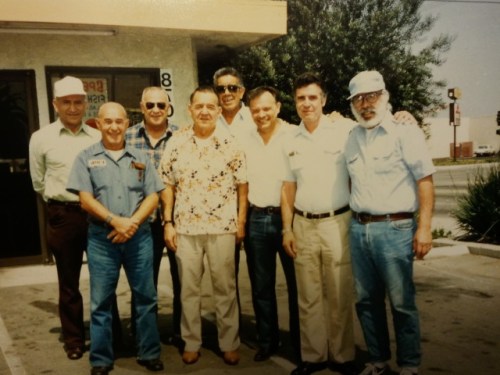
Dad posing with his trucking buddies. (He’s second from the right.)

I know everyone has an opinion on the election, and as I have throughout the long and ugly election season, I’m taking in opinions on both sides. Like many people, I don’t think my parents ever could have envisioned a President Trump.

But my dad was a proud working-class white man, a group that has been both condemned and revered in this election cycle. My father was also a proud immigrant. He loved his adopted country as much as he loved his homeland of Northern Ireland. My father worked with all races and got along with everyone. He was human and did have his prejudices, but my father accepted anyone who came into the country legally who wanted to work hard to make this country a better place and to improve their own life in the process.

So I’ve thought a lot about my dad this week, and about some of the stereotypes that have been associated with the working class. My dad had simple tastes but he had a thirst for knowledge and an impressive understanding and deep interest in world affairs. He was more than meets the cover, and I bristle at the thought of him being lumped in with some of the unfavorable labels of the working class, such as rednecks and white trash.

As I’ve mentioned before, I’m a journalist who was required to cover quite a bit of the election. In the days since the election, the media has been criticized for getting it so wrong, and for being so out of touch. I would have to agree with that, for the most part. I feel like the media group I work for went out of our way to be fair and balanced in coverage, and the fact that we are spread out geographically addresses one of the other post-election criticisms: that most members of the media live in bubbles in New York City or Los Angeles.

In addition to doing a deep research dive into both parties and their supporters, I talked to people in my travels this year. I had extensive discussion with shuttle drivers, who happened to be conservative, and they had many interesting insights. The overall impression that I came away with is that there is a group of Americans who feel forgotten.

I’m not going to argue that Trump is the answer to the working class man’s problems, or that Clinton would have ignored them. I can only control my actions, and I am choosing to be more thoughtful of the working class, which doesn’t just include white men of course, but men and women of all races, religions and cultures.

My mom taught me not to take service people for granted, and that was an important lesson. I saw my father toil to earn very modest wages that kept us afloat in a  lower middle class lifestyle. It seems easy for Americans to lash out at the wealthy, but we should focus more on those who have been ignored and devalued.

As caregivers, we understand these lessons all too well.


2 Comments

Filed under Awareness & Activism

Aging in place not just about home’s interior

condo-water-heater

The “portal to hell” aka the crawlspace where the water heater is located.

As I wrote about in my last post, caregiving can give you tunnel vision, and while I was busy tending to my mother’s every health need, I overlooked some basic household duties, like changing that darned furnace filter.

But another thing I had to deal with on my recent visit to what was my parents’ condo made me realize that aging in place is not just about retrofitting a home’s interior. When I arrived and turned on the kitchen faucet, I immediately noticed that the hot water had a very strong sulfur odor. I Googled the issue and found that it is common in cabins and other kinds of vacation rental homes, where the water sits unused for long periods of time. Basically, the water sitting in the water heater tank is an ideal incubator for bacteria, which, while harmless to humans, creates that godawful rotten eggs smell.

The simplest solution involves flushing out the water heater with bleach or hydrogen peroxide, which kills the bacteria.

As I searched for plumbers, I began to wonder, where the heck is the water heater?

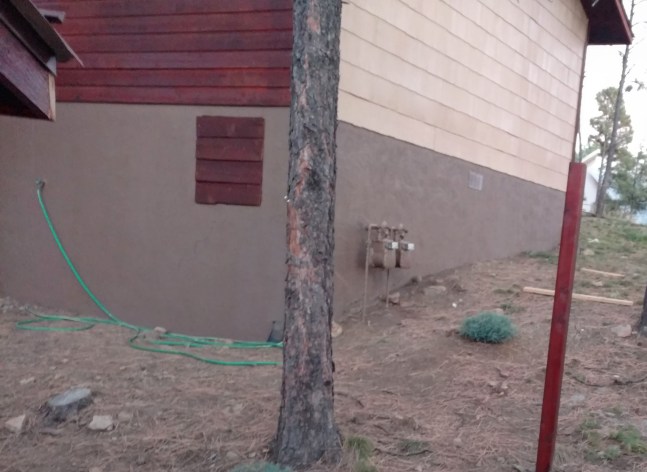
By process of elimination, I figured the square door underneath and to the side of the condo must be where the water heater was located. The photo above is actually a neighbor’s unit, but it looks just like mine. What I couldn’t picture was how a water heater fit in such a small space.

When the plumber came out, the mystery was solved. The wood door had to be unscrewed with a power tool, and then the plumber, a pretty tall guy, angled his way through the portal. I stuck my head inside and saw that the crawlspace was quite large, the entire length of the two condos that are connected together. There were several discarded water heaters under there, a virtual graveyard. The plumber wanted to show me how the water heater was leaking, which required me to climb inside.

I wasn’t sure I was going to be able to do it; I’m not claustrophobic and am in decent shape but I am clumsy, and this was a very awkward hole to crawl through. Somehow, I managed to squeeze through without injuring myself, then was immediately concerned about how I would get back out.

The plumber told me I could flip the breaker on the water heater when I was headed out of town so I didn’t have to crawl back down there. That was another adventure, finding the circuit breaker. It was located in a storage closet outside the condo, and inexplicably placed in the back corner, meaning you had to be careful about what you stored in the closet so you could squeeze your way to the back and reach the breaker panel.

The entire debacle made me think about aging in place, and how important it is to examine the exterior and the interior of the home your aging loved ones are residing in or wish to move to, and look for red flags like this bizarre water heater setup. Take into account things like stairs, crawlspaces and anything else that is difficult for someone with limited mobility to access. Ideally, a homeowner would have convenient access to things like the furnace, the water heater, air conditioner, circuit breaker, etc. in case of emergency.

It’s definitely something I’ll think about when looking for a retirement property. No creepy “portals to Hades” for me!


Leave a comment

Filed under Awareness & Activism

Ways to battle wandering

caregiver-guide-to-wandering

One of the most frightening aspects of my dad’s dementia was his tendency to wander. It is unfortunately a common symptom of Alzheimer’s and other dementias. It can place people in life-threatening situations. In fact, a gentleman with Alzheimer’s in the same town where my parents retired wandered away from his home one winter and died from exposure. He’d fallen into a ditch and had gotten tangled in some weeds and brush.

Fortunately, my father’s wandering never led to physical danger, but it did scare my mom and I. On a few occasions, my mother had to call the police, who were wonderful about tracking my father down, but it was nerve-wracking until he was home. It also became impossible for my mother to take my dad on any errands, because she couldn’t trust him to wait for her. One time he wandered away while she was in the dentist’s chair, and ended up at a fast food restaurant a few doors down, which he claimed was full of spiders. Another time, he wandered away from McDonald’s while my mother was in the restroom. The police found him near the drive-thru.

When I was contacted on Twitter about A Caregiver’s Guide to Wandering, I was interested in learning more. The guide was inspired by Sergeant Jacqueline Fortune of the Harris County Sheriff’s Office in Houston, Texas, who’s department was using Boerner, Inc.’s McGruff Safe Kids ID Kit to address wandering calls in the area they serve. The company decided to create a guide to help caregivers cope with the specific wandering issues associated with dementia.

The 12-page guide offers innovative, concrete tips on preventing wandering as well as developing an action plan to implement when a wandering incident occurs. The guide is designed to be used by agencies — it is in use in the VA Hospital in Palo Alto, California and in agencies in thirteen other states, including several Area Agencies on Aging.

I believe this guide could be useful to every dementia caregiver. If you know of an organization that works with the aging in your community, recommend A Caregiver’s Guide to Wandering as a resource for dementia caregivers.

Full disclosure: I received a complimentary copy of the guide for this review.


1 Comment

Filed under Awareness & Activism, Memories

Will a dementia wonder drug suffer from price gouging?

color pills

If and when a medication that reverses and/or prevents dementia arrives, will anyone but the wealthy be able to afford it? I’ve been pondering this question ever since the pharmaceutical company Mylan was roundly criticized for drastically increasing the price of EpiPens, the common treatment used for severe allergic reactions.

As with Turing Pharmaceuticals and its 5,000-percent increase for its toxoplasmosis treatment Daraprim, Mylan issued a significant price hike for a drug that had been on the market for quite some time. But what about new drugs that are medical breakthroughs for diseases that have proven elusive to treat?

Let’s face it, a medication that could effectively treat dementia would be one of the major medical breakthroughs of modern times. (Of course we must consider that there are several forms of dementia, so a medication that can target Lewy Body Dementia may not work in Alzheimer’s patients, and vice versa. )

Focusing on Alzheimer’s disease, the demand for a proven effective treatment is going to be huge. In an NPR interview about how drug companies price their products, an expert reveals the main factor is how much are people willing to pay for the drug. The interview focuses on Gilead Sciences and its drug Sovaldi, which can cure hepatitis C in most cases. The medication was much more effective than anything else on the market at the time, and hepatitis C can cause serious health issues if left untreated. The medication only needs to be taken an average of 12 weeks, so the price per pill was higher than it would have been for a treatment that took longer. You may have seen the headlines, “A $1,000 pill.” It was true that Sovaldi was priced at a total of $84,000 per bottle when it launched in 2014, though thanks to competition and public outcry, it costs about half that now.

So how much do you think families who have a member battling Alzheimer’s will pay for a medication that could restore their loved one’s sanity? It’s easy to say that a cure is priceless, but in reality, there is a price tag on everything. Perhaps the more interesting question is if the government should step in and regulate prices in such cases, in the name of public health.

I know that if an Alzheimer’s cure pill had been available while my dad was alive, at the prices listed above, we would not have been able to afford it unless Medicare paid for most of it. While I am a firm believer in the free market, I also don’t think any family should have to let a member die because they can’t afford medication.

What are your thoughts? Should medical breakthrough drugs be more heavily regulated to ensure access to the general population?

7 Comments

Filed under Awareness & Activism