Category Archives: Awareness & Activism

Guest article: Preparing for at-home care for a loved one with dementia

By Helen White, freelance writer

The decision to try at-home care for a parent or other close relative with dementia isn’t one that’s made lightly. It’s exhausting work, both mentally and physically, and it can be heart-rending for children of parents with dementia to see the changes that the disease brings. If you’ve made the decision, there’s a lot of preparation to be done, both in the home, to create a safe environment, and in the heart, to help you stay strong and able to cope with your new role as care-giver.

Simplifying the Home and Improving Safety

For someone with dementia, even the simplest everyday tasks and items can become fraught with difficulty. Simplifying the home, reducing clutter, and making spaces more accessible is hugely important to prevent over-stimulation and agitation, as well as accidents that may lead to physical harm.

  • Create “walking paths” so that there’s a direct and easy-to-follow path between each room. Remove or tack down any rugs on the floor.
  • Reduce household clutter, both to prevent accidents and to reduce the likelihood of over-stimulation caused by information overload.
  • Improve lighting to reduce dark spots and shadows, which can cause confusion and distress.
  • It may be helpful to label certain areas and items; for example a “bathroom” sign, and labels for kitchen drawers.
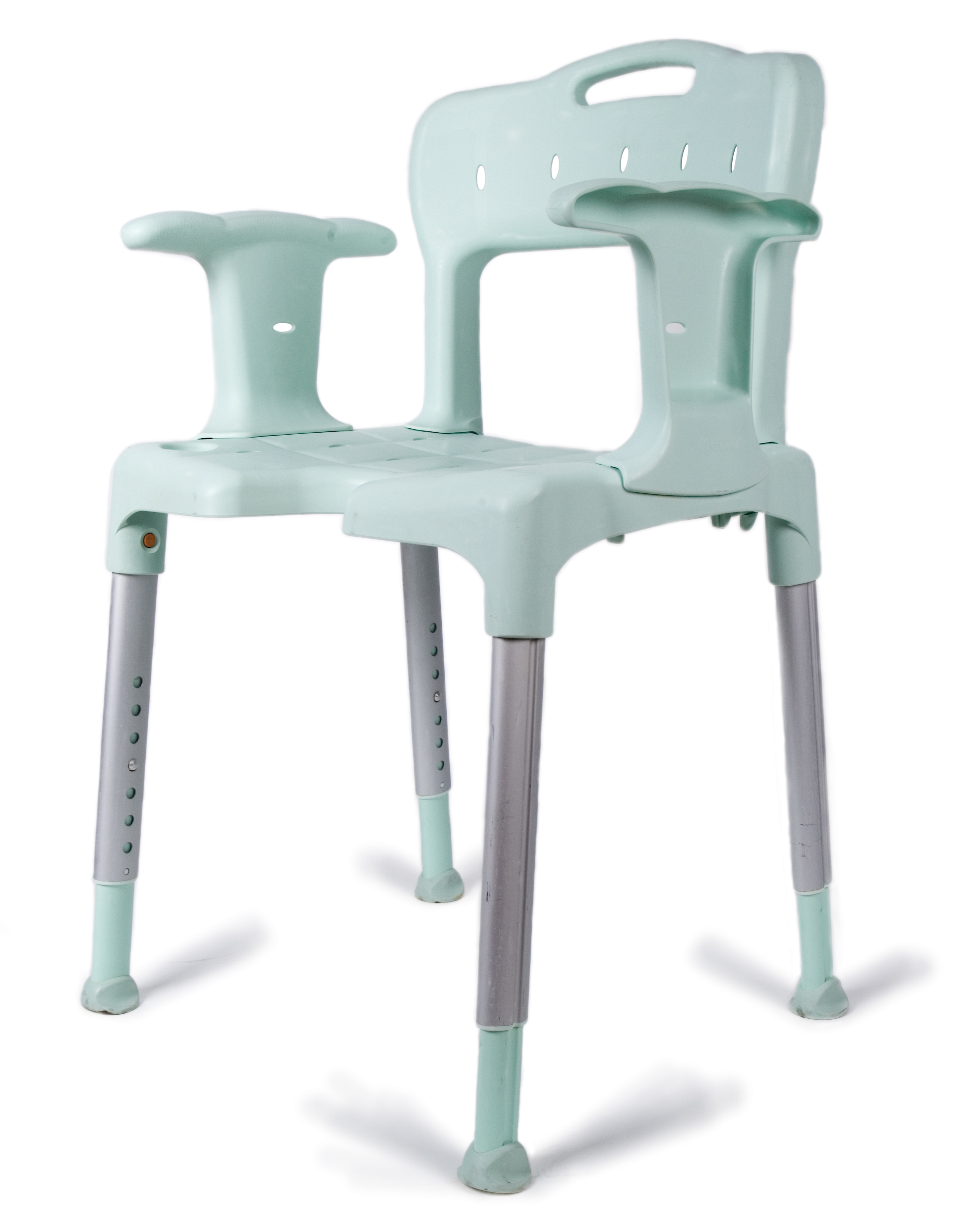
  • Add grab bars where applicable in bathrooms (e.g. for the bath, shower, or toilet) and add non-slip flooring or mats.
  • Consider child-proof locks for electrical devices and wall outlets.
  • Secure any rooms or items that are potentially dangerous or breakable—for example, the garage, basement, attic, or swimming pool, computer equipment, and machinery.
  • Add safety locks to any doors that lead outdoors, and install window devices to limit how far they can open.

shower chair

Preparing the home is sometimes a matter of trial and error: you don’t know how your loved one will react to certain things until they’re with you on a daily basis. Initially at least, focus your efforts on safety, and over time you may find there are additional changes you can make to the home to make things more comfortable and calming.

Setting Up a Routine

For someone with dementia, routine is incredibly important. Having a routine helps them make better sense of a world that is increasingly confusing, and it’s important that your loved one knows there are certain things they can rely on, like a mid-morning snack at the same time every day, or a favorite television program each evening. In situations where their loved one has become agitated, having an established routine can also help a care-giver get things back on track and help their loved one calm down.

  • A routine doesn’t need to be strictly regimented and fill up an entire day; it should just provide the day with structure. For example, it might include:
  • Opening bedroom curtains at the same time every morning to signal the start of a new day
  • Meals and snacks, and medications, at scheduled times.
  • Daily activity time, visitors, outings.
  • Shower or bath time before bed.
  • Playing a relaxing piece of music at bedtime.

Don’t Neglect Your Own Self-Care

Caring for a person with dementia is both physically and mentally demanding, particularly for non-professional care-givers taking care of family members. It’s a situation that can lead to exhaustion, burn-out, and even depression on the part of the carer, so it’s vital that you’re able to take breaks on a regular basis, including days and evenings off. So, as part of preparing to bring your loved one home, try and set up a schedule of some kind, to make sure each person who is acting as carer has sufficient time off.

Having a good support system in place from the start is also very helpful. For example, joining a support group for care-giving families can provide a means of expressing emotions in a safe and non-judgmental environment. This is hugely important, because it’s natural for care-givers to feel negatively-perceived emotions like frustration, fear, and sadness, and they need a safe outlet in which to express them.

References

A Place for Mom (March 2013). “Maintaining Dignity for Dementia Patients.” Accessed January 12, 2015. Caring with kindness.

Carol B. Larkin (May 2012). “A Guide to Safe-Guarding Your Home for Alzheimer’s Patients.” Accessed January 12, 2015. Simplifying home and routine.

Aging Care. “Senior Care Products.” Accessed January 12, 2015. Products for at-home senior care.

Help Guide. “Dementia and Alzheimer’s Care: Planning and Preparing for the Road Ahead.” Accessed January 12, 2015. Preparing the home.

Phillips Lifeline (May 2014). “Proper Dementia Care Can Help Patients Remain at Home Longer.” Accessed January 12, 2015. Benefits of at-home care.

Psych Guides. “Living With: A Family Member With Dementia.” Accessed January 12, 2105. At-home care.

Visiting Angels. “Preparing the Home for Senior Care with Dementia or Alzheimer’s. Accessed January 12, 2015. Home preparation.

Leave a comment

Filed under Awareness & Activism

Book review: ‘Slow Dancing with a Stranger’

You know you are a caregiver or an Alzheimer’s awareness advocate when books like this appear on your Christmas wish list.

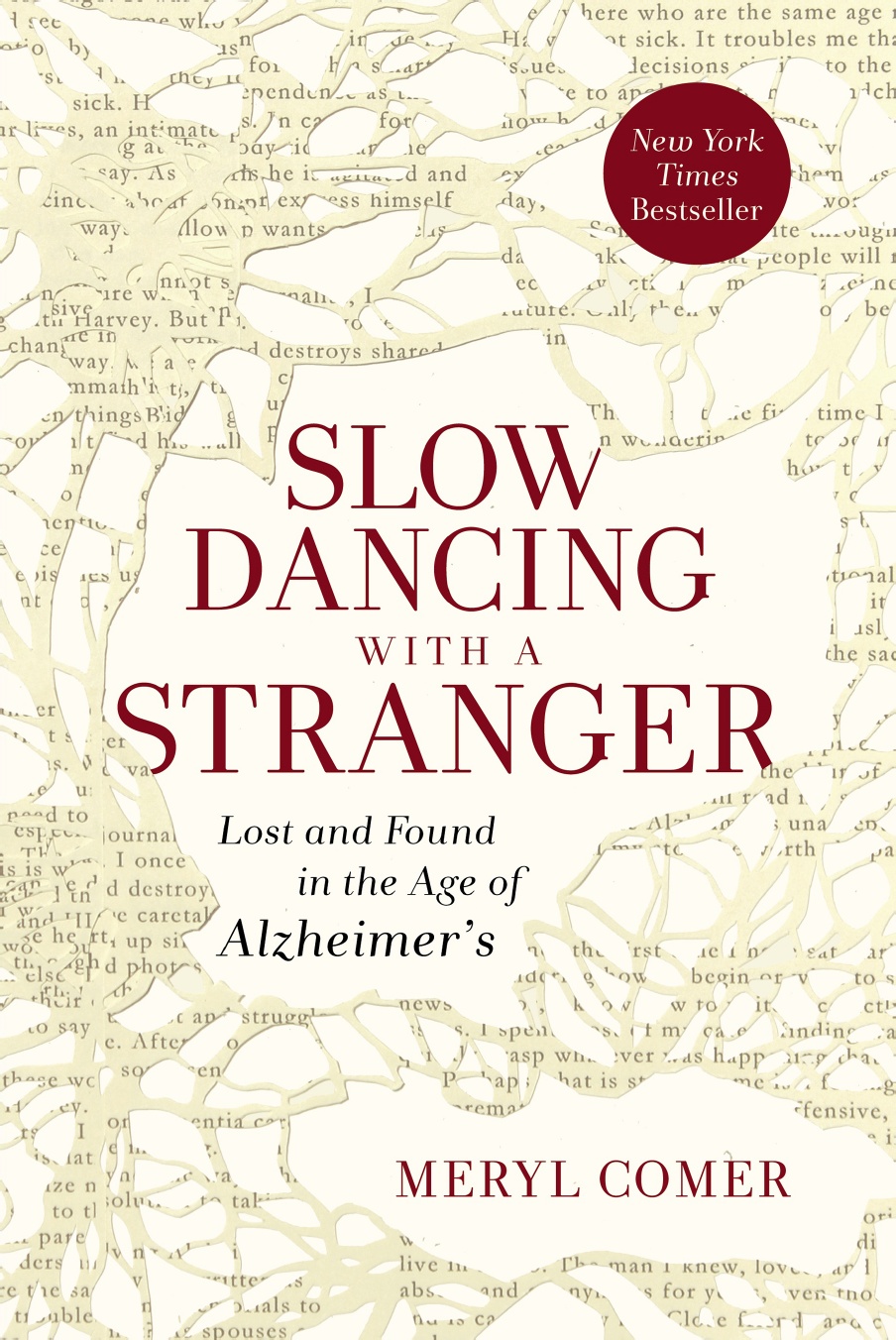
I had read positive reviews of the book, “Slow Dancing with a Stranger” by Meryl Comer, a former television journalist.

Courtesy: MerylComer.com

Courtesy: MerylComer.com

In this raw and honest memoir, Comer attempts to illustrate the “unvarnished reality” of Alzheimer’s while describing her life as the primary caregiver for her husband, a former esteemed NIH scientist who was diagnosed with early-onset Alzheimer’s in his late 50’s. He is still alive, 20 years later. Comer’s mother, who she’s always had a difficult relationship with, also has dementia and is still alive at age 94. The three live together, and a small group of dedicated caregivers work daily shifts to help with the care.

Comer tries placing her loved ones in facilities, but it is important for people to understand that not all Alzheimer’s patients are suitable for facility care, and that in fact, can be essentially “thrown out” if they are deemed a risk to themselves, staff, or other residents. Yet home care brings its own set of challenges, and neither road is an easy one to navigate.

I also think Comer does a good job of demonstrating that some people with Alzheimer’s don’t respond to the more positive therapy methods that are popular nowadays, such as music therapy, exercise, etc. Comer tries everything imaginable to reduce her husband’s anger and anxiety, but nothing seems to work. Comer’s husband has a form of Alzheimer’s that causes violent, physical outbursts, and both Comer’s husband and her mother were extremely manipulative, with her mother calling the police to claim she had been abandoned by her daughter.

I found beauty and awe in Comer’s resilience to take care of her loved ones in spite of all of the setbacks they faced together. Comer has given up her career and essentially her life to take care of her husband and mother. It’s a sacrifice that not everyone could make. To say this is a depressing book would be an understatement, but I hope it will help raise awareness of the debilitating emotional, physical and financial impact of this disease.

100 percent of the proceeds of the book will go towards Alzheimer’s research.

Leave a comment

Filed under Awareness & Activism

The beautiful and ugly world of Alzheimer’s

I read a lot of personal essays written by those who have been impacted by Alzheimer’s, but this one really moved me emotionally. It was published on Huffington Post and titled, “I Never Expected My Mother to Be Diagnosed with Alzheimer’s When I was 26.” Not only does the essay give us a glimpse into how the younger generations are being touched by this disease, it is beautifully written.

mirror person

In the essay, Rebecca Emily Darling discusses some of the upsides of her mother’s Alzheimer’s, such as a greater appreciation of ordinary things, and a nicer demeanor. Yet even these “benefits” are tinged with sadness, because they only illuminate how much the disease has changed the personality of her flawed but beloved mother.

The essay by Darling sums up the good and the bad of this disease so eloquently. If you have a chance to read it, let me know what you think.

1 Comment

Filed under Awareness & Activism

A sweet and simple connection

I watched a video that has been making the rounds on Facebook lately, and I thought it illustrated how we can still reach those in the latter stages of Alzheimer’s, we just have to be flexible in our approach.

Musician Joe Fraley’s mother has Alzheimer’s, and back in October, before she was moved to assisted living, Fraley recorded a video of him and his Mom sitting on the porch while he strummed a guitar and sang.

Clearly, the woman is confused and asks poignant questions like “Who are we?” Fraley’s approach is refreshing because he keeps things light and conversational, while still addressing her concerns and not being dismissive. The woman responds to the music, and you can see how it lights up her face, even if it is just temporarily.

Not only is it important for those with Alzheimer’s to still connect with their family members in small but meaningful ways like this, I believe it is equally important for the family caregivers. While the recorded moment is still tinged with sadness, Fraley was able to reach his mother through the cloud of dementia by their mutual love of music, and that is a memory to cherish.

2 Comments

Filed under Awareness & Activism

Guilty of a totally unnecessary caregiver panic attack

So about 30 minutes into my flight to visit my mom, I took my phone off airplane mode to enable my Bluetooth headphones. (I know, slap my hand, that is an in-flight no-no.)

When I did so, I noticed the voicemail icon was lit up. When I went to see the time the voicemail was recorded, it was when I was at the airport, so I was surprised that I had missed the call. When I checked the phone number of the missed call, it was my mom’s home phone number. In fact, there were two missed calls from her, about 30 minutes apart.

plane sky

If Mom was calling me early in the morning, something HAD to be wrong.

Even though I knew it wouldn’t work, I tried to access the voice mail. No-go, despite my phone still showing a 3G signal.

Fortunately, the plane did not suffer from any issues due to my actions.

But for the rest of the flight, I was frozen with terror. My mind began spinning with all sorts of worst-case scenarios. Knowing Mom has been suffering from this mysterious ailment (most likely a hernia) for some time, I feared she had developed more severe symptoms. She called me wanting to know if she should dial 911 and now was waiting in agony for my reply. Or she had called 911 and was being taken to the hospital and I was several hours from arriving! There was nothing I could do up in the sky but wait it out. I had a two-hour flight, but it seemed like 20 hours.

Finally, we land and I immediately turn my phone back on. I listen to the voicemail. It was from the airport shuttle, confirming my ride. Whew, ok, that was a relief. (They usually call to confirm the day before.)

But what about the mysterious phone calls from Mom’s number? I called her when I got inside the terminal and all was (relatively) well. She had not called me. When I thought back on it, there were no missed calls from the shuttle company. Somehow, my phone read the shuttle number as my mom’s number (same area code, but quite different numbers.)

The point of this story? Caregivers have enough real crisis situations to deal with. Don’t invent imaginary ones, especially when you up in the clouds, helpless to take action.

2 Comments

Filed under Awareness & Activism

National Caregiver Month: Honor a caregiver

In addition to being National Alzheimer’s Disease Awareness Month, November is National Caregiver Month. It’s only fitting for those of us who have cared for a loved one with dementia that these two recognition events occur in the same month.

While caregiving, both family and professional, needs much more recognition than just a designated month, this is a good time to get the conversation started about how important caregiving is to our society.

My mom, who was a wonderful caregiver for my father who had Alzheimer's.

My mom, who was a wonderful caregiver for my father who had Alzheimer’s.

The Alzheimer’s Association is marking the month by allowing people to write a personal tribute on their website.

I’m marking the month by making a visit to my mother, who has been dealing with some recent health setbacks. Caregiving in action!

To all of you in the blogosphere who have shared your caregiving stories, thank you. Together we can raise awareness and help each other through this challenging journey that is always full of surprises.

Leave a comment

Filed under Awareness & Activism

Home care workers raising hell for a good reason

One of the only positive things that has come from both of my parents suffering from serious illnesses is that I discovered the importance of home health care workers. Notoriously underpaid and given little respect, home health care workers in multiple states across America are finally raising their voices and demanding better treatment.

It may not take a college degree to help feed a patient or take care of their toileting needs, but it does take a certain amount of compassion, patience and emotional strength that many people seem to lack. Many home care workers are supporting families, and in America, it would be difficult for a single person to survive on the current minimum wage. Current laws in the U.S. allow home health care workers to be paid less than minimum wage. There is already a growing number of workers in the fast-food and other retail industries that are demanding the minimum wage be increased from a paltry $7.25 per hour to $15 per hour.

holding hands

While I feel $15 per hour is not going to be feasible in our economy, I could support increasing the minimum wage to at least $10. In addition, I would like to see some kind of tax break for home health care workers as an extra incentive to join this profession that is only going to grow in demand as our population rapidly ages.

I remember the kind, yet exhausted home care workers that helped care for my parents in their times of need, and I learned a lot from them. They offered practical, time-saving and thrifty solutions that I never would have considered. They were good-humored but firm when necessary, such as when providing care instructions. They negotiated difficult personalities and never seemed to take a break.

While raising the minimum wage for home care workers will have financial consequences and will require some retooling of already-strained state budgets, it is something that this country needs to understand is a priority. We’ve heard the unfortunate cases of home care workers who physically or mentally abuse their patients, and even steal from them. If these workers continue to be ignored, their resentment will only grow and our loved ones will suffer. Let’s reward those who are providing quality care to our family members and not allow this part of our workforce to remain invisible any longer.

If you are interested in learning more about the cause, Caring Across Generations is a great place to start.

3 Comments

Filed under Awareness & Activism

Fascinating study regarding cancer and Alzheimer’s

Because I had one parent who had Alzheimer’s and another parent who has battled cancer, I was intrigued by this study that explored the low rates of cancer in those with Alzheimer’s and vice versa.

maze

Researchers may have found a defect in a critical brain cell pathway that can lead to Alzheimer’s or cancer depending upon which way the imbalance of cell activity presents itself. This may help explain why Alzheimer’s patients have a lower risk of cancer and cancer patients are at less risk for Alzheimer’s.

Further studies will try to determine if activity can be boosted in the damaged cell pathways, which could potentially reduce the cognitive impairment in Alzheimer’s patients.

I always thought my dad was destined for cancer because of his smoking habit, yet he remained cancer-free, while my mom, who doesn’t have typical cancer risk factors ended up with colon cancer. While I’ve read of people who have had both diseases at the same time, it does seem pretty rare. Instead, we hear more about the cruel irony of the dementia patient who is otherwise physically healthy.

After all of the deaths and misery both of these diseases have caused, it would be wonderful to find an effective treatment for both of them.

Leave a comment

Filed under Awareness & Activism

“The Genius of Marian” an emotional, intimate look at Alzheimer’s

It may seem odd to say that a documentary about Alzheimer’s is beautiful, but there is much beauty in the family-made documentary, “The Genius of Marian,” as well as a great deal of love.

That’s what makes the devastation that Alzheimer’s unleashes on this one close-knit family so utterly heartbreaking.

Photo: geniusofmarian.com

Photo: geniusofmarian.com

The documentary is about two remarkable women, mother and daughter, both who end up with Alzheimer’s. Marian Williams Steele was a talented artist and vibrant woman. She was diagnosed with Alzheimer’s in the late 1990’s and passed away in 2001 at the age of 89.

Her daughter, Pam White, is equally fascinating. She is a beautiful woman with an amazing smile who was an actress and model. After her mother passed, White planned to write a book about her called, “The Genius of Marian.” Sadly, Pam herself was diagnosed with early-onset Alzheimer’s at the age of 61, just as she was getting started on the book.

Her son, Banker White, decided to make a documentary about these two remarkable women. He doesn’t hold back, showing the ups and downs that occur with Alzheimer’s, and how the family struggles and copes with the situation.

White’s husband is a testament to the power of love. He does an incredible job as caregiver for his wife, a role he was thrown into with no experience, like many family caregivers.

I don’t want to give anymore away because you really should see the film. The good news is that you can do so for free thanks to PBS, through Oct. 8. I watched it on the PBS channel on my Roku box. You can also watch it online. If you can, please consider donating to the filmmakers’ charity, The Genius of Caring.

Leave a comment

Filed under Awareness & Activism

Long-distance caregiving sucks

Mom has had a mysterious health setback, despite getting good results on all of her tests.

Trying to manage a health crisis from over a thousand miles away is beyond stressful. I know many of you understand.

Mom is tougher than she looks!

Mom is tougher than she looks!

On Labor Day, Mom called me to tell me she was calling 911. The pain in her back was just too much for her to endure any longer. After several stressful hours, I called the hospital and they said they were sending her home, that she just had a lumbar sprain and constipation.

Frankly, I didn’t believe their diagnosis then and I still don’t. Mom continues to feel lousy, though her back is a bit better. Her digestive problems continue, and I fear there is something going on with the colostomy reversal.

The next step will be more invasive tests, like a colonoscopy (ugh, she just had one done in December) or an endoscopy.

These tests usually require someone to be present with the patient. So now I’m looking at a last-minute plane ticket close to $1000 and who knows if the test will get us any closer to a true diagnosis, when the other battery of tests didn’t show anything? By no means am I saying that spending the money isn’t worth it if I can help Mom get the treatment she needs. It is just another sober truth of caregiving from afar. It is costly, both in the financial and emotional sense.

I know patient advocates exist but in my mom’s area, they seem to work mainly in the hospital setting, answering questions and dealing with paperwork. I wish there was a service where I could hire a professionally trained caregiver to actually go with my mom to the hospital, and be there with her during tests and procedures. The advocate would ask pertinent questions and then be able to report back to me what is going on.

In an ideal world, I would be there with my mom in all of these situations. But we don’t live in a perfect world, and I know there are many other seniors living independently who do not have family members or relatives living close to them. With our rapidly aging population, I feel this will become an even greater issue.

Every time these situations arise, someone always asks, “Why don’t you just move your mom in with you?” or “Why don’t you move closer to your mother?” These people mean well, but these are huge, life-changing decisions to make, and frankly sometimes it is simply not feasible. That being said, feelings of guilt and doubt linger.

One thing I am immensely grateful for: my new job can be done completely remotely, and my boss has given his blessings that I can work wherever and however I need to if I need to go care for my mom.

If you’ve had experience with long-distance caregiving, what resources did you find most helpful?

4 Comments

Filed under Awareness & Activism, Memories