As we enter the holiday season, where some will have more interaction with family members, it’s a good time to assess your family’s preparedness when it comes to aging well. Anthony Cirillo shared on The Aging Experience a “Longevity Preparedness Index” produced by John Hancock in collaboration with MIT’s AgeLab.
Courtesy of John Hancock
The Longevity Preparedness Index , surveyed over 1,300 Americans in 2025 to assess readiness across 8 top aging areas: social connection, finance, daily activities, care, home, community, health, and life transitions.
As Cirillo points out in his post, Americans didn’t fare well overall, scoring just 60 out of 100 for longevity preparedness. He offers actions people can take to increase their ability to age well, from growing social connections to having frank conversations about financial planning and life transitions.
The key theme is that the time to prepare is before one becomes older and before health issues need to be addressed. The one area in which Americans are least prepared is one of the most important when it comes to aging: care. Scoring just 42/100, the majority of those surveyed do not have a care plan and do not know who would take care of them if a health issue required assistance. Creating an advanced care directive is vital.
No one can predict the specific care needs you or your loved ones will require in the future, but considering these critical area of aging can help families be more prepared and make smart decisions that will offer them the best chance of aging well.
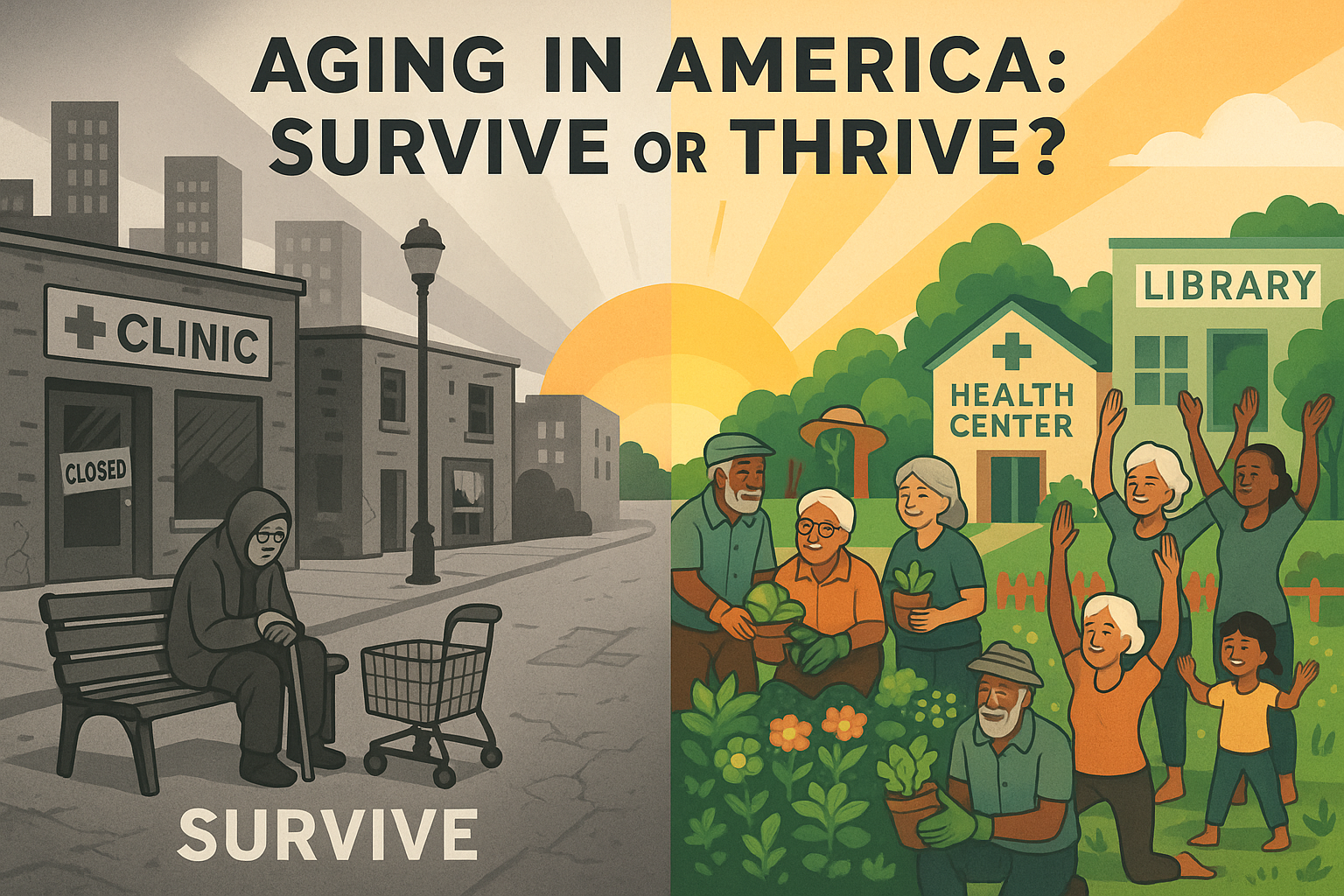
There’s a new documentary about aging, Aging in America: Survive or Thrive, that is airing on PBS for the month of May, which is Older Americans Month. The documentary marks the 50th anniversary of the publication of the Pulitzer-prize winning book “Why Survive? Being Old in America” by Dr. Robert Butler.
While the number of Americans over the age of 65 has more than doubled during the last five decades, in part due to medical breakthroughs, the financial stability of older Americans continues to erode. The documentary notes that older people are the fastest growing group of homeless people in America. Older homeless people may find themselves in that situation for the first time in their lives, after a job loss or medical emergency. The film highlights one such case in which a woman, who was a nurse, ended up living in a moving van for almost a year after being diagnosed with cancer and spending her life savings on treatment.
There’s also a touching segment about a wife caring for her husband with Alzheimer’s in Wyoming, and the challenges of dementia care in an isolated rural environment with limited medical services.
The documentary highlights the organizations that are doing commendable work in addressing the needs of the older population in their communities. From providing meals to companionship and aging in place assistance, these organizations provide critical services to older Americans.
America’s preoccupation with youth hasn’t changed much in the 50 years since Dr. Butler noted that bias in his book. The field of geriatrics continues to struggle to attract new doctors. We don’t have nearly enough care workers to tend to our rapidly expanding older population.
Filmmaker Neil Steinberg said in a Next Avenue interview that he wants to encourage people to “rethink aging” after watching the documentary.
“We need to give people the opportunity to live their later years in dignity,” Steinberg said.
September has arrived and I’m ready for summer to be over! One of the best things about cooler weather is that it encourages me to be more active outdoors.
It’s no secret that middle age ushers in physical changes to the body, many unwelcomed. I’ve already had to address elevated cholesterol levels and I just turned 50. Fitness is something that I’ve taken for granted, because for most of my life, walking has been part of my daily routine. It still is, but the only downside in working from home is that my built-in exercise of walking to and from work has been eliminated. I walk my senior dog twice a day, but while our slow meanders around the block are good for my emotional well-being, they don’t offer the same physical benefits.
Good physical health as one ages isn’t just about weight, though you may have noticed that as you get older, it’s harder to lose a few extra pounds. Staying active can help reduce the risk of dementia, as well. Health.gov has an initiative called “Move Your Way” which encourages one to engage in physical activity they enjoy. Instead of forcing yourself to the gym if that’s not your cup of tea, take a walk in nature, or a dance class. I like this approach as it makes being active more accessible to everyone.
For me, yardwork is an effective, whole body workout that offers a mix of cardio, strength, and flexibility training. Don’t overlook the power of household chores! Sweeping, mopping, scrubbing, etc. all count as physical activity. Aim for a healthy mix of exercise that will help you maintain a healthy weight, as well as muscle strength, flexibility, and balance to prevent falls. The key is to find physical activity that you enjoy, so you’ll have an incentive to make it part of your health routine.
Image courtesy of U.S. Department of Health and Human Services.
Changes in speech and word recall can be among the earlier signs of cognitive decline. We’ve all experienced this, no matter what the age: “It’s on the tip of my tongue!” While not always a precursor to Alzheimer’s or other forms of dementia, it’s important to recognize changes and talk to your doctor about them.
A recent study, albeit with a small sample size of 125 people, shed new light on what is a frustrating yet common complaint among older adults: difficulty in finding words. Among the findings: “Overall reaction time for word retrieval (controlling for psychomotor slowing) was the best predictor of spontaneous WFD (word finding difficulty) and executive function decline, suggesting processing speed as the key factor, and that verbal reaction time may be an important clinical measure.”
AI software was used to extract data such as speech speed, word variety and pauses in speech, according to The Conversation report. The study participants also completed a series of tasks designed to gauge executive function ability, and the results found a link between age-related decline in executive task ability and speech pace.
The findings are interesting but of course more research will be needed with a larger study group. If confirmed, the findings could help in forming more accurate tests for cognitive decline.
There are so many excellent documentaries about caregiving that have been released over the last few years and I’d like to highlight a recent entry, “Duty Free.” It’s about a woman named Rebecca who gets fired from her job at age 75 and is facing a dire housing and economic situation while caring for a son with mental health issues. Her other son, a young filmmaker, uses the challenging moment as an opportunity to help his mother complete a bucket list of adventures and experiences she never got to enjoy as a single immigrant mother raising two children. What transpires are moments of joy and heartbreak as Rebecca forges a new path for herself while addressing her past.
I found this documentary to be very moving while spotlighting an issue that more and more elders find themselves facing. Retirement is becoming less of a certainty as rising economic insecurity means more and more older people will continue to work their entire lives. Rebecca immigrated to this country when she was young and worked hard all of her life in the hotel industry, working her way up to a supervisor position in the housekeeping department before being fired at age 75. Her housing arrangement was also nullified as the result of her job termination, so Rebecca was facing dual hardships. We know from studies that starting around age 50, women in particular find it much harder to secure employment or move forward in their careers. At Rebecca’s age, though she is still vibrant and physically active, the job search is even more grim.
The film also is about caregiving, as Rebecca financially supports her son who has schizophrenia and is unable to work. So many older people find themselves supporting their adult children for a variety of reasons, and that adds to their own economic insecurity. Her other son, Sian-Pierre, is limited in financial resources but does offer something priceless, which is encouraging his mother to do all of the things she never had time to do while raising children and documenting his mother’s story for the world to see.
I encourage you to watch this film and share with others. If you have seen it, I’d love to hear your thoughts.
I totally agree with this! It serves as a good reminder to all of us, and especially those of us who work in the media world, to use person-centered language and not associate someone solely with their disease. Alzheimer’s and other forms of dementia take enough from a person without us contributing to the problem.
Let’s talk about patients. You probably think that’s a typo. I know that it’s not rare to see a typo in my blog. You probably think I meant patience–but I didn’t. I want to talk about dementia “patients.” First, an analogy… My husband, Bill, has had terrible acid reflux since adolescence. He takes medication everyday. […]
I haven’t been shy about my professed loved and admiration for “Miss Norma” Bauerschmidt, who at 90, became an internet sensation when, instead of undergoing grueling treatment for uterine cancer while dealing with the recent death of her husband, she told her doctor, “I’m hitting the road.”
Norma joined her son and daughter-in-law in a motor home for an epic trip around the U.S., where she was welcomed like a celebrity everywhere she stopped. While Norma’s symptoms were managed quite well on the road, her cancer progressed and she died on September 30, 2016.
Her story has touched millions around the world, and I couldn’t be happier about that.
Norma’s story touches upon many topics that are near and dear to my heart. First, the “treatment without question” mentality that pervades the American health care system got turned on its head here. The doctor was taken aback by Norma’s reaction at first, but admitted that his own treatment recommendation would have set up Norma on a long road of recovery that she may not have survived. Instead of spending months in a skilled nursing facility recovering from major surgery and being sick from chemotherapy, Norma chose quality over quantity for the remainder of her life.
The highs and lows of caregiving are poignantly and honestly discussed in this book. Norma’s son and daughter-in-law don’t shy away from the challenges that family caregiving poses, which are only complicated when mixed with an unpredictable life on the road. Norma’s son and daughter-in-law weren’t experienced caregivers before taking on Norma, and their “nomadic by choice” lifestyle had to be adapted to Norma’s abilities and health challenges. Ultimately it was an experience that they wouldn’t trade for all the world, but I appreciate their openness in discussing their caregiving experience.
What was most surprising to me was how, according to her son, Norma was not known as the “wild gal” that we saw on Facebook who would make funny faces for the camera or who took delight in quirky tourist spots. Norma, a quiet, stable presence in the family, had been content to live in her husband’s shadow. But once on the road, a new side of Norma emerged. This may be the most important lesson of all in the book. It is never too late to find oneself.
By late summer, it became apparent that Norma’s trip through this life would be coming to a close soon. Being on the road presented some unique challenges, but Norma passed on as comfortably as is possible, surrounded by love and fulfilled in a year’s worth of joyous sights and experiences. For everyone seeking that elusive “good death,” I think after reading this book you will conclude that Norma had a good one.
Obviously, not all of us have adult children who could accommodate such an epic life’s end journey. What we can take from the book is that when faced with what could have been an overwhelmingly depressing moment in her life, coping with the death of her husband and a cancer diagnosis, Norma chose to embrace optimism. Norma chose adventure, to let go of any old grievances and open her heart to new people and experiences. One of the catchphrases for Norma’s journey is, “Say yes to living.”
This Saturday, I turn 40. I’m not one to worry about wrinkles or grey hairs. My recent physical showed that I’m in good health for now.
But considering the health issues that have impacted my family over the last several years, I can’t help but worry.
It is somewhat ironic that if you had asked me before my parents became sick, I would have chosen Alzheimer’s and cancer as the diseases I dread most. Little did I know that I would have to face both diseases head-on, with dementia striking my dad and colon cancer striking my mom. I always figured Dad would get cancer, being a smoker since he was 16. Mom doesn’t smoke and eats a mainly vegetarian diet, and she gets colon cancer. Go figure.
With Mom’s health in the balance again, it’s not really feasible to make concrete plans for my 40th year, let alone the next decade of my life. But then again, if life has taught me anything over the last few years, it is to live in the here and now.
Still, there are a few wishes I have that I hope I can make come true over the next decade of my life.
I want to write a book. Whether it be memoir, fiction, or self-help, I’m not sure yet. Maybe one of each! I’ve lit my creative flame again over the last few years, but I know it will take hard work and focus to keep it glowing. And yes, I do want to publish the book, even if I have to go the self-publishing route. I plan on signing up for a writer’s workshop this fall.
I want to visit my father’s homeland, Ireland. I had planned on doing this in my 30s, or as a special gift on my 40th birthday, but alas, that is not going to happen. But I can still make it happen over the next few years. Making that family connection is important, and I think will hold greater meaning for me now than ever before.
I want to continue and expand my Alzheimer’s awareness work. In particular, I would like to do more hands-on advocacy work.
I’ve been through many life-changing events over the last decade, and I’m sure I will face more moments, both good and bad, over the next decade. My 40th birthday wish is that I approach these moments with a bit more wisdom, and much more compassion.





![Pageflex Persona [document: PRS0000038_00069]](https://memoriesproject.files.wordpress.com/2014/02/reluctant-caregiver-cover.jpg)






 The Memories Project