Tag Archives: Alzheimer’s

Dad’s infamous cat rant

In honor of what would’ve been my father’s 84th birthday, I’m publishing the infamous “cat rant” that prompted a viral response back when we argued with each other in newsprint, not online.

I had been searching online for the letter for years, but as I was putting together a scrapbook for my dad, I came across dozens of letters to the editor clippings. The cat letter, along with the responses it generated, was in the pile. I was ecstatic.
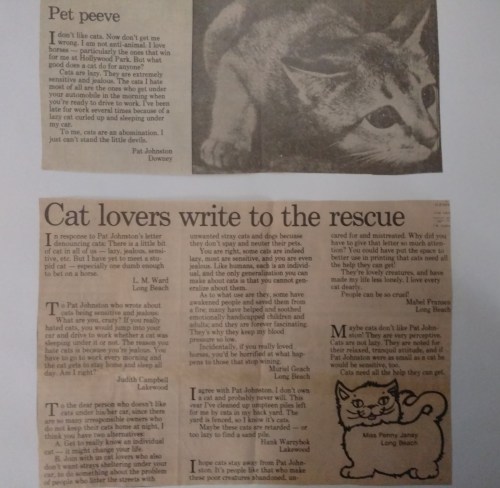
dad cat letter

The funniest thing is that I thought the letter my dad wrote was much longer and talked about how the stray cats would hang on the back fence of our patio and intimidate people taking out the garbage or going to the laundry room. Maybe Dad’s original letter was longer, and was edited for space. But reading it now, and admittedly a huge cat lover myself, it doesn’t sound as bad as I remembered.

You can zoom in with your browser if you want to read the details. Basically Dad says he doesn’t like cats, that they don’t do anything good for anyone, and that cats are lazy, sensitive and jealous. He also laments being late to work because of a cat curled up under his car. He finishes the rant by saying that cats are an abomination. “I just can’t stand the little devils.”

But the responses are great! Who knew there were so many crazy cat ladies (and I use that term endearingly as I am one) in the Los Angeles area in the 1980s? And the fact that it prompted one of the newspaper’s columnists to write his own editorial response is fantastic. His criticism that readers get more outraged over someone who doesn’t like cats but ignore the wars taking place around the world still applies today.
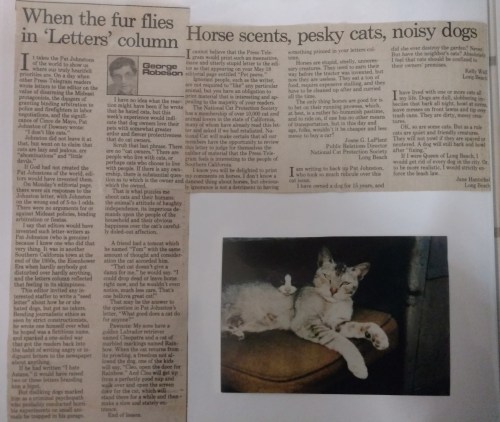
cat letter response_edited


The image of the mother cat and her kitten is included to show how my dad’s opinion on cats changed over the years. When he was working as a security guard at a trucking company, he met a stray cat that everyone called Bonita. The cat may not have been the most beautiful, but she touched my dad’s heart. When she became pregnant Dad made sure she had enough food to eat. Even after he no longer worked there, he’d stop by and leave her some canned food for her and the babies.

As Dad’s Alzheimer’s progressed, he would ask me how my cat “Missouri” was doing. (My cat’s name was Michigan.) So in the end, Dad turned out to like the “little devils” quite a bit.

Leave a comment

Filed under Memories

Medical studies are important, but results may be deceiving

As caregivers, we are always interested in reading the latest and greatest study on whatever condition our loved one is afflicted with. For me, I read a lot about Alzheimer’s and other dementia forms, as well as colon cancer, because those are the two conditions that claimed my parents’ lives.

Since I also work as a journalist, I know all too well how the latest studies become alarming headline fodder to generate page views. Recently, I wrote how a new study was completely misrepresented by certain media outlets, which ran with the headline, “Is Alzheimer’s contagious?” or some variation of that theme.

bacon

The scare study of the week is about processed meats and increased cancer risk. “Bacon is as bad for you as cigarettes” was a typical headline I saw today. But a deeper dive finds that the World Health Organization doesn’t actually rank what they determine to be carcinogens, so while cigarettes, processed meats, and asbestos may all be defined as known carcinogens, the risk of disease and death likely varies.

WHO does track death statistics and those would indicate that smoking still claims more lives than those eating hot dogs. So is eating hot dogs probably bad for you? Yes, if you indulge on a daily or regular basis. And while yet another recent study indicates that food can be addictive (pizza being the most addictive), cigarette smokers are likely to smoke many more cigarettes than people will eat slices of pizza or scarf down hot dogs on a daily basis. The more you are exposed to a carcinogen, the higher your risk of cancer, studies would suggest.

Another interesting twist on parsing these studies comes from the New York Times, which analyzes a study about how honey is no better for health than sugar. Despite the tantalizing headlines, the study group was alarmingly small and the study was very short-lived, making the results less reliable.

My mom disliked processed meats and red meat. She ate little meat, and was mainly a vegetarian. She didn’t smoke. Yet she ended up with colon cancer, which is the main cancer associated with these processed meat studies. So diet is no doubt important, but it isn’t everything. Sometimes, disease strikes at random.

You don’t have to be a health nut to know that bacon and hot dogs are not the healthiest nutrition choices. Enjoy in moderation, and instead of reading and worrying over the latest health study, get out and exercise or enjoy your favorite hobby.

2 Comments

Filed under Memories

Signs you cannot ignore

On Saturday, I went to pick up my writing award. It was a nice presentation. Each of the awards is named after a famous author, and the contest organizers revealed what each author said about the winning entries. Rick Bragg said about my essay, “Strong, really strong. Made me choke up.”

Hopefully that validation will help motivate me to finish the book that I’ve been working on over the last few years.

Joy writing award

Just before I left for the ceremony, Mom’s burial flag arrived in the mail. (Even though we had her cremated, she was entitled to a flag for her Navy service and I thought it would be nice to have in a memorial display for her.) I had to take that as a sign that she was watching the day’s events, ever the proud Mom.

And if Mom was watching from the other side, so was Dad, as she wouldn’t have given him a choice! It is a bit odd to celebrate a piece about my dad’s battle with Alzheimer’s, but I know Dad would have been proud of my award too, as he secretly wanted to be a writer, and loved to read. I think he would have forgiven me for making him the subject matter.

Monday marked the four-month anniversary of my mother’s death. While life has moved on and I with it, I still find myself hitting those potholes filled with “I should have done this” or I could have done xyz better” thoughts when it comes to my mom’s care.

I know the road will smooth out eventually. In the meantime, I’ll keep looking for signs and keep moving forward.

3 Comments

Filed under Awareness & Activism

Is the media misleading the public on Alzheimer’s?

It seems to be a mixed blessing that the media is paying more attention to Alzheimer’s.

On the one hand, the spotlight on a disease that has long been kept in the shadows is welcomed. But modern journalism’s need for clicks sometimes leads to misleading headlines, which only hurts the awareness movement.

Brain

Recently, a study came out which demonstrated in a very small sample of autopsies of 8 people who had been diagnosed with the rare brain disease, Creutzfeldt-Jakob disease related to growth-hormone treatment, 6 of the 8 showed an increase in amyloid plaque that scientists believe is linked to Alzheimer’s.

It is certainly an interesting study, and the results were unexpected, but there are not any solid takeaways until larger studies can be performed. Yet, in the click-crazy world of online journalism, some outlets ran with the headline, “Is Alzheimer’s contagious?”

I’ve read accounts from those with Alzheimer’s who criticize the use of the term “Alzheimer’s sufferer” because they are doing their best to live successfully with Alzheimer’s and sufferer sounds like there is no hope with anyone with the disease.

I might be guilty of using the term “suffering” when describing my Dad’s experience with Alzheimer’s, but that’s because I truly believe he was suffering. I don’t think it should be used as a blanket term, especially for those in the early stages of the disease.

As a journalist, I try to be aware of these considerations, but I encourage everyone to politely correct those who provide misinformation on Alzheimer’s or any other disease.

The old expression of “all publicity is good publicity” may be true for Alzheimer’s, but it is the responsibility of advocates to make sure the coverage is accurate.

4 Comments

Filed under Awareness & Activism

The $1,800 jacket

Always check pockets before donating or discarding clothing, especially when it belonged to someone with Alzheimer’s!

I have written previously about how Dad was obsessed with money. He carried around a bag of change and would dump it on the bed to sort it. He was paranoid people were trying to take his money so he carried around a large wad of bills wherever he went. The staff at the library Dad frequented told me about this, how they would try to tuck it back into his shirt pocket as it threatened to fall out at any moment.

dad jacket

This behavior is common to those with Alzheimer’s. So is stuffing things into the oddest places.

I finally tackled my parents’ clothes closet in earnest. I thought I had gone through my dad’s jacket pockets on a previous trip, knowing full well his tendency to hide things. We found an old family photo under the couch cushion, and I found letters and photos tucked inside junk mail.

I pulled out one particularly heavy and ratty old coat. I set it down on the junk pile and heard what sounded like the jangling of change. At the same time, I saw a bulge in the pocket. I reached in and pulled out a bag of coins, a lighter, and a large wad of bills.

The bill on top was a $100. I could also see dollar bills and foreign currency in the roll. I figured, okay the top bill was a $100, but the rest will probably be smaller bills.

Well, there were a lot of dollar bills and pound notes, but I was shocked to find the wad of bills was worth over $1,800!

This will make a small but noticeable dent in my credit card debt, so I am very grateful to have discovered it.

When caring for those with dementia, what appears to be trash can certainly turn out to be treasure!

1 Comment

Filed under Memories

A birthday missing a song

Today is my birthday, and I have to say I don’t mind being a year older. At least it offers me a symbolic new start, as 40 was one of the most difficult years of my life.

I’m having a lovely time in the mountains, but there is of course one thing missing. As I’ve mentioned previously on this blog, my parents always made a big production out of singing “Happy Birthday” to me over the phone.

I have a poor recording of Mom singing “Happy Birthday” to me last year, recorded from my cellphone. It’s only barely listenable, but I’m glad I have it.

I do have a good video and audio version of my parents singing “Happy Birthday” to me, but sadly, it was when Dad was rapidly declining in the care facility. The staff had him so drugged up that he could barely stay awake, and he mumbled through the song. Mom tried to compensate by being overly cheery, but I know her heart was breaking inside.

Just the year before, Dad belted out the best version ever, and even sang another classic crooner song. That is the recording I wish I had.

While I sometimes feel that in today’s world, people are so busy recording their lives to post on social media that they forget to be in the moment, the upside is that they will have all of the moments recorded to cherish later.

So my birthday wish is for everyone to experience and if so desired, record loving moments with their family. It truly is something we often take for granted, until the opportunities no longer exist.

4 Comments

Filed under Memories

White House Conference on Aging: Great discussions, now we need to see action

Update: I was moved by many of the stories and statistics shared at the White House Conference on Aging. How little paid caregivers earn and the rallying cry to pay them a livable wage of $13/hour. A woman who juggles the demands of motherhood and her father who has Alzheimer’s, yet sits on hold or gets the run-around when calling for help from government agencies.

There were many programs and initiatives unveiled at the conference, and while many sound promising, the proof will be in the results.

Original post:

The White House Conference on Aging is happening today. I think it will be of interest to many who follow this blog.

I wish I could be in Washington, D.C. to participate in person, but I am following along with the live stream of the conference and taking part in the conversation on social media by using the hashtag #WHCOA.

whcoa logo

I hope the conference will help generate greater awareness for the issues impacting caregivers in America, both family caregivers and professional caregivers. The fact that the government is taking a day to discuss aging issues is progress, but of course, legislative action and government funding is ultimately what is needed.

If you catch any of the conference, share your thoughts below.

Leave a comment

Filed under Awareness & Activism

Glen Campbell documentary ‘I’ll Be Me’ a powerful, profound look at Alzheimer’s

I finally had the chance to see the documentary about Glen Campbell called, “I’ll Be Me.” I highly recommend seeing it, even if you are not a fan of Campbell’s music.

The documentary is an unflinching yet loving look at how Campbell and his family have managed his Alzheimer’s diagnosis. The film once again confirms the power of music. It was amazing to see how long Campbell’s music ability endured, even as he entered the late middle stages of the disease.

Embed from Getty Images

The film, made in conjunction with his family, doesn’t shy away from the ugly aspects of Alzheimer’s. Viewers witness Campbell’s temper, repeating questions, communication difficulties, wandering, discussions of incontinence episodes and paranoid outbursts.

Viewers get a behind-the-scenes look at the sometimes chaotic backstage scene before shows. As we all know, those with Alzheimer’s have good and bad days, until they end up with more bad ones than good ones. When you are performing in front of hundreds of people, the good and the bad are magnified.

Campbell is now in the final stages of the disease and lives in a residential care facility.

For Campbell fans it will be difficult to watch one of the greatest guitarists of all times deal with such a debilitating disease, but his phenomenal guitar work is on display throughout the film, as is his sense of humor and his fighting spirit.

If you’ve seen the film, please share your thoughts.

7 Comments

Filed under Awareness & Activism

Guest article: The Disease of Forgetfulness

By Jami Hede of Exploring Dementia

Embed from Getty Images
In 1901, German neuropsychiatrist Dr. Alois Alzheimer took up a position at the Institution for the Mentally Ill and for Epileptics, in Frankfurt, Germany. One of the first patients he examined there was a woman named Auguste Deter, who was 51 years old. Just a few years previously, Frau Deter had been a happy wife and mother, living a normal life for the time period. But then she began showing symptoms of memory loss, trouble sleeping, delusions, temporary vegetative states, dragging sheets around the house, and screaming for hours in the middle of the night. Poor Karl Deter had no choice but to admit her to the institution, because he just couldn’t care for her any more, and also continue to work to support their daughter.

In 1996, Frau Deter’s actual medical records were discovered, written in Dr. Alzheimer’s own handwriting (and her own, at times). The neuropsychiatrist made careful and accurate transcriptions of his interviews with his patient, and a short excerpt of them is given here:

“What is your name?”
“Auguste.”
“Family name?”
“Auguste.”
“What is your husband’s name?” – she hesitates, finally answers:
“I believe … Auguste.”
“Your husband?”
“Oh, so!”
“How old are you?”
“Fifty-one.”
“Where do you live?”
“Oh, you have been to our place”
“Are you married?”
“Oh, I am so confused.”
“Where are you right now?”
“Here and everywhere, here and now, you must not think badly of me.”
“Where are you at the moment?”
“We will live there.”
“Where is your bed?”
“Where should it be?”

Dr. Alzheimer asked Frau Deter many questions, including a test of her memory, and also asked her to write her name. She attempted the latter, but repeated, “I have lost myself.” She was then put into an isolation room, and when released ran out screaming, “I do not cut myself. I will not cut myself.”

In subsequent writings, Dr. Alzheimer described his patient as having no sense of time or place, and poor recall for details of her life, made frequent irrelevant and incoherent statements, had rapid and sudden mood changes, and often “accosted” other patients (who would then assault her). He indicated that he had previously seen patients who showed similar behaviors, but they were much older than Frau Deter. He used the term “presenile dementia” to describe her, and stated that she had the “Disease of Forgetfulness.”

In 1902, Dr. Alzheimer took up a position in Munich, where he worked with another neuropsychiatrist named Dr. Emil Kraepelin. (Dr. Kraepelin is quite well-known, in his own right, for work in the area of schizophrenia and other disorders.) He continued to follow Frau Deter’s case, however, and in 1906 was notified of her death, apparently due to sepsis related to an infected bedsore. He requested that her medical records and her brain be sent to him for further study. It was upon examining her brain that he discovered the neurofibrillary tangles and plaques which are now considered characteristic of the disease.

Dr. Alzheimer gave a very significant presentation to the 37 Conference of South-West German Psychiatrists, in November of 1906, in which he discussed the case of one Auguste D. The following year, he published an article in which he described “A serious disease of the cerebral cortex.” However, the person who first coined the term “Alzheimer’s Disease” was Dr. Kraepelin, and not Alzheimer. He first did this in writings published in 1910.

And the rest is history, as they say. Now, the disease which bears Alzheimer’s name is the most common of many different forms of dementia which have been reported since his time.

Source material is from Wikipedia, “The Lancet,” and others. For more informative articles about dementia, visit Exploring Dementia.

3 Comments

Filed under Awareness & Activism

Our fears are often misguided

Easter makes me think of eggs, of course, and how my dad avoided them like the plague. He feared having a high cholesterol level. Recent studies have debunked many of the previous reported links between egg consumption and high cholesterol, but when I was growing up in the 1970s-1980s, it was a big health focus.

easter eggs

As I got a little bit older and a tiny bit wiser, I thought it was strange that my dad would worry so much about eating one measly egg but smoked a pack or more of cigarettes each day. Surely the coffin nails would kill him via lung cancer before he developed heart disease.

We were both wrong. Despite the decades of smoking and the decades of egg aversion, Alzheimer’s claimed my dad’s life.

It made me think about how often our fears are misguided. We worry about x, when it’s really y that’s getting ready to do harm.

Fear is a valuable self-preservation tool, but it can also hold us back from our potential.

With both dementia and cancer prevalent in my family, I do think about what I eat and other lifestyle choices probably more than the average person.

But I also know I could get hit by a bus on my way to work.

There’s a balance there somewhere, everything in moderation, as the saying goes.

At least I’m going to enjoy my eggs.

2 Comments

Filed under Memories