Tag Archives: Alzheimer’s

Marking 11 years since my father’s death

It has been 11 years since my father died. The weather is similar as it was on that day, a chilly rain, which in turn is typical Irish weather and reminds me of my father’s homeland.

The moment I received the call from my mother that my father was gone is forever embedded in my memory. The death of a parent is one of those world-stopping moments. It’s not something you get over, but the tide of life will continue to push you forward.

Witnessing the devastation of Alzheimer’s disease first-hand in my family prompted me to become an advocate for finding effective treatments and for better support of family caregivers. I join many others in those causes and I’m grateful for the connections I’ve made through the years.

Sharing your dementia caregiving stories is important and I hope you will continue to do so, whether it’s through a blog or other outlet. I know it’s not always easy to share such personal details, but putting a real face on a disease that has long been kept behind closed doors is essential in raising awareness and building public support for better treatments and services.

My father mattered and so do your loved ones. When those difficult anniversaries come, embrace the good memories and use the tough ones to inspire you to push for change.

2 Comments

Filed under Awareness & Activism, Memories

Adjusting holiday expectations


Caregivers can experience additional stress around the holidays on top of an already challenging routine. That stress is often triggered by expectations: from others and ourselves on how a holiday should be celebrated. Family traditions are something to be treasured, but when caring for an ill loved one, those traditions can quickly become burdens.

One of the more difficult aspects of family caregiving is adjusting one’s expectations when it comes to holiday celebrations. My family struggled with these changes as my father’s dementia progressed and again when my mother was recovering from cancer. When a loved one has dementia, they may not recognize that it’s a holiday. They may feel overwhelmed and extra disoriented if their routine is disrupted and extra people are in the home. Big family celebrations and travel may no longer be a good option.

It’s okay not to feel the joy that the season may bring others if you are going through a difficult time. But in order to avoid a completely miserable experience, it can help to adjust expectations. Focus on what matters most to you and the small, simple things that can bring you joy during the holidays. If there is something that is particularly meaningful, seek out the support you need to make that happen, whether it’s attending a religious service or a holiday-themed event.

While nice, the gifts or a fancy dinner isn’t what makes the holiday season special. It’s spending time with loved ones. The traditions may change, but the love remains.

Photo by Markus Spiske on Unsplash.


Leave a comment

Filed under Awareness & Activism

Supporting Alzheimer’s research via trial participation

Louis Reed/Pixabay

While a cure or effective treatment for Alzheimer’s continues to remain elusive, there have been promising research developments this year. Recently, the results of a drug trial found that lecanemab helped to slow the progression of Alzheimer’s.

These breakthroughs wouldn’t happen without trial participants. It’s vital that researchers have access to a sufficient pool of volunteers. There are a variety of ways people can participate in Alzheimer’s research and you don’t have to have a specific diagnosis or be a certain age to participate in some programs. I take a battery of online brain tests and answer a health questionnaire a few times per year. Other areas of research may require in-person interviews, a blood draw, following a specific diet or taking medication.

Participating in a drug trial can come with risks, such as side effects from the medication. For example, aducanumab led to brain bleeding or swelling in 41 percent of clinical trial participants.

Study participants are closely monitored, so side effects are documented and treated quickly. Those willing to take this risk help determine a drug’s safety profile and whether a drug’s benefit outweighs its side effects.

Another important point to remember when it comes to drug trials is that there is typically a group receiving the trial drug and another group receiving a placebo, but “blind” trials don’t inform participants which one they are receiving.

If you are interested in learning more about participating in Alzheimer’s research, visit TrialMatch from the Alzheimer’s Association and the Brain Health Registry.

Leave a comment

Filed under Awareness & Activism

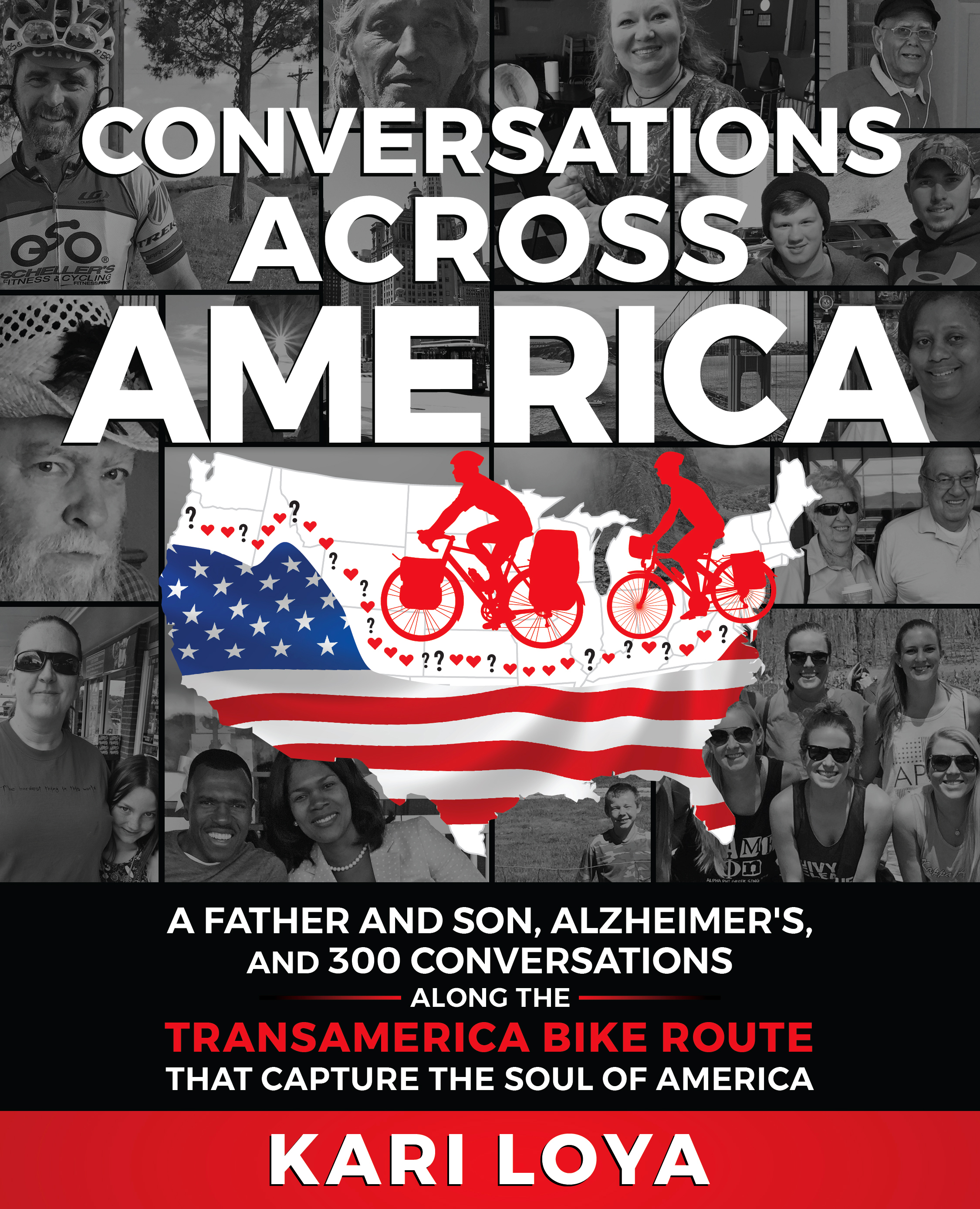
Book review: Conversations Across America

Image courtesy of author.

I had the recent pleasure of receiving a review copy of Conversations Across America by Kari Loya. It’s an insightful look not only at a father-son relationship dynamic after the father is diagnosed with Alzheimer’s, but also a visual and cultural snapshot of America.

There is much to find inspiring about the book. How many of us would be in good enough physical shape to bike across America? I know I wouldn’t and the fact that his father is able to do so while in the early stage of Alzheimer’s is admirable. The obstacles that the father and son duo face on their long journey mirrors the challenges one faces on the dementia caregiving journey. The open road facilitates difficult but necessary conversations between father and son.

The other component of the book offers photos and quotes from people Loya and his father meet along their journey. There is a diverse mix of voices and you likely will not agree with all of them, but it does offer some insight into how we ended up where we find ourselves now. Out on the road, random acts of kindness are not only welcome but necessary. Time and time again, strangers rise to the occasion.

Ultimately, Conversations Across America is a love letter to his father, the natural beauty of the country and the helpfulness and resilience of those living in small towns. It’s a coffee table book with a conscience.

1 Comment

Filed under Awareness & Activism

Exercise in variety of forms offers cognitive benefits, new studies show

We all know that exercise can offer a variety of health benefits, including supporting cognitive health. Sedentary behavior has been linked to an increased risk of dementia. But as we get older, we may have physical limitations that prevent us from engaging in the strenuous physical activity we may have enjoyed or done with relative ease when we were younger.

A new study suggests that low-impact workouts, including stretching and balance exercises, offer the same cognitive benefits in the area of executive functioning as aerobic activity. The study was performed on young adult subjects, so more testing will be needed, especially on older subjects. These findings could lead to the introduction of passive exercise programs at long term care and rehabilitation facilities.

Another recent study focused on sedentary adults who had been diagnosed with mild cognitive impairment. Again, the results were promising: cognitive function had not declined after one year of regular workouts, whether it was moderate aerobic exercise or range of motion exercise. A control group of adults with MCI did show a decline in cognitive functioning over the same time period, researchers said.

So the next time you or an older loved one worry you are not getting enough exercise, just remember, any kind of regular exercise can support cognitive health, along with offering a host of other benefits.

Photo by Anupam Mahapatra on Unsplash.

2 Comments

Filed under Awareness & Activism

Hearing aids to be available over the counter

In what many consider to be a long overdue move, by this fall Americans will be able to buy hearing aids over the counter at pharmacies and drug stores. This will make getting a hearing aid a more affordable and convenient experience.

Hearing loss is considered a risk factor for dementia. While the connection is not fully understood yet, researchers believe that hearing loss may impair cognitive function in a variety of ways. A Johns Hopkins study is underway right now to determine if hearing aids reduce the risk of cognitive decline in senior adults. Results from the study are expected in 2023.

My father suffered from hearing loss around the same time he began to first show signs of dementia. Not being able to hear properly can have a negative impact on social interactions, which can also increase the risk of dementia.

Hearing is often something we take for granted but just like with vision, it’s important to note any changes and address issues promptly. Just like you can purchase a pair of reading glasses at your local pharmacy or drug store, soon hearing aids will also be available. Some medical experts are concerned that skipping a customized hearing aid fitting could have unintended consequences, such as not properly addressing a hearing loss issue. One should consult with their doctor if an OTC hearing aid fails to address their hearing loss but providing consumers more affordable and readily available options is an important step forward.

Photo by JD Mason on Unsplash.

2 Comments

Filed under Awareness & Activism

Prescription drug costs can be unexpected burden for elders

The legislation passed by Congress on Friday includes at least one initiative that has significant bipartisan support, especially among older Americans: Medicare will now be able to negotiate the prices of certain high-price drugs with drug companies.

In other countries, this is a common practice, but the pharmaceutical industry has lobbied hard against the measure over the years. AARP lobbied hard for elders and their families, and finally secured a victory.

I received an eye-opening education about the high price of medications when my father entered a memory care center during the last year of his life. He was put on several medications and Medicare only covered a portion of the costs. We had no say so on what medications he was placed on, and whether there was a generic, more affordable alternative. One medication was being used off label in a way that was not recommended in patients with dementia. We were left owing hundreds per month out of pocket, on top of the room rate of over $4,000 per month. We did not have the money to pay it off each month and after my father’s death, had accrued a bill of over $5,000 which we were able to negotiate down a bit and pay off out of my father’s estate.

The new legislation is limited in scope, but will still have a noticeable impact. In addition to negotiating drug prices, the legislation will:

Cap at $2,000 the annual out of pocket amount Part D prescription drug plan members would have to pay for their medications.

Levy a tax penalty on drugmakers that increase prices of their medications more than the rate of inflation.

Cap the cost of Medicare-covered insulin at $35 a month. (The insulin cost cap for private insurance did not survive a vote, so for now the cap only applies to Medicare members.)

Eliminate out-of-pocket costs for most vaccines under Medicare.

Photo by National Cancer Institute on Unsplash

Leave a comment

Filed under Awareness & Activism

Researchers develop tool that uses audio recordings to detect dementia

Researchers have discovered a new way to diagnose dementia, one that could lead to an automated online diagnosis process.

Currently those concerned about memory issues may go through a battery of cognitive tests. Those tests can include identifying images on a card, reciting a list of random items that are spoken aloud and the famous “clock test,” which requires one to draw a clock set at a specific time. These tests are typically done in person, in a clinician’s office.

Researchers from Boston University have developed an automated tool that can detect not only dementia but mild cognitive impairment (MCI) with impressive accuracy. Such a model could offer great benefits, as early detection is key to being able to access early interventions and get people enrolled in clinical trials. Online testing access would be a key benefit in remote areas.

The computational model uses audio recordings of neuropsychological tests to detect cognitive impairment. The model focuses on the content of what is said versus how words are spoken, researchers said. Researchers discovered that the Boston Naming Test, in which individuals are asked to label a picture using a single word, is the most useful for an accurate dementia diagnosis.

You can read more about the research at Alzheimer’s & Dementia: The Journal of the Alzheimer’s Association.

Photo by C D-X on Unsplash.

Leave a comment

Filed under Awareness & Activism

Stuff You Only Whisper — When Dementia Knocks

Those of us who have cared for a loved one with dementia know the roller coaster of emotions one can feel. Click on the post below from When Dementia Knocks to learn more about one common yet guilt-ridden experience: wishing for our loved ones to depart this world to finally be free of this terrible disease. I know I felt this more than once towards the end of my father’s life.

Last week, a caregiver told me something that she considered so horrible that she could only say it in a whisper. She told me about her husband and his Alzheimer’s journey. He had just moved from a memory care community to a nursing home. She wasn’t pleased with the care he was receiving. Their kids […]

Stuff You Only Whisper — When Dementia Knocks

Leave a comment

Filed under Awareness & Activism

Holiday celebration tips for dementia caregivers

I’ve seen many articles this week about preparing pets for the often loud Fourth of July celebrations. It is true that some animals have a severe reaction to the booming blasts of fireworks, so it’s best to keep them indoors and monitor for signs of stress. I feel fortunate that my current crew (one dog, two cats) don’t seem to be bothered much by fireworks.

But the advice made me consider another group who many be overwhelmed by this weekend’s festivities: people with dementia. The noise, the lights, extra people in the house … it can be challenging for someone with dementia.

Here are some dementia caregiving tips on how to navigate the holiday:

  • Remain flexible: If you are taking your loved one to a public fireworks display or parade, be aware of how your loved one is faring and if you see signs of discomfort or stress, be prepared to leave early.
  • Keep celebrations small and low-key: An intimate dinner or small barbecue with a select group of people can help keep your loved one with dementia from feeling overwhelmed. Hosting at your home means that if your loved one wishes to retire early, they can do so with ease.
  • Find fun ways to celebrate: Just because you are stuck at home doesn’t mean you can’t have fun. Indulge in a favorite meal, play festive music, dance, or watch a favorite movie. Take time to connect in simple ways.
  • Don’t feel guilty if things don’t go as planned: Those with dementia can have good and bad days, and it can be hard to predict what mood they will be in at any given moment. If an event or gathering proves too much for them, don’t be too hard on yourself. Once your loved one is comfortable again in a safe environment, take a moment for yourself. Learning from our mistakes is key in being a successful caregiver.

Photo by Jingda Chen on Unsplash.

Leave a comment

Filed under Awareness & Activism