Author Archives: Joy Johnston

Joy Johnston's avatar

About Joy Johnston

Joy Johnston is an experienced digital journalist and award-winning author. The Reluctant Caregiver, her collection of essays on caregiving, received a gold medal at the 2018 Independent Publisher Book Awards. She received the 2015 Rick Bragg Prize for Nonfiction from the Atlanta Writers Club. Her father’s death from Alzheimer’s complications in 2011 inspired “The Memories Project” blog, which was featured on NPR. She is an Alzheimer's awareness and caregiver advocate.

Hope to see you at the Atlanta Writers Conference

I will be participating in the Book Fair being hosted at the Atlanta Writers Conference this weekend. The Book Fair is being held Friday, May 5 from 11 a.m. to 6 p.m. I will be there most of the day. My latest title, my award-winning children’s book, Slow Dog, will be featured, but I’ll also have a few copies of my award-winning personal essay collection, The Reluctant Caregiver, and a few copies of Chicken Soup for the Soul: Living with Alzheimer’s and Other Dementias, which includes an essay I wrote about my father. All books will be priced at a special book fair discount.

The event will be held at the Westin Atlanta Airport Hotel. Conference details can be found on the Atlanta Writers Club website.

Shortly after my mother’s death, I learned that I had been selected as the recipient for the 2015 Rick Bragg Prize for Nonfiction, in the annual contest hosted by the Atlanta Writers Club. That honor gave me the confidence I needed to keep writing about my caregiving experience and eventually, publish a collection of my personal essays. So the Atlanta Writers Club will always hold a special place in my heart.

If you will be in attendance, please swing by the Book Fair room to say hello!

1 Comment

Filed under Awareness & Activism

Slow Dog a winner in the Firebird Book Awards

I’m thrilled to announce that my children’s book, Slow Dog, was selected as a winner in the Firebird Book Awards hosted by Speak Up Talk Radio.

Winning any award is an honor, but it’s even more special when it’s a contest founded by author and podcast host Pat Rullo of Speak Up Talk Radio. Rullo and her show have long been a supporter of caregivers and encouraging caregivers to share their stories. Contest fees support charitable efforts: handmade pillowcases and children’s books are sent to women and children experiencing homelessness.

I appeared on Speak Up Talk Radio in 2018 to discuss my book, The Reluctant Caregiver.

You can see all of the winners at Speak Up Talk Radio and enter the next quarter’s contest.

Slow Dog was inspired by my rescue dog Murphy. If you are interested in donating to animal rescue, please consider voting for Murphy in a calendar contest being held by PAWS Atlanta. Voting ends April 28. Thank you!

1 Comment

Filed under slow dog

Gardening offers a myriad of health benefits, experts say

While I love walking, I don’t enjoy working out on exercise machines and have zero interest in going to a gym. I prefer solo activities so exercise classes are not something that interest me. But I do enjoy gardening and yardwork and have thought to myself, while breathing hard and sweat pouring down my face, that such activities must provide a good workout.

It turns out that science agrees with my theory. According to a recent CNN article, gardening for fitness is set to become a health trend. The article provides an overview of research that supports gardening as an effective fitness activity. Included is a link to a CDC chart that shows the calories burned while doing common physical activities. The CDC says light gardening/yard work burns 330 calories for a 154-pound person. That’s the same amount of calories burned as dancing and golfing.

What I like about yard work is that it’s a full body workout. From raking leaves and hauling heavy leaf bags to the curb, to pulling weeds and digging holes for new plants, you engage a variety of muscles and also get a cardio workout. For me, it’s not only about the physical activity but the satisfaction one feels after planting something or removing weeds. A yard tended to your tastes can be a serene space for reflection.

For caregivers of those with dementia, gardening is something that could be a satisfying outdoor activity for both you and your loved one, at least in the earlier stages of the disease. Yardwork involves the hands and rote activity, something that those with dementia seem to find soothing. As long as those with dementia are physically capable, getting light exercise and spending some time outdoors on a regular basis is recommended. Do be careful to keep an eye on your loved one and keep sharp gardening tools out of their reach.

Image by marinabridger from Pixabay.

1 Comment

Filed under Awareness & Activism

Marking Dad’s birthday

Dad would have turned 91 today. This is the earliest photo I have of him, taken at school and addressed to his beloved mother.

Such a serious young man, with his whole life ahead of him.

Dad didn’t have an easy life, but I’m sure while his feet were planted in the grass of his beloved Belfast, Northern Ireland, he never thought he’d live in sunny Los Angeles. His journey as an immigrant shaped his life, but he never forgot home.

At the end of his life, while in the final stages of Alzheimer’s, he talked about returning home, to see his sisters. We were able to honor his wish, in a way. Some of his ashes were sent to his family in Belfast.

1 Comment

Filed under Memories

Moving short film “Ruth” captures dementia experience in single take

Whenever I come across realistic, compassionate depictions of the dementia experience I like to share them here. Paul Romero Mendez, the filmmaker behind a short film named “Ruth” reached out to me recently. His moving film was released in 2021. The film depicts a woman with dementia who is lost in her own home. Highlighting this experience is very important, because while remaining in the family home can offer those with dementia the comfort of familiarity, the disease may strip away the very memories that makes the home feel meaningful and safe.

Many of us who have had cared for loved ones with dementia have had to confront the dreaded request to “go home.” But home may not be what you think. If your loved one is in a memory care center, maybe it is their last home, but it could be their childhood home. Time doesn’t necessarily move in a linear fashion for those with dementia. One minute they may be back in their childhood, the next a young adult, and the next to the current time. My father often asked to go home when he was in the memory care center, but he also talked about going home to Northern Ireland to be with his sisters. So I don’t believe home was the condo in Ruidoso where my parents retired. Home may not be a fixed place in the way we think of it, but a feeling of love and contentment.

The film was shot in a single take, so the audience can understand better the swirling cloud of confusion that those with dementia may contend with on a daily basis. It’s a powerful depiction, filmed with compassion. You can watch the film below. (This is a different short film from the one I posted about in January, which is also called Ruth.)

Photo by Danie Franco on Unsplash.

2 Comments

Filed under Awareness & Activism

Escort requirement causing some solo elders to miss important screenings, procedures

I’m glad to see The New York Times covering this important, but often overlooked issue. For solo elders, the requirement for a medical escort to accompany them to and from procedures is a burden that is difficult and expensive to overcome. It can be so difficult that elders decide it’s not worth the hassle and skip the procedure altogether.

Colonoscopies are probably the most common procedure that falls under this rule. Because of the sedative medications used, medical providers require an escort, so a person can’t use an Uber or Lyft as transportation. The escort needs to be a person known to the individual or a medical professional. Not all elders have loved ones still living or located nearby to assist them. And the cost of medical professionals to provide escort service is not covered by Medicare.

This is one of many issues that the population of elder orphans, those without a local support network, can face.

My mother was forced to pay out of pocket for expensive medical transportation to get her to and from her cancer screenings and follow up tests. It makes no sense that Medicaid covers nonemergency medical transport, but Medicare doesn’t.

The article highlights resources solo elders may be able to utilize, including nonprofits and home care companies. Those involved in religious organizations may consider reaching out to their congregation. While there are resources, they take time, effort and sometimes money to utilize. The onus should not be on the patient to jump over high hurdles to access these potentially life-saving procedures.

Photo by Alexander Grey on Unsplash.

5 Comments

Filed under Awareness & Activism

Celebrating the Irish spirit

My father was fiercely proud of his Irish heritage, but was not a fan of the commercialized St. Patrick’s Day festivities. As I grow older, the more I appreciate the culture of my Irish ancestors: resilient, creative, and brilliant storytellers who can tell the funniest of jokes and sing the saddest of songs and care deeply for family and country.

Of course, there is a darker side to every culture and I witnessed my father struggle through what he called “black” moods of depression and over-indulging in alcohol. I touch upon this in my book, The Reluctant Caregiver. But his love of his hometown of Belfast, Northern Ireland and his hopes of a united Ireland never wavered. In fact, in the last conversation I had with him just a month before he died, deep in the fog of dementia, he told me he wanted to go to Ireland.

So I will raise a toast to Dad with some Irish whiskey tonight and continue my exploration of my Irish heritage.

Murphy showing off his St. Patrick’s Day spirit.

I have a lucky giveaway to share with you. Get my e-book, CBD for Caregivers, which I recently revised, for free through April 1.

3 Comments

Filed under Memories

AARP: Valuing the Invaluable 2023 report

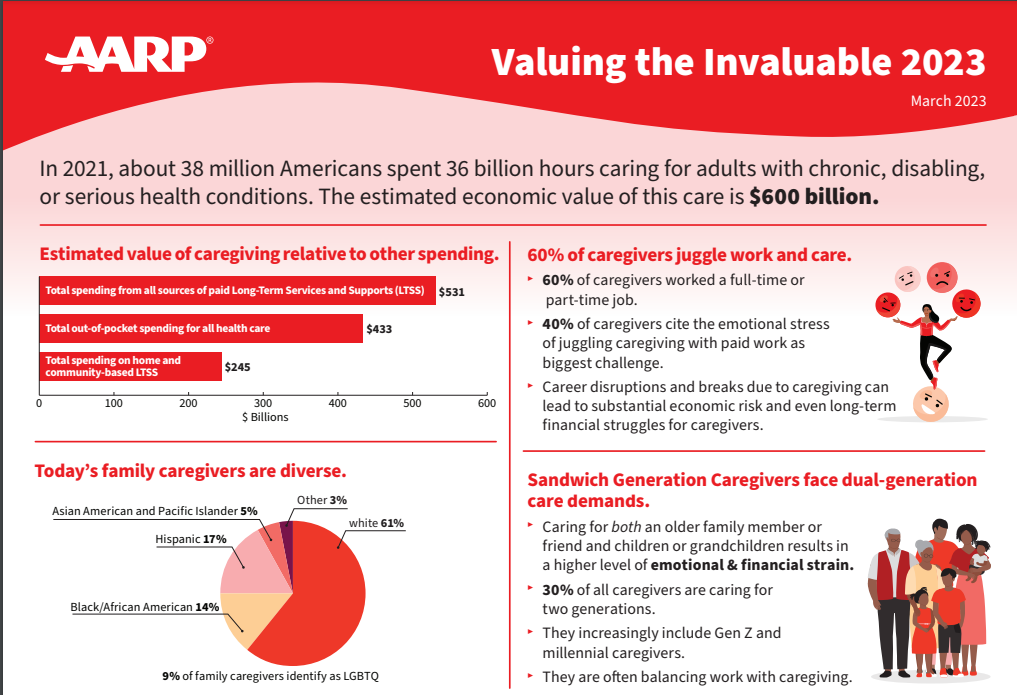
This month, AARP released a report: Valuing the Invaluable 2023 Update. While no one has to tell caregivers how much free labor they provide while caring for their loved ones, it does help to calculate a value for caregiving work and have a well-known organization like AARP broadcast how much economic value caregivers provide.

Among the highlights of AARP’s report:

  • In 2021, approximately 38 million Americans spent 36 billion hours caring for adults with a range of health conditions.
  • The estimated economic value of that care is $600 billion.
  • 60 percent of caregivers juggle a full- or part-time job and care.
  • 40 percent of caregivers say juggling a job and caregiving duties is their biggest and most emotionally stressful challenge.
  • 30 percent of caregivers are “sandwich caregivers” caring for two generations at the same time.
  • Caregivers come from diverse populations and an individual’s culture informs their caregiving experience.

In addition to the findings, the AARP report made several recommendations. The AARP advocates for the passage of caregiver support legislation and strengthening paid family leave, offering caregiver tax credits, expanding respite care options and making sure caregivers are part of their loved one’s care plan.

How many reports will have to be produced for our government to take caregiving seriously? Every year I highlight such reports and the progress we’ve made to support caregivers is frustratingly slow. Keep telling your caregiving story to whoever will listen.

Leave a comment

Filed under Awareness & Activism

Celebrate Read an Ebook Week

It’s Read an Ebook Week. While I’ll always love the feel of pages in a physical book, I do almost all of my reading using my Kindle. It’s just more convenient for my lifestyle.

If you are an electronic book fan, this is a great week to take advantage of special deals. I’m participating in the Smashwords promotions. You can get The Reluctant Caregiver and CBD for Caregivers for just 99 cents today through March 11. Note: It looks like the promotion is so popular that the Smashwords website is experiencing some technical difficulties. If you get a broken link, check back later.

If you are looking for a digital children’s book, you can get Slow Dog for just $2.99 on Amazon.

Happy Reading!

Leave a comment

Filed under Awareness & Activism

Do brain games offer protection against Alzheimer’s?

Every night I wind down by playing two games on my tablet: a crossword and a Jumble word puzzle. I’ve always enjoyed word puzzles. I inherited my love of the Jumble puzzles from my mother, who was a devoted player. One of the ways we bonded as she recovered from cancer surgery was working on Jumble puzzles together. My dad was an avid reader, but his love of words didn’t extend to games. It was particularly cruel when Alzheimer’s took away his favorite hobby of reading.

There are many apps and articles that promote “brain games” as a way to reduce the risk of Alzheimer’s and other dementias. While proponents of such games are enthusiastic about their potential in supporting cognitive health, the research so far is mixed when it comes to benefits.

One study that involved people diagnosed with mild cognitive impairment found that crosswords helped support cognitive health more than other games, though the positive results were not dramatic.

There’s no harm in playing such games if it brings you comfort. I do notice that if I’m tired or not feeling well, I struggle with completing the puzzles as fast as I normally do. I like to challenge myself to complete the crosswords as fast as possible. For me, this means not stopping to ponder a clue that I’m stuck on; instead I keep going and complete as many other words as possible before coming back to the ones that stumped me.

While such games may not offer protective benefits against Alzheimer’s, we do know that doctors use a series of tests which could be considered game-like to help diagnose someone with the disease, such as word memory exercises. I’ve participated in a study which has me complete a series of games along with a cognitive questionnaire a few times per year. Doing word games as part of your daily routine could help you spot a decline in your cognitive abilities earlier than you might have noticed otherwise.

Photo by Ross Sneddon on Unsplash.

2 Comments

Filed under Awareness & Activism