Author Archives: Joy Johnston

Joy Johnston's avatar

About Joy Johnston

Joy Johnston is an experienced digital journalist and award-winning author. The Reluctant Caregiver, her collection of essays on caregiving, received a gold medal at the 2018 Independent Publisher Book Awards. She received the 2015 Rick Bragg Prize for Nonfiction from the Atlanta Writers Club. Her father’s death from Alzheimer’s complications in 2011 inspired “The Memories Project” blog, which was featured on NPR. She is an Alzheimer's awareness and caregiver advocate.

Studying blood vessels in the brain to develop targeted treatment for Alzheimer’s

There is more interesting research going on in the world of Alzheimer’s. Scientists are examining whether the brain’s infrastructure plays a role in a person’s risk of developing Alzheimer’s. A damaged vascular system in the brain could develop cognitive performance issues, akin to an aging power grid that struggles to deliver power to a city, according to the research discussed in this Stanford Medicine Scope blog post.

In looking at a genetic atlas of the brain, researchers found that the “majority of the top Alzheimer’s risk genes are significantly expressed in the [brain’s] vasculature.” If you want to do a deep dive into the research, take a look at the study published in Nature.

The new technology used to create a genetic atlas and the accompanying discoveries give Alzheimer’s researchers new avenues to explore. No cause and effect has been established yet between brain vascular damage and Alzheimer’s risk, but there will now be additional research conducted to examine this area.

What could this mean for potential treatment of Alzheimer’s disease down the road? According to the Tony Wyss-Coray, who runs the lab where the research was conducted, treatments that could target the brain’s vascular system may be more easily accessible as the blood-brain barrier presents a challenge when it comes to getting drugs into the brain.


Leave a comment

Filed under Memories

Being a pet owner may have cognitive benefits

Donna Cecaci/Unsplash

I’ve written before on this blog about having a keen interest in studies that involve dementia, Alzheimer’s and overall cognitive health, while also maintaining a healthy skepticism. This week a preliminary study about how having a pet could benefit cognitive health made the rounds on social media. Those of us who are pet owners know how much love and joy they can bring to our lives. But it’s also important to understand and be able to manage the challenging moments as they age and develop health issues of their own.

The study found that those who had owned pets for five or more years were able to delay cognitive decline by 1.2 points vs. those in the study who did not have pets over a six-year period. The study analyzed cognitive data of more than 1,300 adults age 50 or over. While researchers were only able to establish an association, not a cause and effect with this study, the findings support prior research in this area.

Pets offer loyal companionship and keep us on a routine. Dog ownership encourages daily walks, and regular exercise has been demonstrated to have cognitive benefits. By just being their unique and adorable selves, pets can offer us moments of joy that help relieve stress and lift our spirits. As a society, we should do everything we can to make sure elders and those with health issues have the support they need to keep their beloved pets with them, whether its at home or in a residential facility.

Pets can also present a host of challenges, from behavioral to health issues. I personally have experienced this and dealt with an extended period of sleep deprivation. Researchers believe our quality of sleep, especially in middle age, has an impact upon our cognitive health and that poor sleep may increase our risk of Alzheimer’s and other dementias later in life.

I cannot imagine my life without my pets, but I also accept the considerable responsibility that I have in maintaining their well-being. If you have elder loved ones with pets, check on them to make sure that there are no care issues that need to be addressed.

2 Comments

Filed under Awareness & Activism

Nutritional options important part of palliative care

I came across an interesting discussion recently about whether Ensure and other nutritional beverages marketed towards older people are really the best option.

The discussion that followed the geriatrician’s perspective included interesting pros and cons. It made me think about my parents’ experience with the beverages. My father had never been a fan of milkshakes or similar beverages, but he seemed to enjoy the Ensure drinks, so I would ship cases of them to the memory care center where he spent the last year of his life. My mother existed on Ensure for the last month or so of her life. I have regrets about that, wishing I had taken time to make her something that she would have enjoyed more.

This is why I’m such a strong believer in expanding inpatient hospice and providing more robust home hospice care. As the sole caregiver for my mother at the end of her life, things like whipping up something delicious for her to eat didn’t cross my mind because I was so busy focusing on the “important” things, like her pain medication, treating her bedsores, etc. While I managed to mainly keep her suffering to a minimum, there was no joy in her final weeks.

Those with dementia may struggle with solid food as they enter the final stages of the disease, so liquid forms of nutrition may become a necessity. Homemade smoothies, puddings and milkshakes may interest those who have grown tired of the commercial products. If you can, consult with a nutrition specialist or dietitian about tasty, safe options for your loved one. Bringing loved ones small moments of joy can also lift the spirits of family caregivers.

Leave a comment

Filed under Awareness & Activism

Being less active during pandemic may have health consequences

The pandemic’s impact on health goes beyond those who contracted the coronavirus. Even those who managed to avoid the infection may have suffered consequences to their health, and in an area that many take for granted.

In December, I fell while walking my dog. I slipped going down a moderate slope in the park and landed straight on my rump. The fall knocked the wind out of me for a minute, but I was fortunate not to break or sprain anything. My back was very sore and remained so for about a week. I treated it using over-the-counter pain medication and homeopathic balms. My mobility was limited and I was forced to slow down and take it easy, but fortunately I fully recovered and don’t have any lingering issues.

I’m in my late 40s and in decent health. This was a minor fall, but it reminds me that as I get older, recovery from such incidents takes longer. We often take our mobility for granted, but the pandemic may have a lingering impact on our physical conditioning, making us more prone to falls. Studies suggest that some older adults have experienced a decrease in mobility during the pandemic, The New York Times reported.

Those who now work from home full-time may be moving less than when they went into the office, even if they drove to work. Pandemic restrictions may have shut parks, gyms, malls, and other outlets that older people used to exercise. Depression and anxiety can dampen the desire to exercise. Those who did contract COVID-19 may have battled lingering symptoms that made exercise difficult. And those who received benefits from physical and occupational therapy may have not been able to receive those services during the pandemic.

What geriatric health experts are concerned about is that decreased activity levels may result in worse physical functioning, which is key to older adults’ ability to live independently. A fall can lead to a lengthy recovery and trigger a fear of falling again, creating a vicious cycle with significant health consequences. The good news is that we can engage in simple activities that will help us reverse the impacts of our sedentary lifestyle and regain our mobility. Walking, yoga, and tai chi are all great ways to get moving and improve physical functioning.

Take inventory of your mobility and your elder loved ones and make an action plan if you desire to increase your mobility. Taking small steps now can make all the difference in keeping ourselves and our elder loved ones living independently.

2 Comments

Filed under Awareness & Activism

Nursing home evictions: Understanding your rights

As difficult as it can be to find a good nursing home and secure space for your loved one, the challenge doesn’t end there. Dementia caregivers in particular must be aware and be prepared to take action if the nursing home tries to evict your loved one.

So many people are not aware of the amount of nursing home evictions that take place each year in the US and the chaos and stress it causes families. I experienced a form of this when the skilled nursing facility where my father was placed after being discharged by the hospital said it could no longer care for him because they didn’t have staff that could provide dementia care. My father was not able to return home because he could no longer walk and my parents’ condo had stairs. My father was stranded and eventually was placed over an hour-and-a-half away from my parents’ home in the closest facility with a memory care wing.

In some cases, residents are evicted with very little notice and without a legal reason. ‘I Want to Go Home’ published in The Progressive Magazine offers firsthand accounts of how nursing home evictions can throw families into chaos. One way to protect your loved ones is to be aware of the possibility of eviction and an action plan to implement if it occurs.

I hope this is an issue your loved one never has to face but Justice in Aging offers good resources to learn more.

Leave a comment

Filed under Awareness & Activism

9 Thoughts I Had While My Mom Was Living with Alzheimer’s

I can relate to these thoughts when it came to my dad’s journey with Alzheimer’s. If you are struggling as a dementia caregiver, know that these thoughts are common, so don’t judge yourself harshly.

Lauren Dykovitz's avatarLife, Love, and Alzheimer's

When you love someone who is living with Alzheimer’s disease, you often feel alone in your thoughts and feelings. You may wonder if anyone else thinks the same thing or feels the same way.

I hope to reassure you and normalize the thoughts caregivers may have while caring for a loved one with Alzheimer’s. These are 9 thoughts I had while my mom was living with Alzheimer’s.

1. This is so unfair. Why is this happening to me?

2. She doesn’t deserve this. Why is this happening to her?

3. No one will ever understand what I am going through. I’m all alone.

4. I should be grateful that I still have my mom, but I just want my old mom back.

5. Am I a good daughter? I never feel like I’m doing enough.

6. Why doesn’t this person help out more? They know how hard this is. I…

View original post 172 more words

Leave a comment

Filed under Memories

A thoughtful end to ‘After Life’

I’m a big fan of the Netflix show “After Life” created by and starring Ricky Gervais. While the subject matter and profuse profanity make it a show that not everyone will enjoy, I find its take on death and the grieving process refreshing and poignant.

The third and final season debuted this month and I was blown away by one scene in particular, which felt like my mother was speaking to me from beyond the grave.

As I’ve written about extensively on this blog and in my book, The Reluctant Caregiver, my mother was reluctant to discuss any end-of-life issues, but she did give me a poem she had copied by hand and said she would like that read after she died. She didn’t want any service and she chose cremation over burial so it was left to me, her only child, how to honor her wishes.

The poem she chose is the poem that is read during a very moving scene in the final season of “After Life.” When the actress began reciting the poem, I almost jumped out of my seat and my breath caught in my throat. The poem is fairly well-known but still, what are the chances that the poem my mother chose was the one that was recited on a TV show?

I chose to honor my mother’s wishes by not only reciting the poem after her death, but having it imprinted on her urn. You can read the poem below.

Leave a comment

Filed under Memories

Learning more about Dad’s voyage to America

USS Theenim (AKA-63) in 1946. Source: Official U.S. Navy Photo via Wikimedia Commons

I’ve spent the decade since my father’s death piecing together a timeline of his life. While I know my father discussed the details of his freighter trip from the UK to America during my childhood, I sadly have forgotten most of those details. It bothered me I couldn’t learn more about the ship that he was on, but my initial searches turned up dead ends.

Then I took another look at his naturalization records on Ancestry.com, and discovered the name of the ship, SS American Inventor, was printed right on the form! I don’t know how I missed that initially. At first I turned up little information with the ship’s name, but then discovered that the ship had changed names over the course of its service.

The ship was originally christened the USS Theenim and functioned as a cargo attack ship during WWII, according to NavSource. (Reports say the name was a misspelling of Theemin, a star in the constellation Eridanus.) It served in the Asiatic-Pacific Theater during wartime and earned one battle star. After being decommissioned, it began its merchant service duties where it became the SS American Inventor. The ship’s name changed a few more times before it was sold for scrapping in 1970.

It was neat to see the images of the ship on NavSource. The very last image is of the ship in New York City in the mid-1950s. My father arrived in New York in 1957, so it was really neat to see an image of the city’s skyline during that era, to have a better understanding of the first glimpses of America my father saw on the ship. What an exciting moment for my father, who was just 25 years old and about to step foot in the country he would adopt as his second home.

Leave a comment

Filed under Memories

Vision for the new year

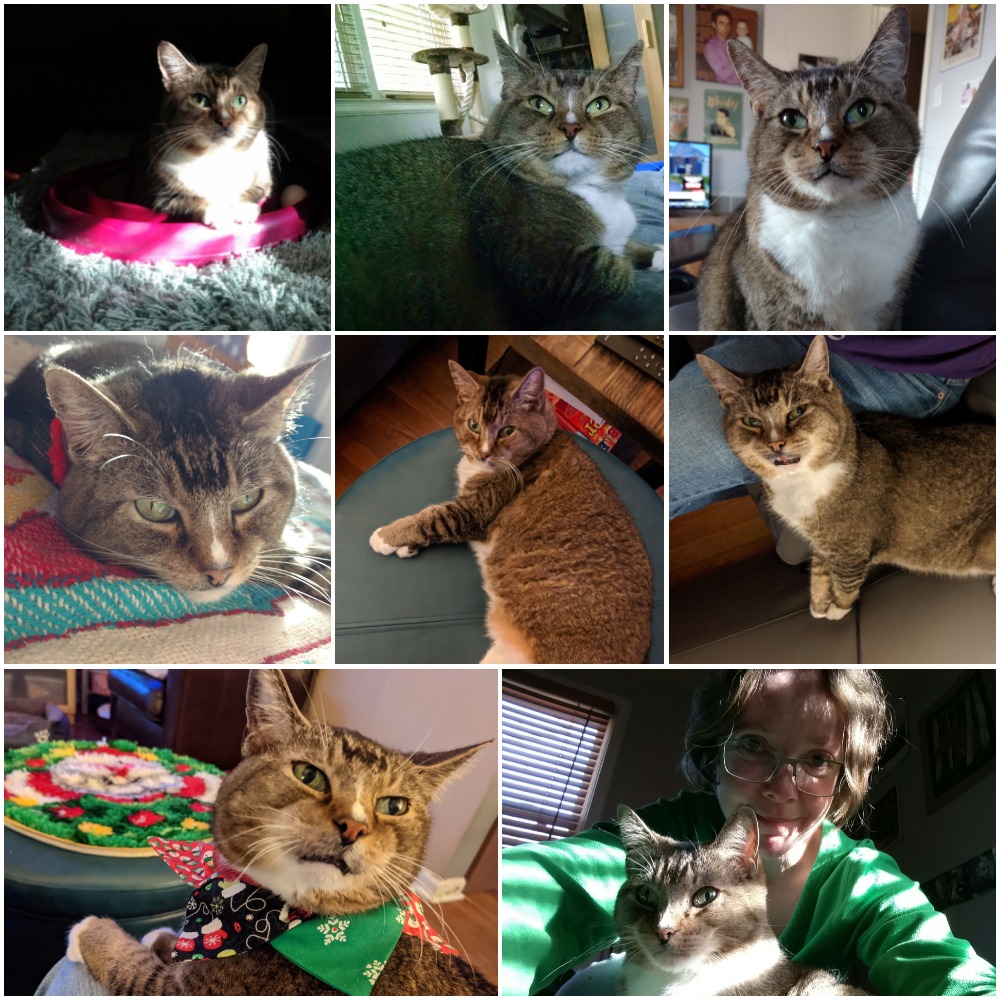
I hope you had a peaceful holiday season. Mine was spent mourning my beloved cat Rosalie, but the holiday break allowed me time to honor her memory in various ways. Her urn arrived this week, and Katie Patton of Blocks from the Heart has done such a magnificent job in capturing Rosalie’s spirit.

And to usher in the new year, I took the plunge and adopted a pair of tuxedo cats named Dorian and Serena. They are young, just a year and a half. I do feel like Rosalie’s untimely passing was a signal from the universe that an opportunity was presenting itself to welcome a new energy into my home and my life. It was a rude awakening, but one that I hope will inspire new endeavors into my caregiving advocacy work. Adopting young cats is also a good lesson in letting go of routines and looking at things from a new perspective … like when a kitty climbs to the top of the kitchen cabinets!

Serena and Dorian

As for vision … I attend a monthly women’s healing circle that involves a variety of spiritual disciplines and meditations. It’s been a virtual respite during the isolation of the pandemic. Each year, the teacher draws a spirit word for each participant, and mine for 2022 is vision. I’m interested in exploring that concept.

To kick off the year, I’m taking a course in children’s book writing. I have an idea for a children’s book that would feature my rescue dog Murphy’s story and connect it to children who have also experienced trauma. I don’t know what will come of it, but I think it is good to flex the writing muscles in a new direction.

On the legislative front, I hope some of the caregiving initiatives can be salvaged from the BBB plan. I know I sound like a broken record, but caregiving issues deserves bipartisan support because it’s something that touches all of our lives, regardless of political beliefs. Caregivers, from frontline hospital and nursing home workers to family members tending to loved ones at home, have sacrificed so much and it’s well past time that we as a society support better funding so that they get the support they need.

Leave a comment

Filed under Memories

Farewell to a sweet soul

I had to say goodbye to my beloved Rosalie two days before Christmas. She went into respiratory distress and a large mass was found on her trachea, which was almost entirely blocking her airway and ability to breathe. Because of its location, her age, and her condition, there were no realistic treatment options. I decided to let her go while she was still under anesthesia from the diagnostic procedure so she could slip out of this world as peacefully as possible.

Rosalie came into my life at the worst of times (my mother dying) and departed during another tough period of my life. I was fortunate to get six years with her delightful spirit. She was by far the easiest cat I’ve ever cared for and very affectionate. While I’ve loved the timid cats that I’ve adopted over the years, Rosalie was not shy at all. Nothing much seemed to spook her. She lived every day soaking up the simple pleasures of life (sitting on the heat vent or napping on the heated blanket during the winter, enjoying food, being petted, knocking her favorite crinkle ball toys under the couch) and I would marvel at how content and relaxed she was no matter what strife I and/or the world was facing.

I may have jinxed her by thinking she could be my “20 year old cat,” because she had the calm and happy-go-lucky demeanor that centenarians often have. Alas, cancer claimed her just a month after her 15th birthday.

The day I adopted Rosalie I put aside my normal common sense and went with my gut instinct. It was just days after another one of my beloved cats had died and many people would have felt it was too soon to adopt another. The weather that day was dreadful and for any other event or task, I would have opted out. Navigating through violent thunderstorms, I arrived at the shelter and met with Rosalie just minutes before another adopter arrived asking about her. From that fateful beginning, Rosalie and I forged a special bond.

She taught me that sometimes rules and traditions are meant to be broken and she could have taught a master class in self-care. I will be forever grateful that the universe brought her into my life.

Leave a comment

Filed under Memories