Caregivers know that one of the more challenging daily tasks can be helping loved ones get dressed. Not only can it be a physical challenge for all involved, there is also the important elements of independence and dignity. For people with continence issues and those with dementia, it is essential that they have clothing that is easy to manage.
My mother struggled trying to aid my father in getting dressed and going to the bathroom in the early to middle stages of Alzheimer’s. He was often stubborn and didn’t want to accept help, which led to accidents and the dreaded clean-up. The only time my father was physically abusive was during one such moment, when she was trying to help him into his pajamas. He got frustrated and struck her in the jaw. I often think about others facing a similar situation each night, feeling alone and in need of help.
This is why I’m pleased to learn of the launch of CareZips Classic by Joe & Bella. This adaptive clothing line offers innovative zippers from the waist to the knees that easily open the entire pant up to make dressing, using the bathroom and cleaning up accidents easier on both the wearer and their caregiver. Its design means one does not have to fully undress to perform routine tasks.
Enter code Gift10 to receive a $10 Joe & Bella gift certificate for each pair you purchase. For every purchase you make at www.JoeAndBella.com, a portion of the proceeds is donated to frontline caregivers. Joe & Bella has already supported more than 100 care communities through their “give-back” program.
I’ve seen many articles this week about preparing pets for the often loud Fourth of July celebrations. It is true that some animals have a severe reaction to the booming blasts of fireworks, so it’s best to keep them indoors and monitor for signs of stress. I feel fortunate that my current crew (one dog, two cats) don’t seem to be bothered much by fireworks.
But the advice made me consider another group who many be overwhelmed by this weekend’s festivities: people with dementia. The noise, the lights, extra people in the house … it can be challenging for someone with dementia.
Here are some dementia caregiving tips on how to navigate the holiday:
Remain flexible: If you are taking your loved one to a public fireworks display or parade, be aware of how your loved one is faring and if you see signs of discomfort or stress, be prepared to leave early.
Keep celebrations small and low-key: An intimate dinner or small barbecue with a select group of people can help keep your loved one with dementia from feeling overwhelmed. Hosting at your home means that if your loved one wishes to retire early, they can do so with ease.
Find fun ways to celebrate: Just because you are stuck at home doesn’t mean you can’t have fun. Indulge in a favorite meal, play festive music, dance, or watch a favorite movie. Take time to connect in simple ways.
Don’t feel guilty if things don’t go as planned: Those with dementia can have good and bad days, and it can be hard to predict what mood they will be in at any given moment. If an event or gathering proves too much for them, don’t be too hard on yourself. Once your loved one is comfortable again in a safe environment, take a moment for yourself. Learning from our mistakes is key in being a successful caregiver.
While it may seem unfathomable to those of us who have seen Alzheimer’s and other dementia touch the lives of our families, a new survey from the Cleveland Clinic suggests that the majority of American women may not be aware of their own risk for the disease.
In what researchers from the Women’s Alzheimer’s Movement (WAM) at Cleveland Clinic called a “startling fact,” 82 percent of women do not know they are at increased risk for Alzheimer’s disease, though two-thirds of cases are women. Only 12% of women who took the survey knew about a potential link between estrogen loss and Alzheimer’s, an area that the Cleveland Clinic is researching.
In other findings from the study, 73% of women have not had a discussion with their doctors about their cognitive health and 62% of women have not discussed menopause or perimenopause. The changes women experience during menopause can impact cognitive health, so it’s important for women to talk to their doctors to learn steps they can take to reduce their risk of dementia.
According to the study, two in five women have dealt with anxiety, depression and/or insomnia.
One not surprising finding from the study: 56 percent of women reported not getting enough sleep. We know that sleep quality can have a direct impact on cognitive health and there is research to suggest poor sleep quality during mid-life can increase one’s risk of dementia. A potential reason for the poor sleep? Over half of the women who took the survey said they cared for others.
While the results of the survey are concerning, researchers said the good news is that women are interested and motivated in learning more about ways they can maintain good cognitive health.
Here in Atlanta we are looking at a brutal heat wave, with temperatures expected to be in the mid-90s for the next couple of weeks. Summer begins officially on June 21, but in some parts of the country it has arrived early.
It’s important this time of year to check in on elder loved ones and neighbors. No one should be dying of heat exposure in their homes in our modern times, yet each year, heat-attributed deaths occur. Those at greater risk include elders, those with pre-existing health conditions and those in public or institutional housing which may not have adequate air conditioning.
I would note another factor, which may be the most tragic of all. Some elders may have air conditioning, but are afraid to turn it on because of the cost. That’s why it’s important to check in and make sure your elder loved one’s homes are adequately cooled. Fans may not be enough in areas experiencing a prolonged spell of extreme heat. Check with local officials to see if public cooling stations are available.
As we honor our fallen military members this Memorial Day weekend, our somber mood extends to the deadly school shooting in Uvalde, Texas.
Comparisons to Sandy Hook make me think back to December 14, 2012, and of my mother, who awakened from major surgery to news reports of the mass school shooting. We watched the tragic news unfold on the TV in her hospital room. My mother was more concerned for the children, and for their parents, than she was about her own physical health.
Almost a decade later, more children have died. More families are grieving. More somber anniversaries have been added to our national calendar. One of the most profound ways we could honor the sacrifice our fallen military service members made for America is by working to reduce the amount of mass shootings.
I hope you get to spend time with your loved ones this weekend. After a week such as this, time spent with family becomes even more precious.
May is Mental Health Awareness Month, so it’s a good time to check in on the caregivers in your life, and if you are a caregiver, take what time you can for self-care.
According to Mental Health America, this month’s campaign is focused on “Back to Basics.” As we emerge from the pandemic, some people are realizing that while they physically survived the pandemic, their mental well-being may need tending. Caregivers who are feeling overwhelmed, stressed, depressed or anxious are encouraged to seek help. Not all areas of the U.S. have adequate mental health resources, so online resources may help fill some gaps.
While professional help is the best, don’t hesitate to reach out to family, friends and community resources. As difficult as it can be to talk about such subjects, it is imperative for one’s well-being to open up to a trusted person. Caregiving can leave one feeling very isolated, with few such resources. That’s where online communities can come in handy.
In addition to professional services, what caregivers need most to support their mental health is a break. Respite care is essential, but remains limited in availability and under-utilized. On my website, Respite Care Share, I have a list of respite care resources. Reach out to the public health agencies in your state to see what programs are available.
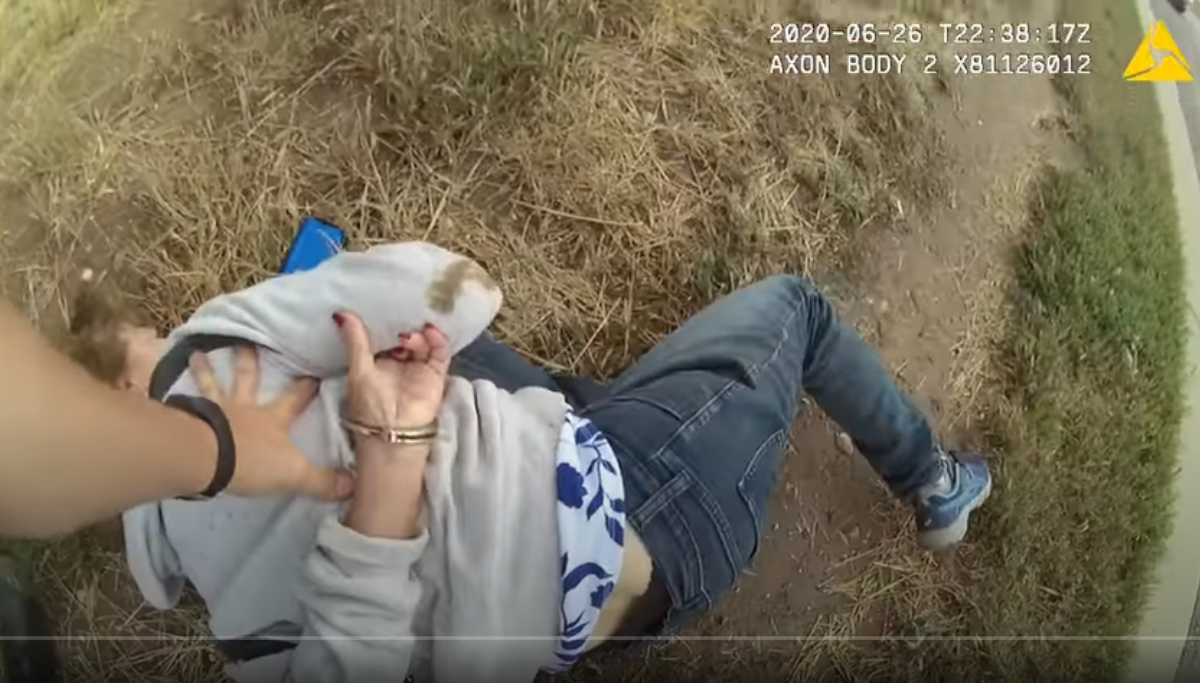
Still taken from video courtesy of The Life & Liberty Law Office
It seems rare that justice is done in cases like these so I wanted to give an update on a case that I’ve written about previously on The Memories Project.
A police officer in Colorado who used excessive physical force against a 73-year-old woman with dementia who had been accused of shoplifting has been sentenced to 5 years in prison.
The case went viral after the video of the rough arrest was released to the public and shared on social media. Karen Garner was accused by Walmart staff of trying to walk out of the store with $14 of merchandise in June 2020. Staff were able to retrieve the merchandise in question, but Garner walked away from the store before police arrived. Officer Austin Hopp attempted to stop Garner, who was confused and not cooperative due to her dementia. Hopp proceeded to slam Garner to the ground during the arrest, dislocating her shoulder. She was also hogtied and suffered a fractured arm and sprained wrist.
Garner’s ordeal didn’t end there. When she complained about pain at the police station, she was mocked and ignored. Hopp and two other police officers laughed about the incident, boasting, “We crushed it.”
You can watch the arrest below. Viewer discretion advised.
A female officer involved in the arrest has also been charged in the case and has a court hearing in June.
May is Mental Health Awareness Month so it’s a good time to advocate for dementia training for law enforcement. West Virginia Gov. Jim Justice signed a bill into law in April to establish dementia training for law enforcement. Every state should have such a training program.
In order to honor our elder’s wishes to age in place, it’s important to make sure they have the proper support. That may include hiring in-home care aides to perform housekeeping and some basic medical tasks. This is especially true for those of us who are long-distance caregivers.
Finding a good fit can be a challenge. Some elders may resent the idea that they need help and sabotage any hopes of securing care services. Those with dementia may become more confused or combative with a stranger in the house. Even those who are willing to accept a care aide in the home may find their routines are disrupted, which may cause short-term distress.
I was fortunate that my mother’s aide, hired through a local home health care agency, was a wonderful woman who clicked with my mother. Not only did she offer my mother a helping hand, she offered her companionship. My mother had a very set way of doing things so I know she probably was a challenge for the aide at times, but I so appreciated the aide’s services. I knew I could trust her and that my mother was receiving the support she needed to stay in her home.
MarketWatch published an article that has helpful tips on what you should look for when choosing an in-home care aide. Beyond the basics like a background check, it’s important to know the aide’s skill set, availability, and career aspirations. Going through a home health agency can offer some peace of mind, but can be more expensive. Word of mouth can be a good way to find a caregiver in your community. When it comes to hiring a care aide, hands-on experience may be more key than formal education.
There are websites and apps that allow one to hire a caregiver remotely, which can be useful for long-distance caregivers but can be a bit more of a gamble without that in-person assessment. Long-distance caregivers should consider a video call before making any hiring decisions. Don’t overlook your gut instinct; if you feel an aide is not the right fit, don’t hesitate to take action. It’s not unusual to cycle through a few care aides before finding a good fit.
Anyone who is dealing with chronic pain or caring for someone with a chronic pain condition being treated with opioids will want to pay close attention to the Centers for Disease Control’s updated opioid prescribing guidelines for doctors.
The public comment period has ended and a draft of the guidelines has been completed. The CDC’s final recommendations will follow.
I all too well remember the 2016 guidelines. Doctors were warned about the upcoming changes in 2015, the year my mother died, and those guidelines (along with the doctors’ gross misinterpretation of the guidelines) caused my mother to die an agonizing death. Others sadly experienced a similar fate. Some people who had been on a successful maintenance regimen of opioids found themselves suddenly cut off by skittish doctors. Some people turned to the illicit drug market. Others committed suicide because they could no longer endure the pain.
NPR reviewed the draft document of the revised CDC guidelines. Officials blamed doctors for misapplying the CDC’s 2016 guidelines, saying it was supposed to be a “roadmap” not a “rigid set of rules.” But it’s difficult to put all the blame on doctors across the county who apparently were in fear of losing their medical license if they didn’t follow the CDC’s guidance. Clearly something or someone made them fearful enough to go against their medical training and harm their patients.
America’s overdose crisis prompted the stricter prescribing guidelines in 2016, and states in which opioid overdoses were epidemic passed laws to further restrict opioid distribution. This knee-jerk reaction, after these same states welcomed a flood of opioids from Big Pharma for years, had an unfortunate outcome for those who did use opioids responsibly to treat chronic pain conditions in which no other medications were effective.
My mother had intractable cancer pain in the last several months of her life. The CDC guidelines were not supposed to be implemented for those with cancer. But my mother’s doctor didn’t believer the cancer had returned and that she was dying. She believed my mother had become dependent upon the drugs and started limiting her prescription until she finally let my mother’s opioid prescription run out while the doctor was on vacation. My mother suffered mightily because of the doctor’s misinterpretation and fear of the CDC guidelines.
The 2022 guidelines make some improvements, according to pain specialists interviewed by NPR. There is no specific limits on the dose and duration of an opioid prescription. Clinicians will be encouraged to use their own judgment in deciding what is a safe and effective dose for each patient. And the CDC will stress more clearly that the guidelines are not “intended to be applied as inflexible standards of care” or as “law, regulation or policy that dictates clinical practice.”
While the new guidelines still discourage opioids as a first-line therapy for common acute pain conditions and for chronic pain conditions, it does acknowledge that opioids can play a role in chronic pain treatment, especially if other approaches have been tried.
If you or a loved one is running into issues of doctors not willing to manage your pain properly, keep pushing. Find another care provider. No one should have to die in agony because of bureaucratic guidelines. As NPR points out, the 2016 prescribing guidelines didn’t have the intended effect of reducing opioid overdoses. All of that suffering, all for nothing.
HFC’s Humans of Dementia Storytelling Contest is open and will be accepting submissions through April 30. This is a great way for young people to share their experiences of caring for a loved one who has Alzheimer’s or other dementias.
More about the contest: “HFC invites high school and college students to submit written or photo profiles of someone you know who has or had Alzheimer’s or related dementias.”
HFC, formerly known as Hilarity for Charity, was founded by actor Seth Rogen and his wife, Lauren Miller Rogen. Lauren’s mother developed early-onset Alzheimer’s at age 55 and died in 2020. HFC’s mission statement: “HFC is a national non-profit whose mission is to care for families impacted by Alzheimer’s disease today, activate the next generation of Alzheimer’s advocates, and be a leader in brain health research and education.”
Please share with the students in your life who have been touched by Alzheimer’s and other dementias. Encouraging our youth to share their perspectives on this disease will help spread awareness and embolden younger generations to contributing to finding effective treatments and care options.







![Pageflex Persona [document: PRS0000038_00069]](https://memoriesproject.files.wordpress.com/2014/02/reluctant-caregiver-cover.jpg)






 The Memories Project