Marking five years since Dad’s death

It’s hard for me to believe that five years have passed since my father’s death. So much has happened in those five years that I feel almost like a different person, or that I experienced December 20, 2011 in a different lifetime.

Little did I know at the moment I learned of my father’s death, in the newsroom of the Atlanta Journal-Constitution, on a cold and rainy Tuesday, that six months later, I would become caregiver for my mother. Even at that moment, the colon cancer was likely growing inside of her, waiting to make its ugly appearance in our lives. I thought I would spend 2012 grieving for my father, but instead, I had to shelve my grief in order to care for my mother.

I never expected to be virtually unemployed for well over a year after my mother fell ill. It was my father’s death that allowed me to pursue new career opportunities, as I had not wanted to take a new job when I knew he may pass at any moment. It turned out to be a bad move, and when Mom required emergency surgery, I was forced to quit after just two months, to go tend to her in New Mexico.

If I had guessed what my life would be like five years from that dreaded day in December 2011, I would not have imagined my mother being dead for a year and a half. She was 74 at the time of my father’s death, and appeared to be in good physical shape. I was most concerned about her loneliness and depression after Dad’s death.

Sometimes it all seems like a bad dream, but of course, I know all too well that it was real life. Good things have happened over these five years: my writing won an award, I secured full-time employment again, I’m slowly but surely crawling my way out of debt. I’m using my experiences, both positive and negative, in the caregiver advocacy role that I now cherish. The past five years have been turned into essays that have touched people and generated conversation around the topic of caregiving.

I certainly would never want to live the past five years of my life over again, but I am a better person for surviving them, and for taking the lessons my parents taught me to help others in a similar situation.


5 Comments

Filed under Memories

A visit to Amy’s Place

I finally had the pleasure of visiting Amy’s Place, a memory care cafe in metro Atlanta. Amy’s Place was selected by Atlanta magazine as a 2016 Groundbreakers finalist. This year the theme was how to make Atlanta a better place to grow old.

Amy’s Place certainly fulfills that mission. The charming home is open free of charge to people with dementia and their caregivers. It is designed as a place to visit and relax. Two adorable dachshunds bring wail-tagging joy to visitors, and caregivers can utilize a fully-stocked kitchen and shower while their loved ones receive attention and supervision from staff. Amy’s Place also offers caregiver support groups and fun social events, like painting classes.

I had a chance to meet co-founder Pam Van Ahn at the holiday party held at Amy’s Place last week. She and her sister Jean opened Amy’s Place earlier this year and are receiving rave reviews from the caregiving community. The memory cafe is part of their nonprofit, Caring Together in Hope.

The more I learn of programs like this, the more hope I have that we as regular citizens can make a difference in the lives of those with dementia and just as importantly, their caregivers. If you know of programs in your area that are designed to help caregivers, let me know in the comments section. I’m working on putting together a list of resources for my own Respite Care Share project.


4 Comments

Filed under Awareness & Activism, Memories

Bringing the gift of technology to seniors and caregivers

The holiday season can be overwhelming for family caregivers. I was grateful to take advantage of the technology that was available when my parents were alive to make the caregiving job easier. Health technology is a rapidly growing field, and now there are numerous apps, aids and devices to help seniors safely age at home. I’m going to name a few products that I either have used or am familiar with, in case you are buying a gift for a caregiver or senior living at home alone this holiday season. (These are not endorsements, just feedback from a real user and former caregiver.)

jitterbug-phone

Senior-friendly phone: My mom loved her Jitterbug phone, which is made by Great Call. Mom was not tech-savvy at all, and she was a bit skeptical about even using a cell phone at first, but she quickly learned how convenient it was. By far, the phone was the best gift I ever bought for her.

Medical alert services: I purchased a Philips Lifeline device for my mother, because that’s the brand the local home health agency used at the time. The service was quite useful and I felt that it was worth the monthly monitoring fee. My mom had a few falls over the last year or so of her life and each one was immediately recognized by the sensor that she wore as a necklace.  A representative checked on her over the intercom to see if she needed additional assistance. One time she did, and EMTs arrived to check her over.

The one downside was that the pendant that Mom wore was very sensitive and could easily be accidentally activated. That part annoyed Mom, but I guess it’s better to be too sensitive than to not work when you need it.

Another kind of medical alert service is a wandering detector for those with dementia. I bought one for my father that was part of the Alzheimer Association’s Safe Return program, but we never had the opportunity to use it before Dad entered the Memory Care unit. As GPS and other location tools become more refined, I think these kinds of tools can be very helpful. Instead of a bulky device, something as small and easy to apply as a tag on clothing could help monitor those with dementia. When I was setting up Dad’s unit, I did notice that because of my parents’ rural location, the GPS signal was weak.

Blood pressure monitors: Neither of my parents had blood pressure issues, but at-home blood pressure monitors are readily available on Amazon for a reasonable price. While these devices should never replace an actual doctor or home health visit, they might be useful for seniors who like to take a proactive approach to their health or their caregivers who wish to monitor a loved one’s blood pressure in-between professional check-ups.

Smart home speaker (Amazon Echo, Google Home, etc.): I think my mother would have loved the interactive features of the Amazon Echo. I bought one out of curiosity, and bought another device so I can use it to control the living room lights. I also use it to play music as it has a decent speaker. Other than that, I don’t use it that much, but I could see my mom using it almost as a remote companion, asking it questions, getting it to tell jokes, telling her the weather, etc.

Another excellent use of these smart home speakers is for medication reminders. I would have loved to have used it to remind Mom to drink water on a more regular basis, which may have helped with her chronic constipation. The best thing about these devices is they are so easy to use once they are set up. Basically the user just needs to say the trigger name or phrase and then ask a question or command. The devices do require Wi-Fi, and initial setup can be a bit of a pain.

Tablets: I was never sucked in by the attraction of tablets, because I’m a computer power user who would rather just use my laptop for bigger screen tasks, and am fine using my smartphone for small screen tasks. The tablet was a solution searching for a problem to me. However, the mobility and ease of use of tablets could be ideal for seniors.

Tablets make tasks like emails, instant messaging and video messaging, viewing photos and videos super-simple. Playing word games can help keep older minds active and being able to connect with others remotely could reduce loneliness.

Find a professional caregiver online: One of the best gifts you could offer a caregiver is a break. I’ve used Care.com before, and liked how you could search online for caregivers in your area. Payment could be made online, which I found convenient.


Leave a comment

Filed under Memories

Marking National Family Caregivers Month

mom-joy

I learned a lot about caregiving from my mother.

Before November slips away, I want to recognize that this is National Family Caregivers Month. I love this year’s theme: “Take Care to Give Care.” Supporting family caregivers is something I believe strongly in, and I am grateful I have the opportunity to give back.

My development of the Respite Care Share concept continues, and I’m working on the poster presentation that will take place at the 2017 Aging in America conference. Along the way, I’ve met many dedicated family caregiver advocates. We have a long ways to go, but as with most things, a grassroots-level, community-based approach will generate quicker results than waiting for government action.

The Caregiver Action Network offers good tips for family caregivers on managing their own health.

  • Stress: Family caregivers often face a tremendous amount of stress, yet ignore their own mental and physical health. I was certainly guilty of this when I was a caregiver. It’s important to take steps to minimize and manage stress, and promptly address any health issues that arise.
  • Healthy lifestyle: It’s easy to throw out healthy habits like a nutritious diet and regular exercise when you are overwhelmed with family caregiving duties. But a poor diet and sedentary lifestyle can make one feel sluggish, and more vulnerable to experiencing health consequences from stress. There was a walking trail adjacent to my mother’s condo, so I went almost daily for walks, which helped relieve stress.
  • “Rest. Recharge. Respite.” I love this mantra from the Caregiver Action Network. My sleep was disrupted every day when I was caregiving for my mother, and there was no way to avoid that (leaking colostomy bags always seem to occur at 3 a.m. and will not wait!), but I tried to make sure I got a set amount of hours of sleep each day. I did take breaks when Mom was stable enough, and that really helped.

A big thank you to all of the family caregivers out there, who are facing another hectic holiday season. There are many people focused on providing greater support for family caregivers, so don’t give up hope.

Leave a comment

Filed under Awareness & Activism

Memories of humble, yet happy Thanksgiving meals

Embed from Getty Images

I’ve never had patience for big family gatherings, probably because I grew up celebrating holidays with just my parents. That helped keep planning and bickering to a minimum. I have particularly happy memories of Thanksgiving, enjoying a humble but delicious meal and watching The Twilight Zone marathon throughout the day.

This year, thanks to the contentious election, I’ve come across several articles offering tips on how to survive the holiday with relatives. While I get that family stress is real, and kept my own visits home as an adult to a minimum, it is a bit sad that we need instruction guides on how to navigate a meal without suffering a nervous breakdown. Winning an argument or criticizing someone else’s viewpoint is more important to some than recognizing common bonds and accepting the imperfections in all of us. (That being said, I do not believe toxic family members should get a free pass; repair relationships where you can but move on when necessary.)

Over the last several years I have been preoccupied with family caregiving, and I witnessed the best and worst from my parents, and from myself. For those who are grieving the loss of a loved one, the holidays are a mixed bag of emotions. I am grateful for the memories of simply, happy Thanksgiving meals with my family, and I hope that all of you find those moments this week with your family and friends.

2 Comments

Filed under Memories

Mom’s rules on Southern cooking

corncakes

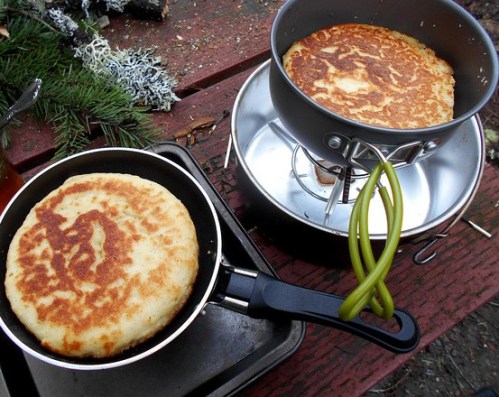
These are a bit on the large side, but remind me of what Mom’s corn cakes looked like. George Wesley & Bonita Dannells/Flickr https://creativecommons.org/licenses/by-nc-nd/2.0/

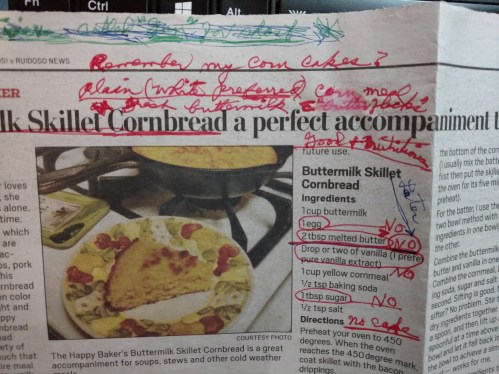
The upcoming holiday season and cooler weather has me thinking about food and family traditions. Mom always had a big stack of newspaper clippings to go through each time I visited. They were on all sorts of random subjects, and she would write notes on them to share with me. After Mom died, I came across a stack that we had gone over but that she had kept. In the collection was her take on a cornbread recipe that had been published in the local newspaper.

Mom was not pleased with the recipe, and scribbled her “corrections” all over it. Mom learned how to make cornbread, and more importantly, corn cakes (also called hoecakes) from her mother, and the family recipe was adamant about no sugar. Cornbread was to accompany savory dishes like greens with pot likker, or pinto beans. It was not dessert.

cornbread-recipe

I was able to find a couple interpretations of hoecakes that Mom would have approved of online. The Salon headline is perfect: You’re Doing it Wrong: Cornbread and offers a bit of history on the hoecake as well as a super-simple recipe. Mom’s recipe was very similar in that she omitted the egg and sugar, but she used buttermilk instead of just water.

On the newspaper article that was published just six months before she passed, Mom wrote in red ink, “No cake” after writing “no” next to such sacrilegious ingredients as sugar, egg and vanilla extract. She wrote at the top, “Remember my corn cakes?”

Indeed I do, they were one of my favorite meals as a young child. Dense discs of cornmeal, fried to a golden brown, soaking up butter. (Mom likely was using margarine, which was a shame, but I didn’t know any better as a kid.) I think I had a side of beans with mine, because my young palate couldn’t stand the concept of collard, mustard or turnip greens. The funny thing is, the way Mom made them, without any added flour, the hoecakes are naturally gluten-free. Now I would appreciate them with a “mess of greens” just like Mom.

One of these days, I’ll get around to making hoecakes, and there won’t be any sugar in sight. When I do, I will smile and think of Mom.


1 Comment

Filed under Memories

Woes of the working class

SAMSUNG

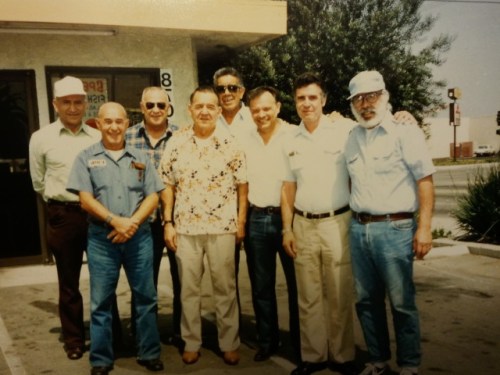
Dad posing with his trucking buddies. (He’s second from the right.)

I know everyone has an opinion on the election, and as I have throughout the long and ugly election season, I’m taking in opinions on both sides. Like many people, I don’t think my parents ever could have envisioned a President Trump.

But my dad was a proud working-class white man, a group that has been both condemned and revered in this election cycle. My father was also a proud immigrant. He loved his adopted country as much as he loved his homeland of Northern Ireland. My father worked with all races and got along with everyone. He was human and did have his prejudices, but my father accepted anyone who came into the country legally who wanted to work hard to make this country a better place and to improve their own life in the process.

So I’ve thought a lot about my dad this week, and about some of the stereotypes that have been associated with the working class. My dad had simple tastes but he had a thirst for knowledge and an impressive understanding and deep interest in world affairs. He was more than meets the cover, and I bristle at the thought of him being lumped in with some of the unfavorable labels of the working class, such as rednecks and white trash.

As I’ve mentioned before, I’m a journalist who was required to cover quite a bit of the election. In the days since the election, the media has been criticized for getting it so wrong, and for being so out of touch. I would have to agree with that, for the most part. I feel like the media group I work for went out of our way to be fair and balanced in coverage, and the fact that we are spread out geographically addresses one of the other post-election criticisms: that most members of the media live in bubbles in New York City or Los Angeles.

In addition to doing a deep research dive into both parties and their supporters, I talked to people in my travels this year. I had extensive discussion with shuttle drivers, who happened to be conservative, and they had many interesting insights. The overall impression that I came away with is that there is a group of Americans who feel forgotten.

I’m not going to argue that Trump is the answer to the working class man’s problems, or that Clinton would have ignored them. I can only control my actions, and I am choosing to be more thoughtful of the working class, which doesn’t just include white men of course, but men and women of all races, religions and cultures.

My mom taught me not to take service people for granted, and that was an important lesson. I saw my father toil to earn very modest wages that kept us afloat in a  lower middle class lifestyle. It seems easy for Americans to lash out at the wealthy, but we should focus more on those who have been ignored and devalued.

As caregivers, we understand these lessons all too well.


2 Comments

Filed under Awareness & Activism

What is a Memory Bear?

I couldn’t resist sharing this post from Bonnie, who makes the beautiful Memory Bears. This bear could have been made for my Dad, he was the ultimate Notre Dame fan!

As the holidays approach, those who are dealing with the loss of a loved one may be seeking a symbol of comfort and remembrance. A Memory Bear would make a lovely gift.

If you have recommendations on other thoughtful gift ideas for those who are grieving, I would love to hear about them.

As a child, remember holding that favorite teddy bear close to you. What a comforting affect teddy had on us. Memory Bears are very similar. A memory bear is made from your loved ones favorite clothing. Standing 22″ tall, a memory bear is soft and cuddly and just right to hold and hug as you […]

via What is a Memory Bear — Memory Bears by Bonnie

1 Comment

Filed under Memories

Opening a box of memories

spoolie-hanky

Just when you think you’ve gone through everything after a loved one dies, you find hidden treasures.

Mom often talked about getting into the storage closet attached to the condo, but the door could prove tough to open with changes in the weather. The past few times I attempted when Mom was still alive, I couldn’t budge the darn thing. As Mom’s health declined, the storage closet was mainly forgotten. But as I mentioned in my last couple of posts, it became imperative that I get in there this time around, because that’s where the property’s circuit breaker is located.

This time, it popped open without any problems. After wading through some cleaning supplies, I was pleasantly surprised to find a large box filled with items from my childhood. I thought that most of it had long been donated. There was my View-Master, my Casio mini-keyboard musical instrument, and a bunch of school-related items.

I also found some Christmas decorations that have sentimental value, so I set aside those as keepers.

There was another box which had items belonging to my mother. There were many decorative items that I set aside for donation, and then I came across a container of hankies. I quickly flipped through them to see if there were any special ones I wanted to keep.

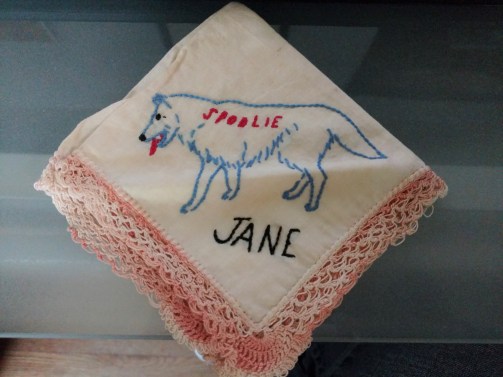
That’s when I found the hanky pictured above. I’m not sure if my grandmother or my mother stitched this, but it is of the beloved family dog Spoolie. I love the detail of the wagging tongue. So this was a keeper, along with a red one that had “Mother” stitched on it in gold.

In total, with items I had set aside earlier, I was able to donate six boxes. Through Care.com, I connected with a lovely local woman who was happy to come get all of it in her pickup truck. She volunteers with a church that in turn works with local charities, including one which supports domestic violence victims and one that supports the local Native American community. Mom’s treasures will brighten someone else’s home, and my toys will help make a child’s holiday a bit more delightful.

The Spoolie handkerchief will become part of Mom’s scrapbook. Glad I finally got that storage door open!

3 Comments

Filed under Memories

Aging in place not just about home’s interior

condo-water-heater

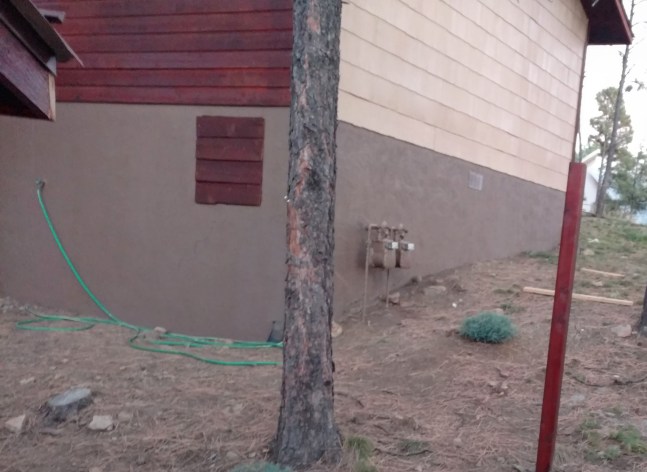
The “portal to hell” aka the crawlspace where the water heater is located.

As I wrote about in my last post, caregiving can give you tunnel vision, and while I was busy tending to my mother’s every health need, I overlooked some basic household duties, like changing that darned furnace filter.

But another thing I had to deal with on my recent visit to what was my parents’ condo made me realize that aging in place is not just about retrofitting a home’s interior. When I arrived and turned on the kitchen faucet, I immediately noticed that the hot water had a very strong sulfur odor. I Googled the issue and found that it is common in cabins and other kinds of vacation rental homes, where the water sits unused for long periods of time. Basically, the water sitting in the water heater tank is an ideal incubator for bacteria, which, while harmless to humans, creates that godawful rotten eggs smell.

The simplest solution involves flushing out the water heater with bleach or hydrogen peroxide, which kills the bacteria.

As I searched for plumbers, I began to wonder, where the heck is the water heater?

By process of elimination, I figured the square door underneath and to the side of the condo must be where the water heater was located. The photo above is actually a neighbor’s unit, but it looks just like mine. What I couldn’t picture was how a water heater fit in such a small space.

When the plumber came out, the mystery was solved. The wood door had to be unscrewed with a power tool, and then the plumber, a pretty tall guy, angled his way through the portal. I stuck my head inside and saw that the crawlspace was quite large, the entire length of the two condos that are connected together. There were several discarded water heaters under there, a virtual graveyard. The plumber wanted to show me how the water heater was leaking, which required me to climb inside.

I wasn’t sure I was going to be able to do it; I’m not claustrophobic and am in decent shape but I am clumsy, and this was a very awkward hole to crawl through. Somehow, I managed to squeeze through without injuring myself, then was immediately concerned about how I would get back out.

The plumber told me I could flip the breaker on the water heater when I was headed out of town so I didn’t have to crawl back down there. That was another adventure, finding the circuit breaker. It was located in a storage closet outside the condo, and inexplicably placed in the back corner, meaning you had to be careful about what you stored in the closet so you could squeeze your way to the back and reach the breaker panel.

The entire debacle made me think about aging in place, and how important it is to examine the exterior and the interior of the home your aging loved ones are residing in or wish to move to, and look for red flags like this bizarre water heater setup. Take into account things like stairs, crawlspaces and anything else that is difficult for someone with limited mobility to access. Ideally, a homeowner would have convenient access to things like the furnace, the water heater, air conditioner, circuit breaker, etc. in case of emergency.

It’s definitely something I’ll think about when looking for a retirement property. No creepy “portals to Hades” for me!


Leave a comment

Filed under Awareness & Activism