Tag Archives: death

The gift of having difficult conversations

This holiday season, one of the best gifts you can give the caregivers in your life as well as those nearing the end of their lives is the space and attention to have difficult conversations.

This includes not only end-of-life conversations but challenging family situations that need to be addressed. Perhaps there’s a caregiver in your family or friend circles that could use more support. If we’ve learned anything over the last few years of tremendous loss of life from the pandemic, it’s that we may not have the time we think to work through difficult issues with our loved ones. Now is the time to be proactive.

I was reminded of this while watching the Peacock TV series, “The Gentle Art of Swedish Death Cleaning.” This isn’t normally the type of show I would watch but in episode 2, a woman with terminal cancer is featured. In fact, the woman was quite organized and she didn’t need that much help in downsizing. Beyond practical matters, she was dealing with challenges connecting with loved ones as she neared the end of her life. As one of the death cleaners proclaims, she needs “death cleaning of her soul,” which is an empowering concept that they help her fulfill.

Can you facilitate that process for yourself or someone dear in your life? What a meaningful holiday gift that would be.

Photo by freestocks on Unsplash.

Leave a comment

Filed under Awareness & Activism

Don’t wait: Discuss end-of-life care wishes for those with dementia

The American Society on Aging, along with Compassion & Choices, hosted a webinar recently on honoring the end-of-life care wishes of those with dementia.

Also check out this interactive exhibit that discusses end of life care from a variety of individual perspectives.

This is an issue that I encourage everyone to consider, as my father’s end of life care was not what I wanted it to be. But without a roadmap (as is discussed in one of the videos above), my mother and I were forced to muddle through on our own. As I discussed in my book, The Reluctant Caregiver, my mother and I were at odds when it came to care options for my father as he neared the end of life. This is a common occurrence in families and can create regrets and guilt.

That’s why I suggest not waiting when it comes to discussing end-of-life care wishes after a dementia diagnosis. I also would like to point out that in the top video, honoring choices is the focus, but there are times when those wishes can’t be honored, for a variety of legitimate reasons. The ultimate goal is safety for your loved one and those caring for them.

Photo by Centre for Ageing Better on Unsplash.

Leave a comment

Filed under Awareness & Activism

Sharing the harsh realities of caregiving

While my caregiving journey with my parents was difficult, I try to share a variety of experiences here on The Memories Project, to reflect the diversity of caregiver stories. No two caregiving experiences are ever alike, but an essay I read this past week hit close to home for me on so many levels.

In this HuffPost essay by Kim Richards, she recounts the difficult experience of caring for her mother with cancer. I found so many similarities between Richards’ experience and my own caregiving experience that I recounted in my personal essay collection, The Reluctant Caregiver. Our mothers died within a year of each other, both lived in New Mexico, and both were in denial about their terminal condition. Richards had to give up her small business to move out-of-state to care for her mother; I had to quit a new job and was left with no health insurance.

I know these accounts are difficult for many to read and can be triggering for those of us who had a difficult caregiving journey. But I do think it’s important to share both the good and the bad, the inspirational and the challenging, so that hopefully people can be more emotionally prepared when it’s time for them to be a caregiver.

I’m grateful to all who share their caregiver stories as it helps me gain a better understanding of the diversity of the caregiving experience.

Photo by Isaac Quesada on Unsplash.

4 Comments

Filed under Awareness & Activism

Marking 8 years since my mother’s death

With each passing year, it becomes more difficult to believe so much times has passed since my mother’s death in 2015. Death has a way of warping time, so one can feel the distance of those elapsed years but also be surprised at the sharp pangs of grief that can arise at random moments.

I made an active choice to stay in the caregiver community after the death of my parents and have no regrets about that, but it does keep the illness and end-of-life memories fresher than perhaps they would be otherwise. What is most disappointing is seeing so many family caregivers dealing with the same bureaucratic roadblocks and healthcare challenges that I experienced.

I’m grateful to be able to share my caregiving story and read the moving accounts of other caregivers.

An unusual thing happened this morning after I published this blog post. As I came down the stairs, arms full of laundry, I turned to a portrait of my mother that hangs on the wall at the top of the staircase. I said, “Hi Mom,” and continued on my way. About an hour later I was in the kitchen when I heard a crash and then something tumbling down the stairs. When I went to see what had fallen, it was the portrait of Mom I had just acknowledged an hour before. Mom was never a subtle communicator. It would be just like her to make a dramatic statement. For now, Mom’s portrait has a new spot in the living room.

2 Comments

Filed under Memories

Mother’s Day and loss

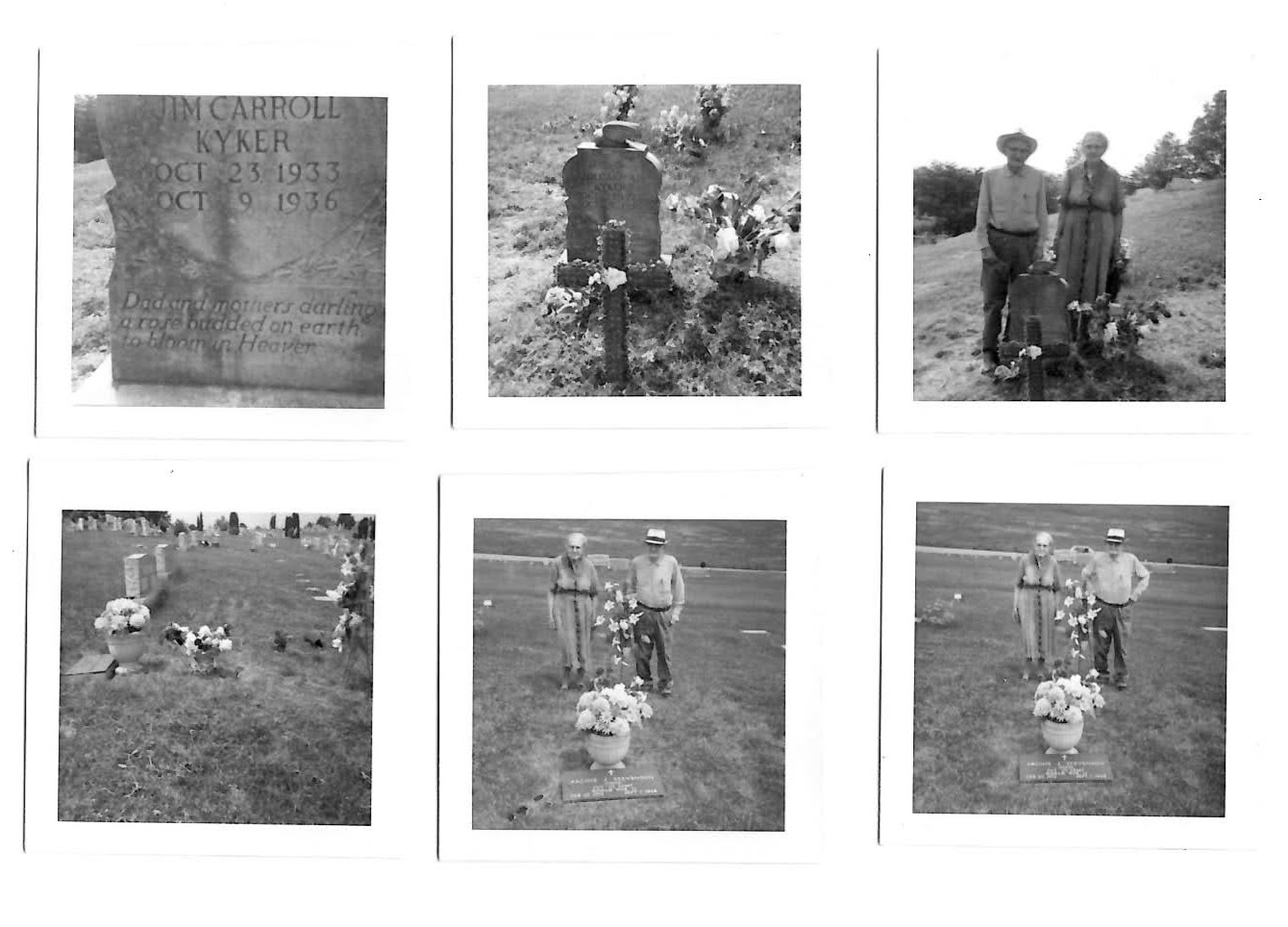
I was going through family photos ahead of Mother’s Day and opened an envelope that I haven’t look in very often because it’s photos of my grandmother in her casket at her funeral. My grandmother on my mother’s side died exactly 2 months before I was born. I had never noticed that my grandmother’s funeral date and my mother’s day of death were just a single day apart in the month dedicated to mothers.

Behind the funeral photos were a set of tiny photos, just a bit larger than postage stamps. I don’t remember seeing these photos before. They were of my grandparents at the grave of my beloved uncle, Jim Carroll, who died just before his third birthday. He died from complications after an accidental drowning. I can only imagine the pain and sorrow his untimely death caused. My mother was born the following year, and she always said that she believed God gave her a sense of humor to lift the spirits of the grieving family, especially her mother.

In the photos, my grandparents are older, so I can assume this was taken in the late 1960s or early 1970s. Little Jim Carroll died in 1936 but the decades that had since passed had not lessened the love for their beloved child.

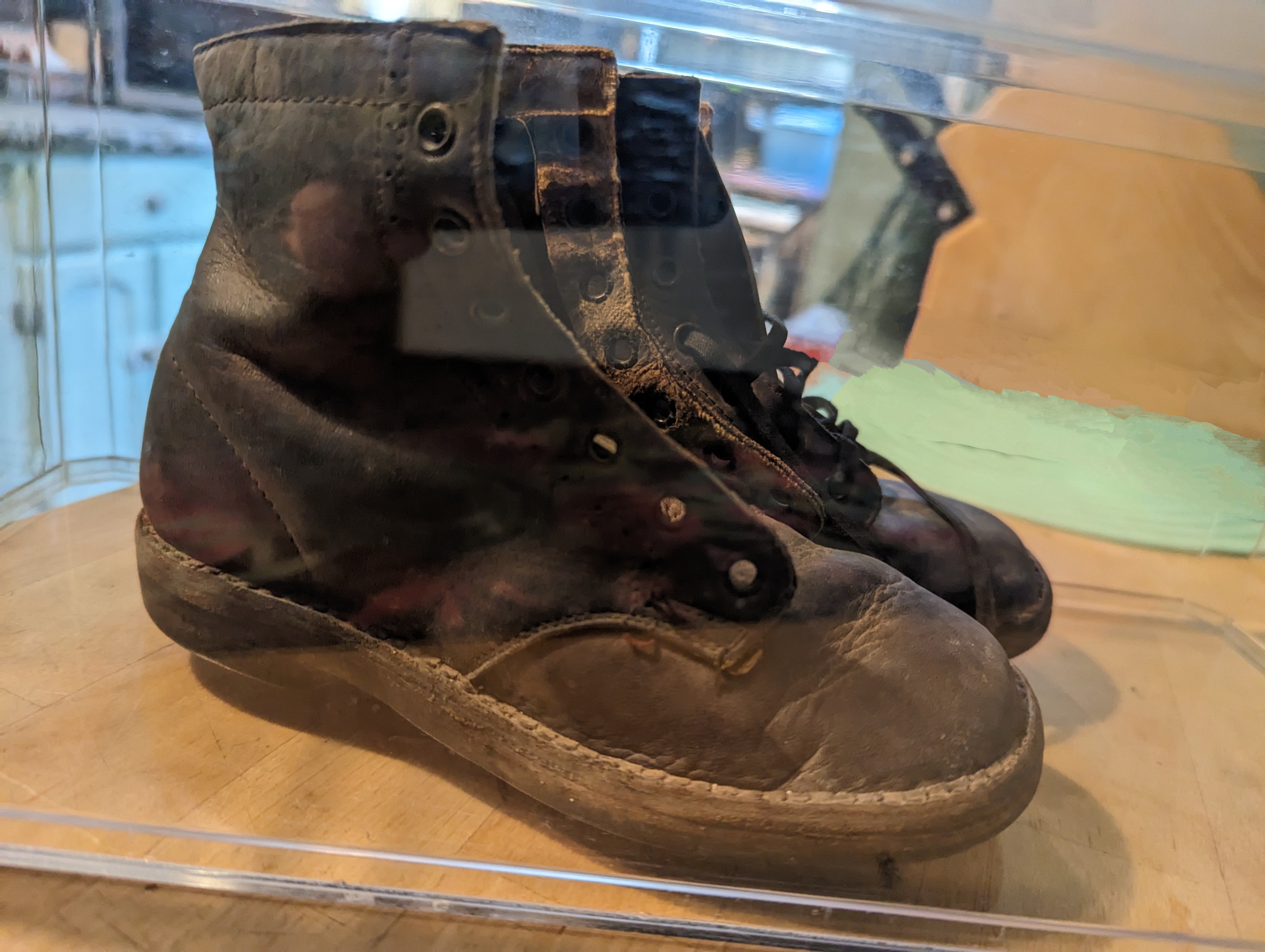
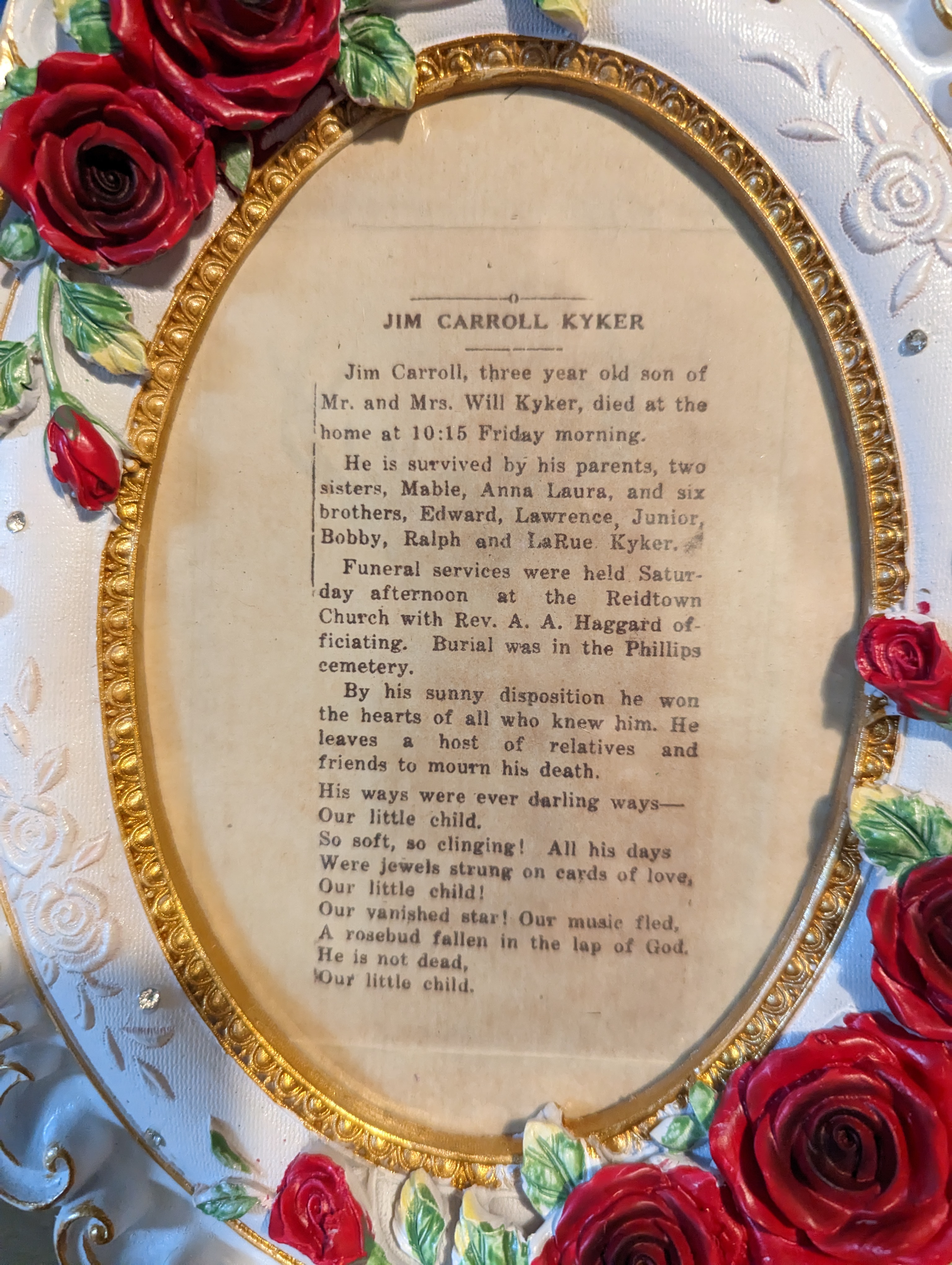
I think of Jim Carroll often, as I have what is a most precious heirloom: his shoes. Still caked with clay, the tiny shoes were handed down to my mother, who was disturbed by the sight of them. I told her to keep them for me. Now they sit on top of my family memorial display, next to his moving obituary.

If you are grappling with family loss this Mother’s Day, I hope you can find some peace and comfort.

Leave a comment

Filed under Memories

Consider sharing your caregiving story

I had a great time at the Atlanta Writers Conference Book Fair. It’s been awhile since I’ve attended a conference in-person. It’s always inspiring to see so much creativity on display.

To that point, I met several caregivers at the Book Fair who shared their personal caregiving stories with me. If you are on the fence about writing about your caregiving experience, I would encourage you to try, even if it’s in a personal journal and not for public consumption. Doing so can be a cathartic experience. You may find that you do have lessons to share that would benefit other caregivers. If so, there are many self-publishing platforms available, in addition to the traditional publishing route.

Understandably, while you are an active caregiver, you likely will not have time to work on a book project. I scribbled down notes, quotes, scenes, anything that I thought I might want to revisit in written form later. Sometimes having a bit of distance can help in framing an experience in a balanced way, but capturing those visceral images in real-time was important for me. I published The Reluctant Caregiver 2 years after my mother’s death and 6 years after my father’s death. Of course if you’ve been following my blog from the beginning you know I began The Memories Project within weeks after my father’s death. At the time I thought I would mainly be writing about my father’s journey with Alzheimer’s but then my mother fell ill. By the end of my caregiving journey with my parents, I had a variety of experiences and lessons to share.

No doubt you will too.

[To give you inspiration, check out the recording of Poetry for the Dementia Journey, a poetry reading event hosted by AlzAuthors. At about the 37-minute mark, you can hear a poem I shared about my father.]

Leave a comment

Filed under Awareness & Activism

Celebrate Read an Ebook Week

It’s Read an Ebook Week. While I’ll always love the feel of pages in a physical book, I do almost all of my reading using my Kindle. It’s just more convenient for my lifestyle.

If you are an electronic book fan, this is a great week to take advantage of special deals. I’m participating in the Smashwords promotions. You can get The Reluctant Caregiver and CBD for Caregivers for just 99 cents today through March 11. Note: It looks like the promotion is so popular that the Smashwords website is experiencing some technical difficulties. If you get a broken link, check back later.

If you are looking for a digital children’s book, you can get Slow Dog for just $2.99 on Amazon.

Happy Reading!

Leave a comment

Filed under Awareness & Activism

‘All the Little Things’ caregiving photo essay delivers big emotional impact

Highlighting the challenges that come with caring for a family member in which you have a difficult relationship dynamic is an issue that is important to me. I discuss my own challenges when caring for my mother in my book, The Reluctant Caregiver.

Lori Grinker has created a moving, powerful photo essay, “All the Little Things,” which is about caring for her mother Audrey. The mother and daughter faced a trifecta of challenges: Audrey was already dealing with dementia when she was diagnosed with cancer at the beginning of the COVID-19 pandemic. Grinker and her mother had always had a strained relationship, but the pandemic delayed a move into an assisted living facility, so mother and daughter lived together for three months. Grinker not only captures images of her mother, but of objects in her mother’s apartment. Those objects sparked memories and discussions that allowed the pair to open up the lines of communication more.

One of the objects that jumped out at me was the worn baking sheet. I remember my mother having a similar favorite baking sheet that she never wanted to discard no matter how discolored it became.

Grinker’s work was awarded the 2022 Bob and Diane Fund Grant. Grinker was also recently interviewed by NPR.

Life isn’t a Hallmark movie, so one shouldn’t expect an “all is forgiven” ending. Grinker told NPR that she and her mother were able to find some love for each other and most importantly, Grinker says she no longer harbors anger for her mother’s actions. She told NPR even if she cannot forgive her mother for some things, she now understands some of her mother’s life choices better.

Audrey died in March 2021.

Photo by Dollar Gill on Unsplash.

1 Comment

Filed under Awareness & Activism

Marking 11 years since my father’s death

It has been 11 years since my father died. The weather is similar as it was on that day, a chilly rain, which in turn is typical Irish weather and reminds me of my father’s homeland.

The moment I received the call from my mother that my father was gone is forever embedded in my memory. The death of a parent is one of those world-stopping moments. It’s not something you get over, but the tide of life will continue to push you forward.

Witnessing the devastation of Alzheimer’s disease first-hand in my family prompted me to become an advocate for finding effective treatments and for better support of family caregivers. I join many others in those causes and I’m grateful for the connections I’ve made through the years.

Sharing your dementia caregiving stories is important and I hope you will continue to do so, whether it’s through a blog or other outlet. I know it’s not always easy to share such personal details, but putting a real face on a disease that has long been kept behind closed doors is essential in raising awareness and building public support for better treatments and services.

My father mattered and so do your loved ones. When those difficult anniversaries come, embrace the good memories and use the tough ones to inspire you to push for change.

2 Comments

Filed under Awareness & Activism, Memories

Complex relationships can complicate grief

With the passing of Queen Elizabeth and marking the 21st anniversary of 9/11 this weekend, I thought it would be a good time to discuss the complexities of the grieving and mourning process. As humans we often crave a blueprint for navigating difficult times. But as a recent article from Next Avenue points out, “Grief isn’t organized; it’s a mess and a natural human experience. There is no ‘normal’ way to grieve.”

I delved into the complicated relationships I had with my parents and how that impacted my grieving process in The Reluctant Caregiver. Diseases like dementia can also leave loved ones feeling conflicted; one may feel feel relief that their loved one is free of such a terrible disease yet still deeply mourn the person’s death.

Others may mean well but how one processes grief is an individualized process. What may seem “normal” for one person may be inappropriate for another. It’s also important to remember that there are many nontraditional family structures now and that we live in a time when people are more encouraged to share and process their family trauma.

For those who are grieving the loss of someone who they had a complicated relationship with, allow the feelings to flow naturally and try to ignore any societal expectations. If you would like help navigating the challenging journey, consult a therapist, grief counselor or grief support group.

Photo by Mike Labrum on Unsplash.

2 Comments

Filed under Awareness & Activism