Would you take a blood test that can predict Alzheimer’s?

This past week, researchers revealed they had developed a blood test that can accurately predict whether a senior will develop dementia in the next few years. The test has been performed on a small pool of subjects, with promising results. The test focuses on a particular set of lipids that are present in those who end up developing Alzheimer’s disease and other variations of cognitive decline. In the studies conducted so far, the blood test has had an impressive 90 percent accuracy rate.

The blood test is still years from being made available to the public as a diagnostic tool for dementia. Still, the fact that a simple blood test now exists raises the question: would you take the test?

blood test

I definitely would want to know, so I would take the test. Something to keep in mind with this particular blood test is that it only can predict the development of cognitive decline two or three years prior to onset. When it comes to genetic testing, some people fear of living with the knowledge of increased disease risk for decades, like a black cloud over their lives. I can understand that, though I have undergone commercial genetic testing that indicates I have the ApoE4 gene variant that increases my risk for Alzheimer’s. But with this new blood test, that window of time is a more reasonable one, allowing you enough time to get your affairs in order and spend quality time with your family. Not everyone would accept this information in a positive manner and it could trigger depression or destructive behavior; obviously the test should never be forced upon a patient.

That being said, I’m not saying that getting those test results indicating you have a 90 percent chance of developing dementia in a few years would be easy to digest. You might well react differently than you think you would.

Would you take a blood test that could accurately predict the onset of dementia?
1 Comment

Filed under Awareness & Activism

Building community to prevent dementia-related tragedies

This story out of Alabama is tragic on so many levels. Neighbors called police to perform a wellness check on an elderly couple, one who has dementia. The neighbors reported not seeing the couple for months. When the police arrived, they saw the woman who has dementia moving about the home. Through a window they could see her husband, clearly deceased, on a bed. When the police gained access to the home, they found the woman with dementia in poor health, and two dogs that they believed starved to death. Authorities believe the woman lived with her dead husband in that home for at least a month.

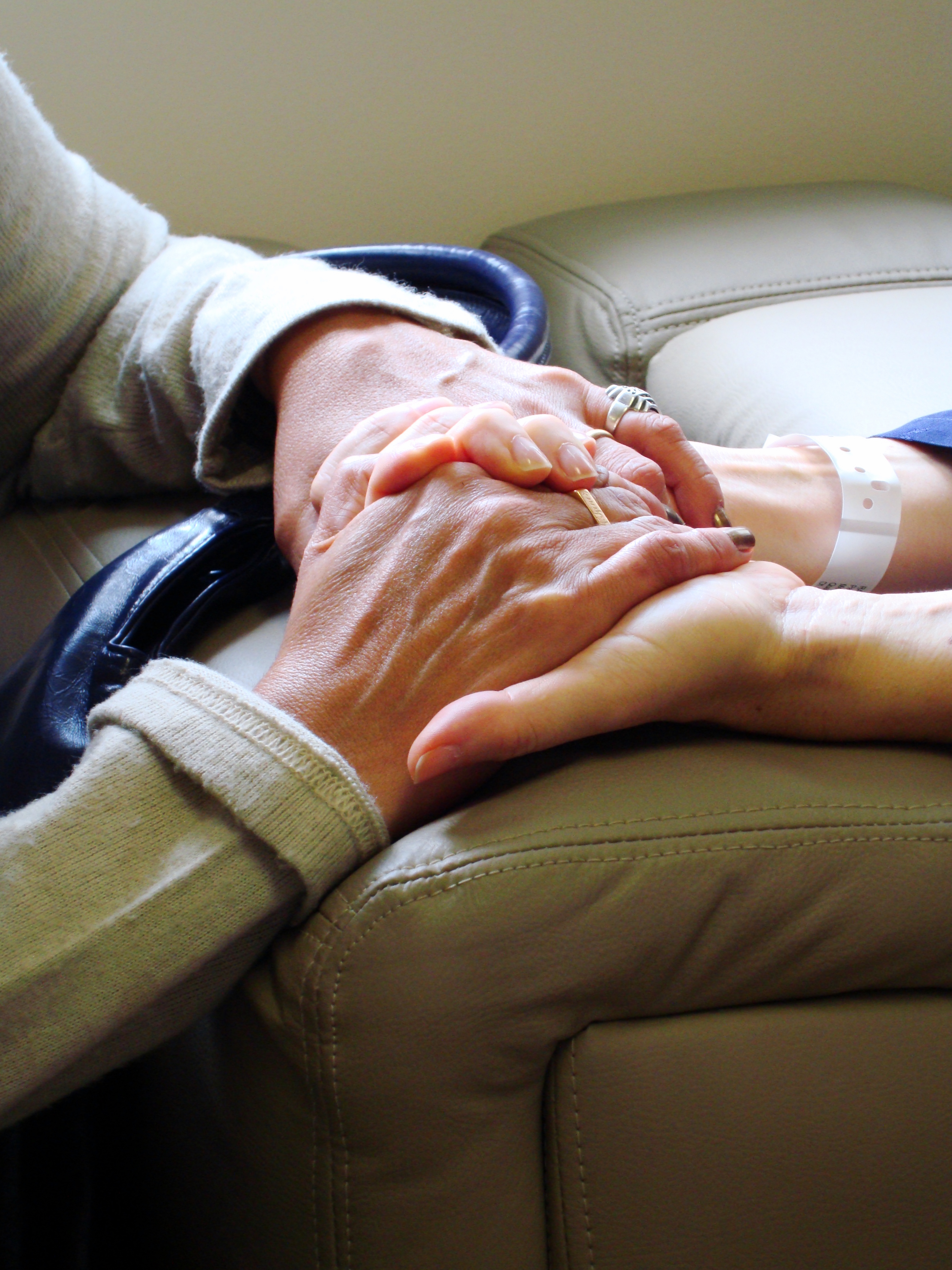
holding hands

We must strengthen our communities to prevent heartbreaking tragedies like these from happening. In our modern society, it seems we have discarded a true sense of community. I keep to myself and do not socialize with neighbors; I live in a big city and while the neighbors seem harmless enough and I speak to them in passing, urban life tends not to encourage close neighborly relations. I did spend an hour tracking down my neighbors across the street to let them know they had left the trunk of their car wide open, so I’m not completely cold-hearted. I work from home so I naturally observe the routines of my neighbors. If I knew I had a neighbor with dementia, I think I would pay more attention. Of course, people have a right to privacy so communities can’t advertise who has dementia even if it is to provide assistance.

I’m not sure what the answer is but there does need to be more safety nets for our elderly population. Not everyone has children or a group of close friends or family members to check up on them. We shouldn’t let these people fall through the cracks, and end up in tragic situations like what occurred in Alabama.

Does your community offer any programs that check-in on seniors to make sure they are safe?

3 Comments

Filed under Awareness & Activism

Voices of the Sandwich Generation Dementia has Fueled

Check out this Huffington Post interview with three women in the sandwich generation that are providing care for parents with dementia. They do a great job at explaining the challenges we all face as caregivers.

Kay H. Bransford's avatarDealing with Dementia

huffpost I was interviewed by Nancy Redd with Huffington Post who did a story on  Parents Who Care For Parents With Alzheimer’s . She interviewed three of us, all at different stages with parents who have dementia and all with children.

You can watch the video interview and hear from:

  • Kathy Ritchie @MyDementedMom (Phoenix, AZ) Blogger at My Demented Mom; Writer. Kathy has a toddler.
  • Kay Bransford @kay_bransford (McLean, VA) Blogger at Dealing With Dementia; Chief Curator at MemoryBanc. I have an 11 and 16-year-old.
  • Susan Poulos (Greensboro, NC) Caring for Mother with Alzheimer’s; Freelance Writer. Susan’s boys are now considered adults.

It was interesting to hear the stories and I hope you will watch. Shared. 

View original post

Leave a comment

Filed under Memories

The dreaded conversation

UsAgainstAlzheimer’s recently sent out an email about planning for your parents’ future, if/when they become incapacitated in body or mind and are unable to care for themselves anymore. The message stressed how important it is to have “the conversation” where you discuss these difficult topics with your family and develop a plan just in case it is ever needed. Of course, I think this is the smart and right thing to do and would encourage all families to do this.

But from my personal experience, easier said than done. As I’ve mentioned before on this blog, my dad had a fear of death so he never wanted to broach the subjects of becoming ill and dying. My mom, ever the chipper one, would respond to my encouragement to fill out the will paperwork by saying, “Well, you already act like we have one foot in the grave. We’re not dead yet!”

momdadme0308-2

I’m hoping that with the baby boomers, such discussions won’t be viewed in such a taboo fashion. And as long as Generation X and younger can fill out a form online, they’ll probably be willing to do it. While the younger generations certainly have earned some fair criticism about their navel-gazing tendencies, in this case, it is a good thing to sit down and spell out exactly how you want these aspects of your life to be. The more introspective, the better!

For those of us who have family members with dementia who did not plan ahead, you often feel like you are stumbling through the dark, hoping you are doing the right thing, but the uncertainty can haunt you in the middle of the night. My dad was afraid of dying, but if he could have understood what his sad reality was going to be with Alzheimer’s, would he have been more inclined to be a DNR? I’m not sure, but I am plagued by what the doctor on duty at the nursing home said the day Dad died. The DNR instructions from the hospital did not make it to the new facility, and the doctor said he thinks the EMS worker broke Dad’s ribs when performing CPR on him. That should not have happened. We as a family should have triple-checked about the DNR order. That’s why it is so vital to discuss these things before an emergency arises, because no one is in a proper frame of mind at that point.

What tactics have worked in your family to discuss these sensitive end-of-life topics?

5 Comments

Filed under Awareness & Activism

My story will appear in “Chicken Soup for the Soul Living with Alzheimer’s & Other Dementias”

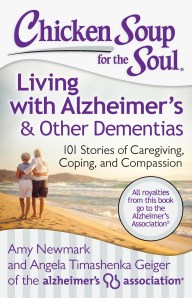
I am very excited to announce that a story that I wrote about my father, called “French Toast,” will appear in a special edition of the popular “Chicken Soup for the Soul” series. This edition features stories about living with Alzheimer’s and other dementias and is a joint project with the Alzheimer’s Association. All royalties from this special edition will go directly to the Alzheimer’s Association. The book will be released on April 22, 2014.

CSS Living with Alzheimer's & Other Dementias

I am thrilled to be a part of this upcoming book, especially for a publisher as popular and well-respected as the “Chicken Soup for the Soul” folks. From thousands of submissions, 101 stories were chosen to appear in the book. I look forward to reading all of the inspirational stories.

If you’re wondering how I came about submitting my story, it was really just by chance. I was doing my daily “looking for paid writing gigs” web search and was on the Work-at-Home Moms website. Now I’m not a mom (unless you count the pets) but I find that their website sometimes posts opportunities I don’t see elsewhere. It was on their website that I saw the “Chicken Soup for the Soul” callout for Alzheimer’s and dementia stories. I said to myself, “Why not?” I submitted two stories: a depressing one and a funny one. The funny one was accepted. 🙂

One of the main goals I had in mind when starting The Memories Project blog was to raise awareness, not just for Alzheimer’s but for family caregivers as well. I’ve virtually met so many wonderful people through my modest but loyal following. The dialogue we have has educated and inspired me and lifted my spirits. Yet I know so many others are struggling silently and I hope by being able to get out the word on a larger platform, more people can get the support they need.

To prepare for the upcoming release of the book, I’ve added a couple of pages to my blog: media appearances and publishing credits. If you or someone you know would be interested in a copy of the book, an interview or a guest blog post, feel free to contact me directly at joyjohnston.writer@gmail.com.

9 Comments

Filed under Awareness & Activism

Caregiving like a labyrinth

I was reading an interview with Gail Sheehy in Today’s Caregiver magazine. In it, she talks about the caregiving journey being akin to navigating a labyrinth. When you make your way through a labyrinth, you must follow the path as it is presented to you, even it takes you forward and then suddenly reverses, taking you back several paces before veering off again. Sheehy talks about requiring patience and faith to reach the center. This can be spiritual faith or faith in nature, yourself, etc. Once you reach the center, think about the physical state of your loved one. Are they on the mend or are they declining? If it is the latter, Sheehy states that you need to accept that you and the loved one you are caring for are on two separate journeys. Their journey through the labyrinth will result in their departing this world soon, where as you must find the path back to your life. Sheehy warns of not sacrificing two lives for one, as she has seen many caregivers do who fail to take care of themselves during their caregiving period.

labyrinth

To me, the concept of a labyrinth perfectly describes the caregiving journey. We move forward, then a setback moves us backwards. We learn more the more time we spend on the caregiving journey. There are frustrations along with successful moves. Eventually, we all reach the same path that includes our exit from this world, but as caregivers we have to recognize that we can only go so far down that path with our loved ones.

Sheehy also discusses the crisis points that caregivers experience and how they can better manage these stages. Sheehy stresses that caregiving should never be a solitary journey; to protect your own health you need to form a circle of care to support you. Easier said than done for many of us, but I think Sheehy’s ideas should receive widespread adoption and community resources should be directed towards these concepts.

3 Comments

Filed under Awareness & Activism

Sharing the Story of Dementia through Pictures

You might learn some new factoids from this infographic, even if you think you are a dementia expert.

Kay H. Bransford's avatarDealing with Dementia

I was recently sent a link to this “infographic” that sums up the large topic of dementia using pictures.

First, I want to reiterate that dementia is the umbrella term used to describe a variety of disease states — from Alzheimer’s to Vascular and even a symptom in some patients with Parkinson’s.

I made the request that they find a way to show the growth of Dementia — I feel as we are getting more education on the symptoms — many more families will find they are starting their journey with a loved one into the land of dementia. Shared.

Thank you to mba healthcare management and Riley for sharing this with me.

Dementia
Source: MBA-Healthcare-Management.com

View original post

Leave a comment

Filed under Memories

Disasters and random acts of kindness

You probably heard about the snowstorm that struck Atlanta, Georgia last week and shut down the city. Many people ended up being stuck on the highway, miles from home. Children were stranded on school buses or at schools, separated from their parents. Elderly people and those with chronic diseases were in need of medications and care. Even though we all knew it was a temporary situation, with temperatures rising well above freezing by the end of the week, during that initial 24-hour period, it gave all of us here a good taste of how people react in dire circumstances.

I was pleasantly surprised to see, that even in this age of selfishness, there were a lot of examples of people going out their way to help those in need. While social media is often seen as a vapid waste of time, people took to online networks like Facebook and Twitter to learn where there loved ones were and to help those in need. People who needed medical attention were taken to hospitals, and a stranded pregnant woman and young child were provided with shelter. Teachers stayed with their stranded students overnight instead of with their own families. One man walked six miles during the snowstorm just so he could spend the night with his daughter, who was stranded at her elementary school.

helping

Sure, there was the guy who drove a fake tow truck to try and steal abandoned cars off the road, but he was quickly caught. 🙂

It made me think about the random acts of kindness bestowed on my family during my dad’s illness and when I was my mom’s caregiver. The little things that made such a difference, like the shuttle driver that bought my mom flowers while we were viewing my dad’s body at the funeral home. That same shuttle driver risked her life to get me to the airport right after a brutal snowstorm so I could try to make it home for Christmas, then came back to pick me up when the airport shut down and drove me to a hotel. I sent her a thank you card but there really is no way to repay these acts of kindness. There was another shuttle driver who picked me up from the hospital in his personal car after he had completed a long day at work, when I was stranded at the hospital with mom and literally had no other way to get home.

When you are a caregiver, these simple acts of kindness make such a difference, whether you find yourself dealing with a disaster on a personal or larger scale. Bless all of those people who open their hearts and help those in need.

Leave a comment

Filed under Memories

I Think I’m Going to Cry

The sentiments and observations in this post are so true. My mom would snap at my dad when dementia first reared its ugly head, then feel terrible about it later. Of course, as caregivers, we all struggle with guilt. That’s why offering support to family caregivers is so important.

Leave a comment

Filed under Memories

Other people’s memories: “Half a Life”

A memoir that relies heavily upon the memories of a single life-changing event is “Half a Life” by Darin Strauss. I’m sure you’ve read many stories about a tragic car accident that claims the life of an innocent person. While often alcohol and drugs are involved, sometimes these events are truly accidents, with no direct fault assigned to the person behind the wheel. Have you ever wondered what happens to these people? To know, even if you weren’t directly at fault, that your actions claimed the life of another human being … how would you manage to go on with your life carrying that memory? Well, author Darin Strauss knows, because he was the person behind the wheel of the car that struck and killed a classmate who was riding a bicycle.

2014-01-21 19.18.43

Strauss had just turned 18, and perhaps the inattention and inexperience of a young driver played roles in the accident. Still, no charges were ever filed and his community, even the deceased classmate’s parents seemed to forgive Strauss. But then the grieving parents decided to sue Strauss for millions of dollars, and the case dragged on for several years, thwarting Strauss from moving on with his life. Even though he saw a therapist, he never worked through his guilt and other feelings surrounding the tragedy. He did what many of us try to do during difficult situations: he put a smile on his face and carried on, suppressing his emotions.

The memory of the accident haunts all facets of his life, from work to friendships to the dating scene. Not only do the lingering memories of the accident have a negative impact on his emotional well-being, they physically make him ill and he has to have stomach surgery before turning 30.

Finally, as he marries and becomes a father, he decides to engage in the best therapy of all for a writer: he would write about the experience in a memoir. The result is a powerful work, and a lesson for all of us trying to process difficult memories. I was very moved by this book and highly recommend it.

Leave a comment

Filed under Memories