Tag Archives: Alzheimer’s

New survey shows need to increase Alzheimer’s awareness for American women

While it may seem unfathomable to those of us who have seen Alzheimer’s and other dementia touch the lives of our families, a new survey from the Cleveland Clinic suggests that the majority of American women may not be aware of their own risk for the disease.

In what researchers from the Women’s Alzheimer’s Movement (WAM) at Cleveland Clinic called a “startling fact,” 82 percent of women do not know they are at increased risk for Alzheimer’s disease, though two-thirds of cases are women. Only 12% of women who took the survey knew about a potential link between estrogen loss and Alzheimer’s, an area that the Cleveland Clinic is researching.

In other findings from the study, 73% of women have not had a discussion with their doctors about their cognitive health and 62% of women have not discussed menopause or perimenopause. The changes women experience during menopause can impact cognitive health, so it’s important for women to talk to their doctors to learn steps they can take to reduce their risk of dementia.

According to the study, two in five women have dealt with anxiety, depression and/or insomnia.

One not surprising finding from the study: 56 percent of women reported not getting enough sleep. We know that sleep quality can have a direct impact on cognitive health and there is research to suggest poor sleep quality during mid-life can increase one’s risk of dementia. A potential reason for the poor sleep? Over half of the women who took the survey said they cared for others.

While the results of the survey are concerning, researchers said the good news is that women are interested and motivated in learning more about ways they can maintain good cognitive health.

Image by geralt/Pixabay.

Leave a comment

Filed under Awareness & Activism

Reflecting on Father’s Day

Thinking of Dad on this Father’s Day weekend. One thing I’ve been reflecting on lately is how even when my father was dealing with the latter stages of dementia, he would tell my mother and I to be careful. He was still trying to protect his family.

To those who have lost their fathers to dementia or who are actively caring for their father with dementia, I hope you can find comfort in loving reflections. For those whose fathers are still alive, I hope you get to spend quality time with him this weekend. Finally, I want to recognize all of the amazing male caregivers out there, fathers and husbands and brothers and sons, who care with compassionate strength.

Leave a comment

Filed under Memories

The Happy Caregiver — When Dementia Knocks

This is a very good message to pass along to the dementia caregiving community. While I tend to focus on the struggles of being a reluctant caregiver, it’s important to note that some caregivers do find a way to maintain a decent quality of life. As Elaine points out in her blog post, having sufficient funds to cover care costs is part of it, but attitude is also a factor.

Click through the link below to read the thoughtful post from When Dementia Knocks:

I write a lot about the challenges of dementia caregivers…their high rates of clinical depression and anxiety…their loneliness…their daily stressors. This post doesn’t change anything I’ve written in the past, but I do want to acknowledge something. Some caregivers are doing okay. Some caregivers are happy. Some caregivers are enjoying life and thriving. That doesn’t […]

The Happy Caregiver — When Dementia Knocks

Leave a comment

Filed under Guest posts

Marking 7 years since Mom’s death

The top of Mom’s urn.

It has been 7 years since my mother died. The pandemic has made time’s passing more difficult for me to track. Seven years feels both not long ago and yet another lifetime ago. I think my mother would be very upset about the state of the world right now, as she always looked for common ground and the good in people. Those things seem to be in short supply these days.

I did have a moment of synchronicity today. I was listening to Glenn Campbell’s late masterpiece albums, Ghost on the Canvas. It was recorded after Campbell’s Alzheimer’s diagnosis and was one of my mother’s favorite albums. It’s one of my favorites too, and I’ve listened to it dozens of times. Today I played it on the YouTube app on my TV and when I looked up during one of the instrumental interludes, I realized the song was titled, May 21, 1969.

I had never noticed this before! According to information I found online, May 21, 1969 was the date the date Campbell’s network variety show debuted on network TV. It would become a hit and known as “The Glen Campbell Goodtime Hour.”

What are the chances that May 21, the day my mother died, would also be in a song title of one of our favorite albums? The moment felt like Mom’s spirit connecting with me through the wonders of the universe.

2 Comments

Filed under Memories

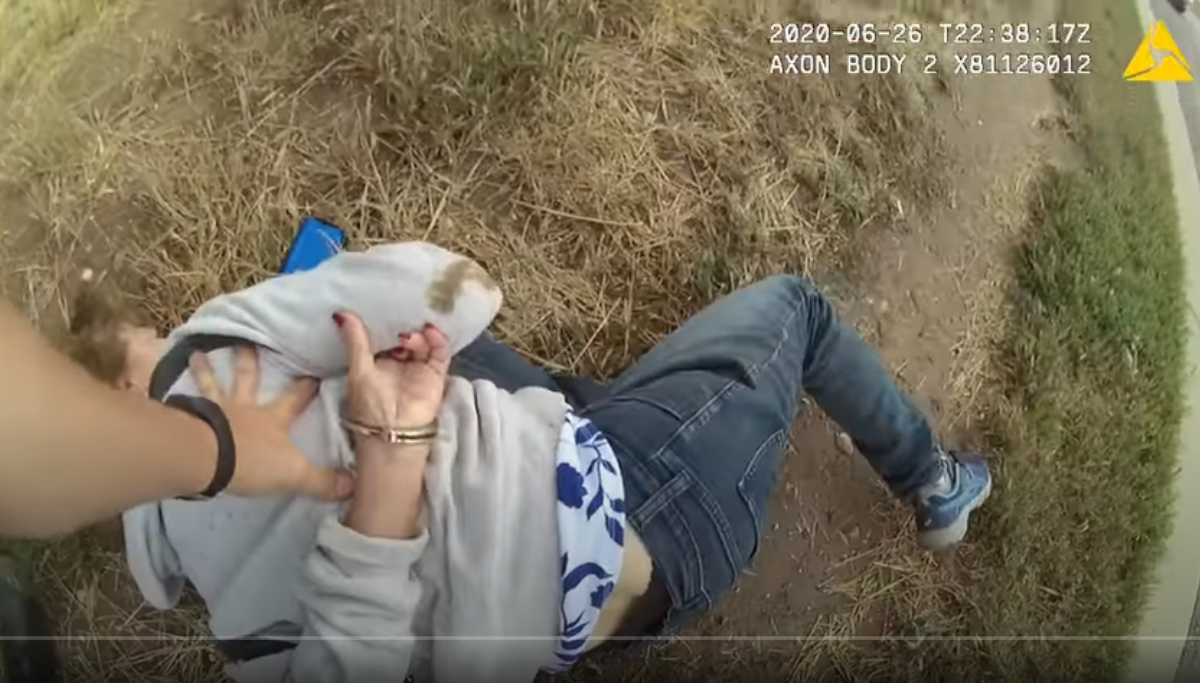
Officer who injured woman with dementia during rough arrest sentenced to 5 years in prison

Still taken from video courtesy of The Life & Liberty Law Office

It seems rare that justice is done in cases like these so I wanted to give an update on a case that I’ve written about previously on The Memories Project.

A police officer in Colorado who used excessive physical force against a 73-year-old woman with dementia who had been accused of shoplifting has been sentenced to 5 years in prison.

The case went viral after the video of the rough arrest was released to the public and shared on social media. Karen Garner was accused by Walmart staff of trying to walk out of the store with $14 of merchandise in June 2020. Staff were able to retrieve the merchandise in question, but Garner walked away from the store before police arrived. Officer Austin Hopp attempted to stop Garner, who was confused and not cooperative due to her dementia. Hopp proceeded to slam Garner to the ground during the arrest, dislocating her shoulder. She was also hogtied and suffered a fractured arm and sprained wrist.

Garner’s ordeal didn’t end there. When she complained about pain at the police station, she was mocked and ignored. Hopp and two other police officers laughed about the incident, boasting, “We crushed it.”

You can watch the arrest below. Viewer discretion advised.

A female officer involved in the arrest has also been charged in the case and has a court hearing in June.

May is Mental Health Awareness Month so it’s a good time to advocate for dementia training for law enforcement. West Virginia Gov. Jim Justice signed a bill into law in April to establish dementia training for law enforcement. Every state should have such a training program.

2 Comments

Filed under Awareness & Activism

When Money Habits Change — Dealing with Dementia

This is such an important topic and I’m grateful for Kay Bransford’s excellent blog post. As my father’s dementia progressed, simple tasks like paying for groceries or a fast food meal became a challenge that caused my father to become angry and accuse others of trying to rip him off. My mother eventually had to take over those tasks. After my father’s death, my mother’s loneliness made her susceptible to the barrage of telemarketers who would call on a daily basis. As a long-distance caregiver, it was difficult and frustrating for me to try and manage from afar.

Click on the link below to read the helpful post on Dealing with Dementia:

There were a few odd conversations with my Mom when things didn’t make sense. But the most alarming thing was when I realized my parents had changed their decades-long habit of giving every January. I started to notice that my mother was writing checks to charities that they had never previously supported. I would read…

When Money Habits Change — Dealing with Dementia

Leave a comment

Filed under Guest posts

HFC’s Humans of Dementia Storytelling Contest for students is seeking submissions

HFC’s Humans of Dementia Storytelling Contest is open and will be accepting submissions through April 30. This is a great way for young people to share their experiences of caring for a loved one who has Alzheimer’s or other dementias.

More about the contest: “HFC invites high school and college students to submit written or photo profiles of someone you know who has or had Alzheimer’s or related dementias.”

HFC, formerly known as Hilarity for Charity, was founded by actor Seth Rogen and his wife, Lauren Miller Rogen. Lauren’s mother developed early-onset Alzheimer’s at age 55 and died in 2020. HFC’s mission statement: “HFC is a national non-profit whose mission is to care for families impacted by Alzheimer’s disease today, activate the next generation of Alzheimer’s advocates, and be a leader in brain health research and education.”

Please share with the students in your life who have been touched by Alzheimer’s and other dementias. Encouraging our youth to share their perspectives on this disease will help spread awareness and embolden younger generations to contributing to finding effective treatments and care options.

Leave a comment

Filed under Awareness & Activism

2022 Alzheimer’s disease facts and figures

The Alzheimer’s Association has released its 2022 Alzheimer’s Disease Facts and Figures report.

This year, the Alzheimer’s Association is taking a closer look at Mild Cognitive Impairment (MCI) and encouraging greater awareness and understanding of this condition and its relation to Alzheimer’s disease.

Here are some of the top takeaways:

  • More than 6 million Americans are living with Alzheimer’s
  • 1 in 3 seniors dies with Alzheimer’s or another dementia
  • In 2020, COVID-19 contributed to a 17% increase in Alzheimer’s and dementia deaths
  • More than 11 million Americans provide unpaid care for people with Alzheimer’s or other dementias and in 2021, these caregivers provided more than 16 billion hours of care valued at nearly $272 billion.
  • Fewer than 1 in 5 Americans are familiar with mild cognitive impairment (MCI), which can be an early stage of Alzheimer’s
  • About one-third of people with MCI due to Alzheimer’s disease develop dementia within 5 years of diagnosis

Leave a comment

Filed under Awareness & Activism

Reflections on death being more about the journey than the destination

Photo by Greg Rakozy on Unsplash

I recently had the privilege of writing a blog post for The Conversation Project. My father died 10 years ago and in May, I will be marking seven years since my mother’s death. I’ve had a lot of time to think about end of life issues in the years since their passing and I’ve shared my perspectives here on The Memories Project blog and in my book, The Reluctant Caregiver.

In my post for The Conversation Project, A Good Death Is More about the Journey than the Destination, I discuss my family’s reluctance to talk about death and end of life issues, and how that impacted their end of life journeys, albeit in very different ways. My father’s death impacted how I cared for my mother, when just several months later, she was diagnosed with cancer.

Neither of my parents experienced the kind of death that I would want for myself, and that is why it has become such an important advocacy issue to me. Please talk to your loved ones, discuss your end-of-life wishes and document it all so that you can have some peace of mind when that phase of life is reached. What I wish for everyone is that you can find the time to simply be with your loved ones who are nearing the end of life, and not overly preoccupied with medical care duties. Just like at the beginning of life, it’s important we have those bonding moments at the end of life as well.

Visit The Conversation Project for tips and guides on how to start these important conversations with your own family.

Leave a comment

Filed under Awareness & Activism

Studying blood vessels in the brain to develop targeted treatment for Alzheimer’s

There is more interesting research going on in the world of Alzheimer’s. Scientists are examining whether the brain’s infrastructure plays a role in a person’s risk of developing Alzheimer’s. A damaged vascular system in the brain could develop cognitive performance issues, akin to an aging power grid that struggles to deliver power to a city, according to the research discussed in this Stanford Medicine Scope blog post.

In looking at a genetic atlas of the brain, researchers found that the “majority of the top Alzheimer’s risk genes are significantly expressed in the [brain’s] vasculature.” If you want to do a deep dive into the research, take a look at the study published in Nature.

The new technology used to create a genetic atlas and the accompanying discoveries give Alzheimer’s researchers new avenues to explore. No cause and effect has been established yet between brain vascular damage and Alzheimer’s risk, but there will now be additional research conducted to examine this area.

What could this mean for potential treatment of Alzheimer’s disease down the road? According to the Tony Wyss-Coray, who runs the lab where the research was conducted, treatments that could target the brain’s vascular system may be more easily accessible as the blood-brain barrier presents a challenge when it comes to getting drugs into the brain.

Leave a comment

Filed under Memories