Houser, Ari, Selena Caldera, Brendan Flinn, and Rita Choula. Valuing the Invaluable 2026: Family Caregivers’ Contribution Reaches $1 Trillion. Washington, DC: AARP Public Policy Institute, March 26, 2026. https://doi.org/10.26419/ppi.00402.001.
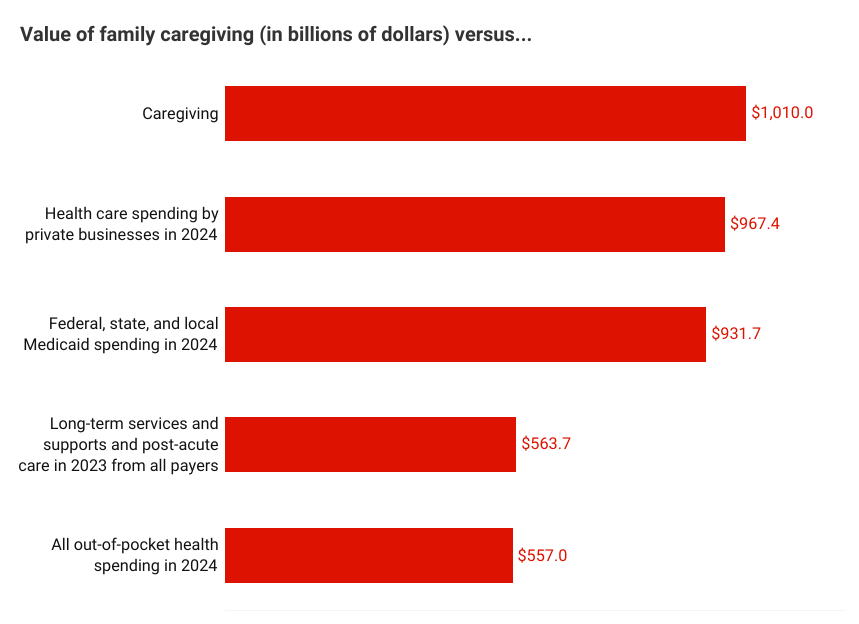
The latest caregiver report has been released by the AARP Public Policy Institute. Titled “Valuing the Invaluable 2026” the report, researchers found that the economic value of family caregiving in 2024 was worth a whopping $1 trillion.
In comments on the report, AARP CEO Dr. Myechia Minter-Jordan said, “When you look at caregiving at this scale, it becomes clear that this is not just a personal responsibility; it is a foundational part of our economy and our care system, and it is time we start recognizing it that way.”
Here are other main takeaways:
The $1.01 trillion amount breaks down to 49.5 billion hours devoted to family caregiving, equaling a workforce of 23.8 million full-time workers.
An estimated 59 million family caregivers helped an adult family member, neighbor, or friend with daily activities during the year, with 63 percent providing monthly care.
The economic value of family caregiving exceeded the total amount of federal, state, and local Medicaid spending in 2024 ($932 billion).
The cost and value of family caregiving has grown rapidly since the AARP’s first caregiving report in 2006, where the economic value of caregiving was found to be $350 billion.
Family caregivers now average 27 hours of care per week. This is on top of a part- or full-time job, plus for sandwich caregivers, caring for children and elder relatives at the same time.
More than half (55 percent) of family caregivers perform tasks typically handled by health care professionals, such as giving injections or managing a catheter. As a caregiver for my mother, I was required to care for her colostomy and after much trial and error, learned to manage her colostomy bag quite well. As I wrote in The Reluctant Caregiver, this task was well outside of my skillset and comfort zone, but as the sole family caregiver, I had no choice but to step up and take charge.
In conclusion, AARP noted: “This unpaid care generates significant public benefit, including savings for taxpayers, yet it often does so at considerable cost to caregivers’ own health, well‑being, and long‑term economic security.”
To kick off the year I had to repipe my home, something I had been dreading and putting off for several years. I had a lot of old galvanized pipes that had been there well before I purchased the property in 2005. For years I had been patching leaks; sometimes the would rust/corrode over which bought me a bit more time but made me recoil at the idea of the water quality coming through these ancient pipes.
It was one of those home improvement projects that hung over me like a dark cloud. I’m not a procrastinator, quite the opposite, but the cost of an entire home repipe is astronomical. It’s one of those projects you hope to put off until you get some kind of windfall, but let’s face it, that rarely happens in life. Same thing with caregiving situations; a medical crisis doesn’t wait until you have a nice rainy day fund.
Even though home improvement and caregiving may seem to have little in common, I did find that some of my prior caregiving skills and experience came in handy. Initially I had a similar sense of intense dread about this project as I did about caregiving, but once I’m committed, I’m all in.
Researching topics I know little about gives me some sense of control I crave in these types of situations. My researching abilities are my strength and organizing price quotes, materials, and methods for my plumbing project reminded me of how I researched care options for my parents.
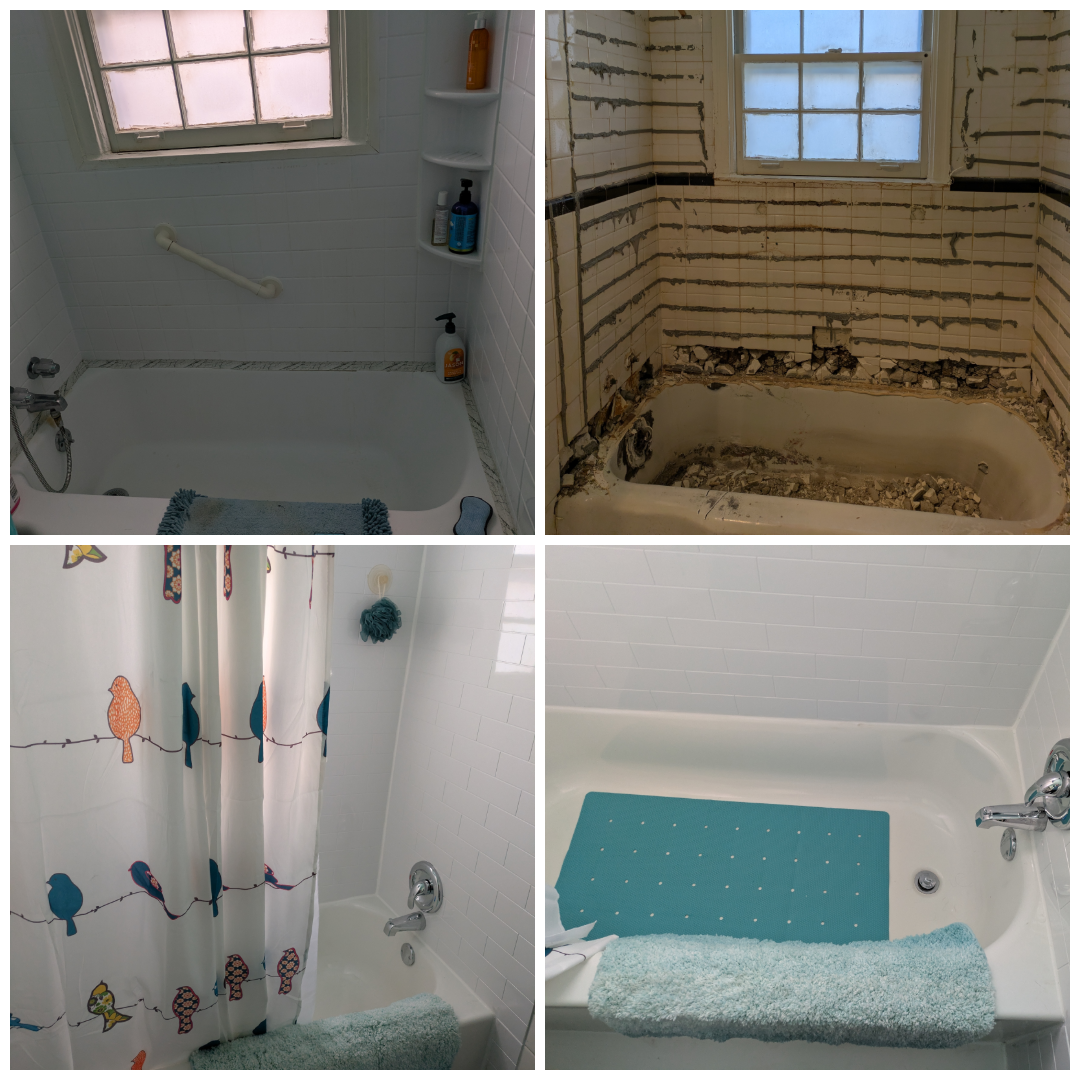
Flexibility is not one of my strengths but required in both home improvement and caregiving situations. There is always a level of uncertainty involved and one has to steel themselves for unexpected outcomes. Admittedly, I thrive on order and structure; I’m a deliberate decision maker and don’t like making spur of the moment decisions. But I find that I’m able to adapt when necessary. I learned to dread the knock on my bedroom door when the plumbers came across the unexpected and needed my input, such as tile behind the shower wall, and an ancient cast iron tub inside the tub I’d been using for the past 20+ years! But I pushed through, just as I did with making caregiving decisions.
Another area where I found similarity between home improvement and caregiving is having to rely upon other’s opinions and advice. As an independent person, this is a challenge for me to be “needy” even though I was certainly paying a high price tag for plumbing expertise. With caregiving, I felt a similar helplessness, relying upon the medical expertise of strangers who I hoped had the best interests of my parents in mind. I will say I gained an entirely new appreciation for plumbers and the technical expertise they have.
Co-existing with a house full of strangers and the constant noise that ensued was another challenge. I work remotely so there was a high level of disruption for a few days. I was concerned about how my senior dog Murphy would do, as he’s not fond of strangers in the house. Would he bark nonstop for hours on end? I made sure I had my noise-canceling headphones fully charged. Funny enough, Murphy slept through all of the drilling and hammering and only barked when he heard people on the stairs. I also was concerned about the cats escaping outside, as the plumbers at one point had to access the room I was keeping them enclosed in but fortunately they stayed put. Ironically, I got even more work done than normal because I didn’t want to be in the plumbers’ way so I stayed glued to my desk.
Once the repiping was done, I had to bring in another service to fix the tile damage. By the time I got quotes and service scheduled, I had been staring at my nice new shower for over two weeks but unable to use it. Then there was a missing part of the shower trim that I had to order and have the plumbers come back and install. In total, I went almost an entire month without a proper shower. (At least I had a nice new sink to do sink baths. And also good thing it’s winter and I live alone.) After the shower tile renovation was completed, I had to repaint a bit, add waterproofing, and re-do the floor tile. In fact, I just finished today one of the final steps, about six weeks after the project got started.
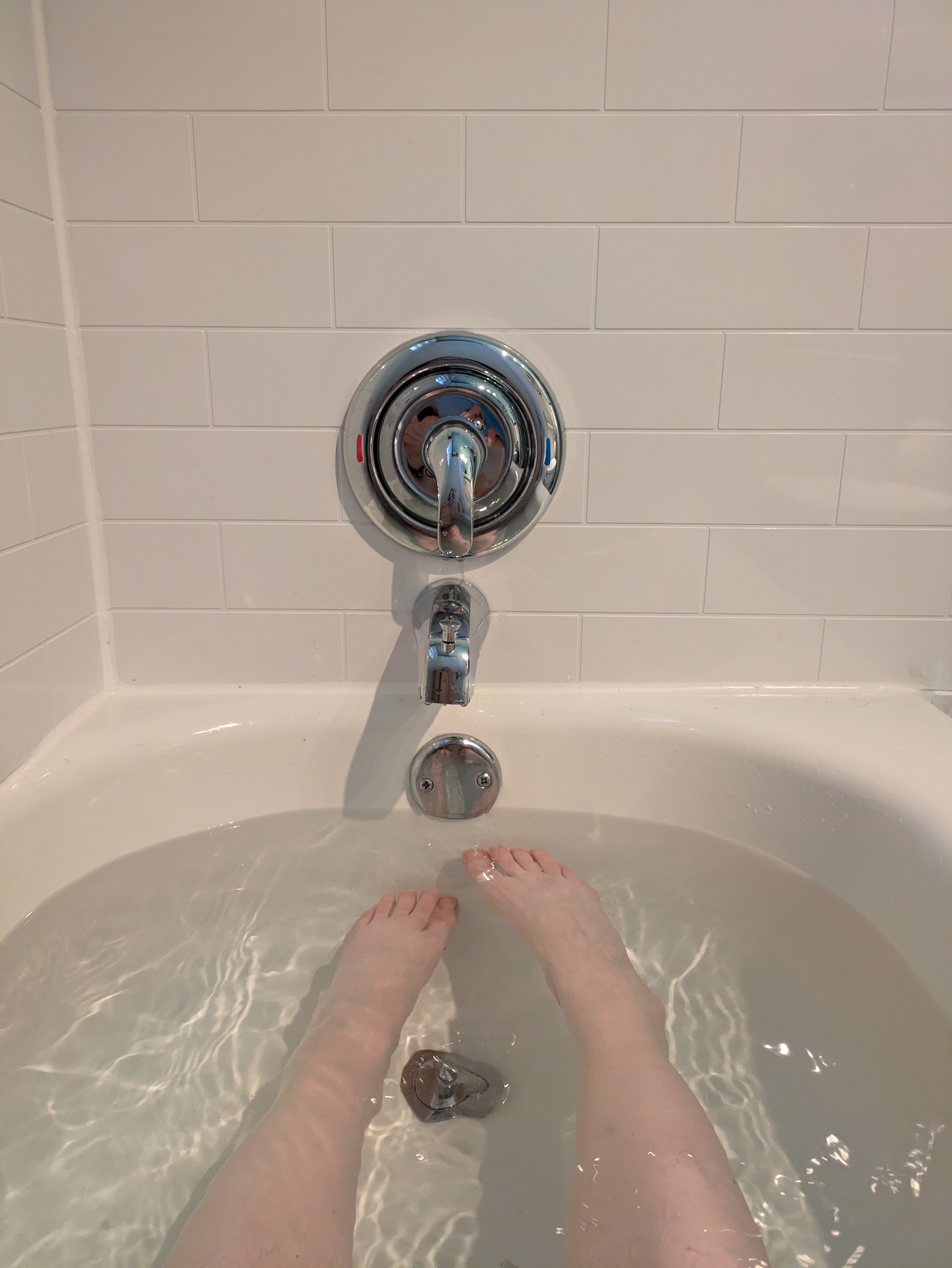
Yes, I finally had a bath! Celebrate the small wins, just like in caregiving.
I’m relieved to have nice, new plumbing and everything is working well, but after all of the effort and astronomical cost, it does feel a bit anticlimactic. Caregiving can feel like that sometimes; my mother slowly recovered from cancer surgery and then one day she was independently living again but there wasn’t a definitive winning moment. Life just moves on, one way or another.
A new toilet and sink aren’t sexy, but it does make one appreciate the basic necessities of domestic life more.
Finally, home renovation and caregiving have another thing in common: they are both expensive! I half-joke that I should start a GoFundMe but instead, I will link to my books, if you’d like to contribute to my unofficial plumbing expense fundraiser: The Reluctant Caregiver | Slow Dog.
This weekend I got what turned out to be a funny reminder to slow down. Yesterday I was knocking out a bunch of household chores and was intent on getting the bed made before lunch. I was making ramen for lunch and had some leftover beef broth from making soup earlier in the week that I wanted to use instead of water to make it extra tasty.
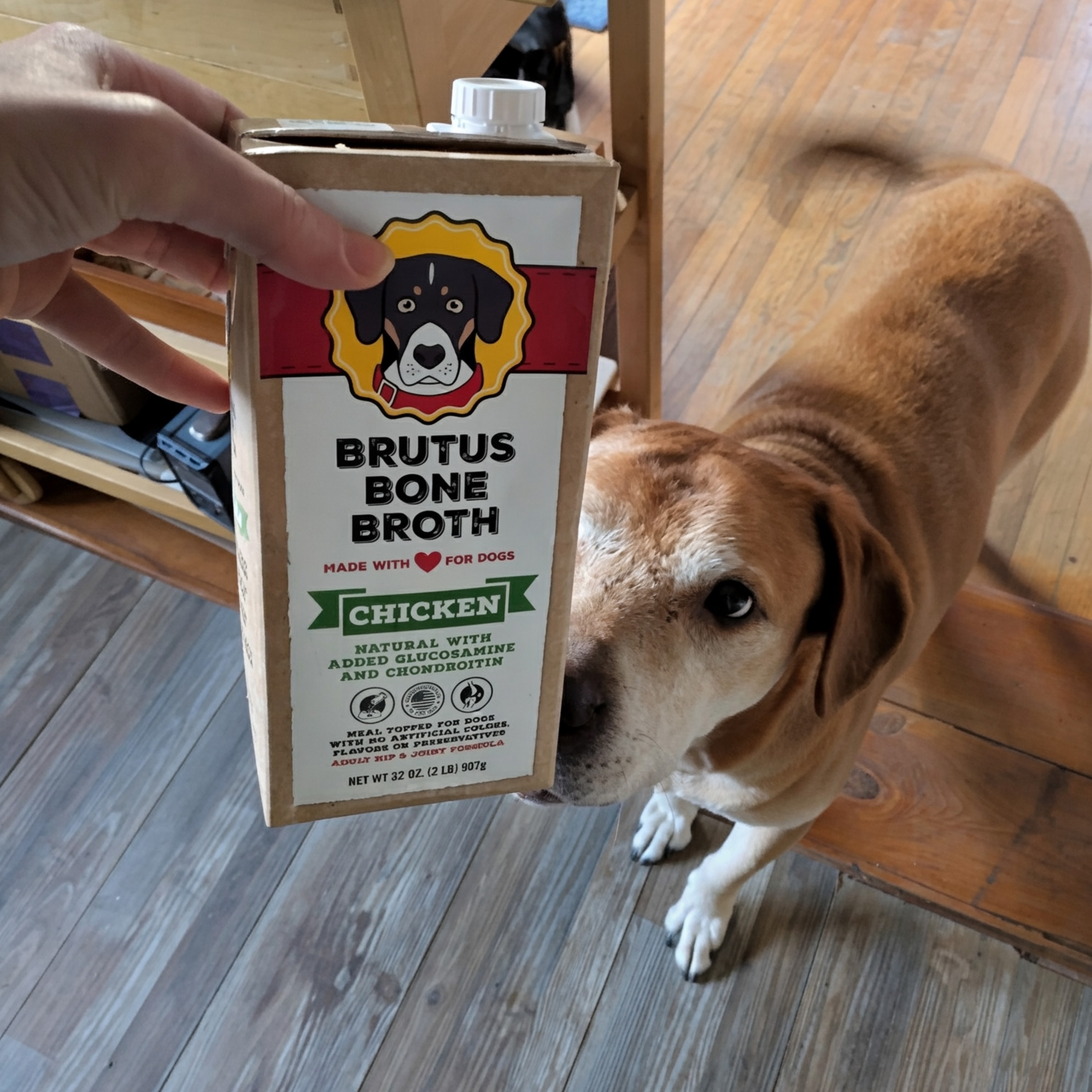
Murphy, my senior dog, also enjoys a bit of Brutus Bone Broth with his meals, a special formulation for dogs with supplements for joint health. I keep the broth containers, which come in similar carton containers, on separate shelves in the refrigerator after opening so I don’t accidentally give Murphy my broth which has sodium and seasonings like onion and garlic in it.
Welp, you can probably figure out what happened next. Yesterday in my rush to have all my chores done before lunch, I started the ramen while distracted and let it cook while I made the bed. [First mistake.] Murphy was extra excited in the kitchen and getting underfoot while I was making lunch, so I shooed him out. [Second mistake.] I got the bed made and ate my lunch and then got ready to feed the dog that evening.
And when I opened the refrigerator, I was surprised to find no dog broth. How is that possible, it wasn’t near empty yet ….
Ruh-roh. That’s when my eyes saw the container of beef broth, still sitting on a lower shelf. I had accidentally used the dog’s broth in my ramen.
I probably turned a little green around the gills while I dug the dog broth carton out of the trash. My first concern was if the broth was gluten-free, as I’m a celiac and strictly follow a no gluten diet. I breathed a big sigh of relief when I saw those two magical words “gluten free” on the label. That was followed closely by two more welcomed words: “human grade.” Scanning the limited, whole-food ingredients, the dog-formulated broth was probably healthier than the broth for people. The joint supplements were also fine for people.
I’m fine and can laugh about the whole situation now, especially Murphy trying to give me a sign. He was probably wondering what yummy treat I was making him with his broth! Fortunately I had another container of dog broth in the pantry, so he will not go without. You would think the author of Slow Dog would take some her own advice. It’s a good reminder that being intentional requires daily practice.
As a caregiver, of course, it’s even more important to not be distracted when preparing meals to avoid allergies or drug interactions. Your and your loved one’s well-being is more important than when the bed gets made. Lesson learned and noted!
Looking for more caregiving tips? I’m participating in the The 17th annual Smashwords Read an Ebook Week sale. Get the e-book version of The Reluctant Caregiver for half off through March 7, 2026.
I’ve been fortunate to be part of the AlzAuthors community over the years and had the opportunity to share The Memories Project blog, my personal essay collection The Reluctant Caregiver, and more recently, poetry. I look forward to this new chapter and supporting the mission of sharing the work of authors writing about the Alzheimer’s and dementia experience. In addition to showcasing books, AlzAuthors hosted a podcast and a film festival.
AlzAuthors celebrated its 10th anniversary in 2025. I’m grateful to all of the volunteers who donated their time and talent to build and grow such a wonderful organization.
For those who have contributed to or have used AlzAuthors as a resource, the website and its helpful content will remain available. Stay tuned as new opportunities to share and connect become available.
Each dementia case is unique. There are many forms of dementia, each which affect different parts of the brain and may cause different cognitive symptoms. As a caregiver, one area that can be difficult to navigate is how much help a loved one with dementia needs. That’s in part because progression isn’t linear and there may be good and bad days that can create an emotional minefield for family members. It can be heartbreaking to see a loved one’s reaction when they realize they are losing their independence even when family caregivers have their best interest at heart. On the other end of the spectrum, family members can feel tremendous guilt if an incident happens because they weren’t monitoring their loved one enough.
Dr. Elaine Eshbaugh had a good post on this topic on her blog, When Dementia Knocks. As she points out, there’s no definitive guide or course of action to follow. The best advice is simply to pay attention, try to include your loved ones with dementia in daily activities as long as it’s having a positive impact, and don’t beat yourself up because you did too much or too little on any given day. As a caregiver, the most important moments to step in are for safety reasons. If your loved one loves to cook but it’s not safe for them to cook alone, maybe you have a night where you cook together. If your loved one can no longer safely drive, consider taking them for scenic drives or on a drive to a favorite spot.
It can be a challenge to honor a loved one’s independence while at the same time protecting them from harm. So much of dementia caregiving becomes ad-libbing your way through each day. As Dr. Eshbaugh says in her blog post: “You won’t always get it right, and that’s okay.”
Wishing you and your family a holiday filled with love.
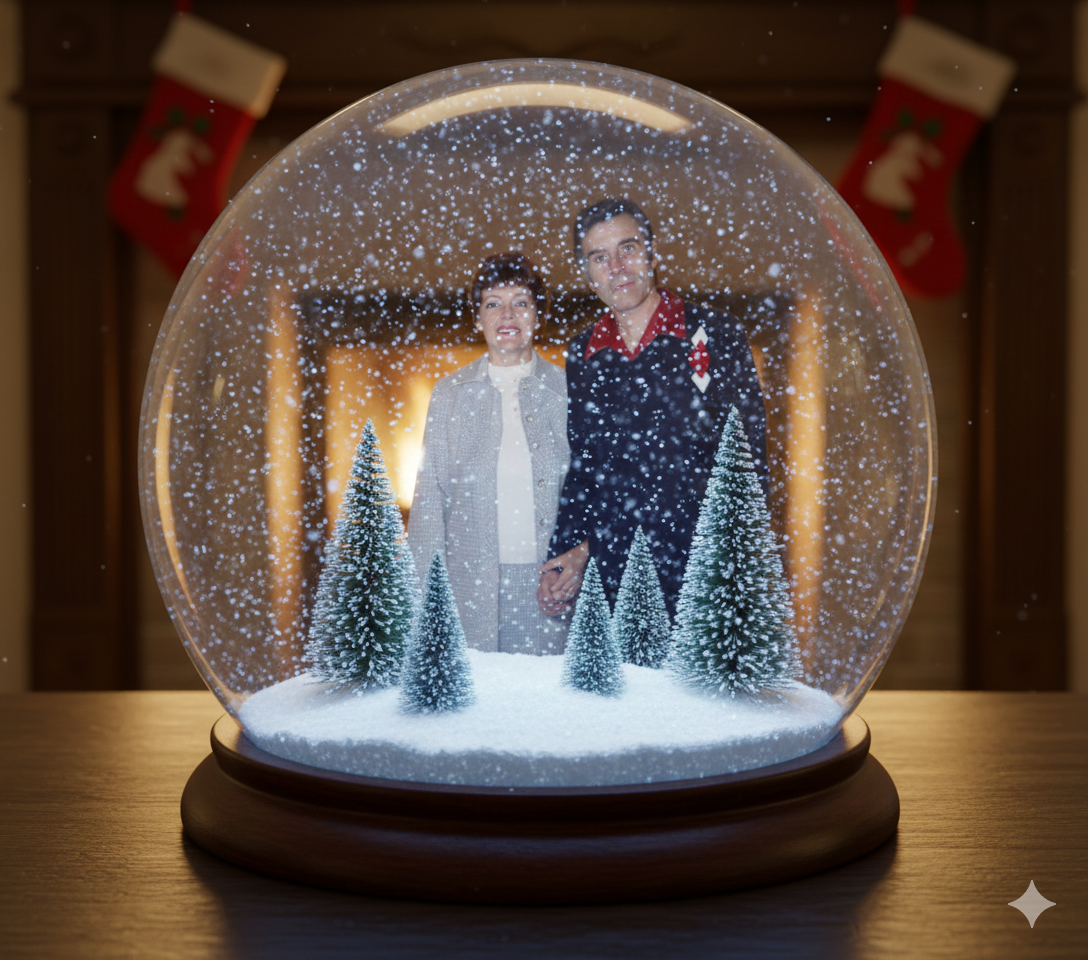
For those of us grieving the loss of a loved one this holiday season, may you find some sense of peace and solace in honoring your loved one’s memory in a way that is meaningful to you. For me, that is looking at photos from my childhood. I created a virtual snow globe featuring a photo of my parents at Christmas.
Remember the caregivers in your life, and if possible, offer to pick up a task so that they don’t feel overwhelmed this holiday season and can carve out a bit of self-care time. Respite care comes in many forms.
Need a last-minute gift? E-books make a great gift. Smashwords is running the 2025 End of Year Sale through Jan. 1. You can get the e-book version of my award-winning personal essay collection, The Reluctant Caregiver, for half-off.
The holidays can usher in a mix of loving family moments and caregiver burnout. I read an article by psychotherapist Mike Verano on Today’s Caregiver in which he named the common caregiver condition of feeling both exhausted and restless at the same time as “exhaustlessness.” It’s an accurate term for two emotions that seem on the surface an unlikely combination until you experience what Verano calls the “emotional hurricane” of caregiving.
I definitely can relate to being completely exhausted but also being overwhelmed with a restless energy due to being hypervigilant. Verano refers to the physical sensation as being “like taking a sleeping pill and an energy drink at the same time.” Exactly! Caregivers know that they have a limited window for sleep and self-care, but at the same time, they can’t shut off their brains from going through to-do lists.
Even after a caregiving situation ends, it can take quite awhile to disconnect oneself from that hyper-aware state of monitoring. It can feel that something is missing if you are not constantly looking for problems to arise and fix. Being gentle and patient with oneself during such transition periods is essential.
For those feeling “exhaustlessness” due to their current caregiver situation, the holidays can be a good time to discuss the need for more support while family members are gathered together. Talking to a mental health professional, one trained in family caregiver dynamics, can also be helpful in learning how to establish boundaries, so that you don’t always feel like you are caught up in an emotional storm.
Each year I consider a wide range of useful gifts for caregivers, everything from books to high-tech gadgets. No matter how amazing a gift is, I’ll always believe that personal time away from caregiving duties is the most precious gift of all. Respite comes in many forms, and can be as simple as an afternoon off to engage in self-care. For the family caregivers on your gift list this holiday season, think about how you can give them a bit of personal time back.
The good news is that in a year in which many are struggling financially, giving someone else time need not cost money, but only sacrificing some of your time. Offer to sit with a loved one to free up time for the caregiver. Volunteer to assist with a time-consuming task, like grocery shopping or making meals. Cleaning the house or tackling household repairs are other ways to give the gift of time.
Here are some other thoughtful gift ideas for caregivers:
Joe & Bella: Dressing can become a time-consuming challenge for those with dementia. I love the line of adaptive clothing from Joe & Bella, which looks nice and includes clever additions, like magnetic closures and CareZips to save time and reduce frustration.
Happy Healthy Caregiver: Check out the digital gifts, such as a self-care journal and for something with a personal touch, create a Caregiver Jar filled with affirming and inspiring quotes.
Alzheimer’s Association Gift Guide: Thoughtful gift ideas for caregivers and people living with dementia. I like that the guide offers suggestions at different stages of the disease.
Of course, I will take a moment to recommend my book. Beginning Monday Dec. 8 through Jan. 1, Smashwords is running the 2025 End of Year Sale. You can get the e-book version of my award-winning personal essay collection, The Reluctant Caregiver, for half-off.
Every generation has its challenges, but Generation X finds itself in an extended “sandwich generation” role, raising children and taking care of aging parents who are living longer than ever, but not without their share of health issues.
In the recent Generations issue by the American Society on Aging, an article by Grace Macalino Schauf describes her overwhelming caregiver situation and how she had a breakthrough that helped her better manage her many caregiving duties. Schauf found herself caring for her 80-something parents, including her mother with vascular dementia and helping her young adult sons navigate college while also filling the childcare gaps left by her sister-in-law’s sudden death.
Schauf explained that in her Filipino culture, the eldest daughter is expected to fulfill the caregiver role in the family, yet she realized that she was being stretched beyond capacity. The breakthrough came when she developed a “caregiver identity integration.” The framework created boundaries and required an identity reset, to fully integrate the caregiver role into her life instead of trying to manage fragments of her identity that left her frustrated and bitter.
I definitely understand the feelings of resentment that can surface in the family caregiver role. It’s one of the reasons why I wrote The Reluctant Caregiver. I also shared my Gen X caregiver experience on the Rodger That podcast. People shouldn’t feel guilty about such negative feelings, but for their own emotional health and to be a better caregiver, it’s important to address these feelings, reach out for support and develop a caregiving plan that works better for you, much like Schauf did. The process can be painful and messy, much like caregiving itself. But as Schauf said, being present, not perfect, is the goal. Being present as a daughter is something I wish I had done more of, versus being worried about every aspect of my caregiver role.
This holiday season is a great time to assess your family caregiver situation and determine if changes need to be made.
I was attending an event this weekend where we were talking about grief and gratitude. It’s an appropriate topic for November as we quickly approach Thanksgiving where we are reminded to be grateful for our blessings.
But when one is going through difficult times or actively grieving, tapping into gratitude can feel impossible. A person at the event I attended suggested that the bigger and deeper the grief, aiming to engage in smaller moments of gratitude can feel more achievable and still have a significant impact. The last thing one should do is force themselves to be grateful, because authenticity is essential. The last thing someone who is grieving should do is feel guilty because they cannot muster feelings of gratitude.
What can be helpful is taking time to be present in the moment. Recognizing the complexity of the more negative emotions and understanding that grief’s depth mirrors the bond you had with what is gone. Those relationships that were complicated may trigger even a deeper mix of emotions. Honoring those feelings over time can slowly make space for other feelings to emerge, such as gratitude.
It can also help to focus on something outside of your current situation. I find nature to be one of the simplest and most satisfying ways to ground oneself in a moment of gratitude. Being of awe of the stars in the night sky, a gorgeous sunrise, the colors of the leaves in autumn — these simple moments of gratitude have helped chip away at the oppressive grief I have felt at times during the holiday season.
Hope these tips help if you are navigating grief this holiday season.








![Pageflex Persona [document: PRS0000038_00069]](https://memoriesproject.files.wordpress.com/2014/02/reluctant-caregiver-cover.jpg)







 The Memories Project