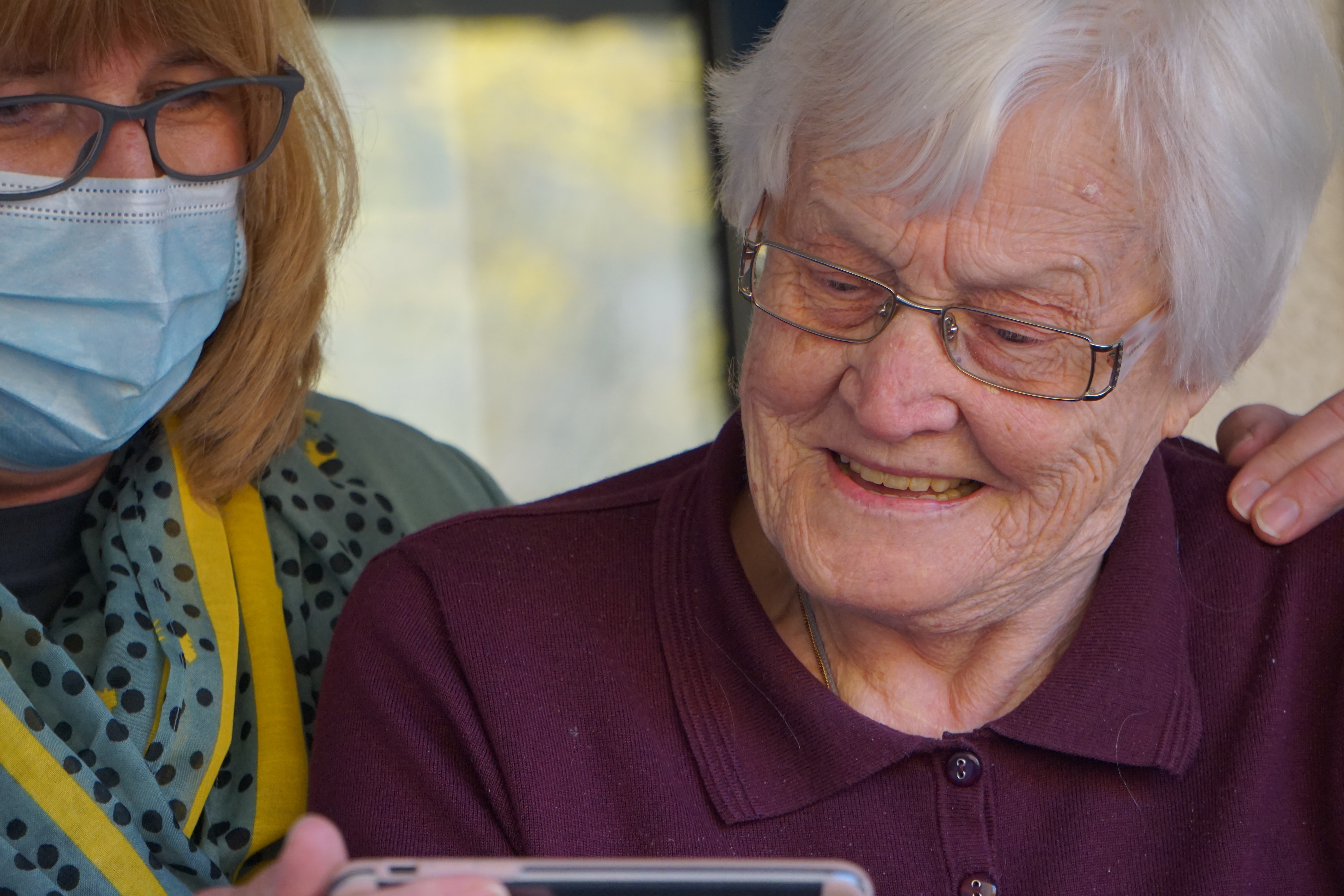
This is a very good message to pass along to the dementia caregiving community. While I tend to focus on the struggles of being a reluctant caregiver, it’s important to note that some caregivers do find a way to maintain a decent quality of life. As Elaine points out in her blog post, having sufficient funds to cover care costs is part of it, but attitude is also a factor.
Click through the link below to read the thoughtful post from When Dementia Knocks:
I write a lot about the challenges of dementia caregivers…their high rates of clinical depression and anxiety…their loneliness…their daily stressors. This post doesn’t change anything I’ve written in the past, but I do want to acknowledge something. Some caregivers are doing okay. Some caregivers are happy. Some caregivers are enjoying life and thriving. That doesn’t […]
The Happy Caregiver — When Dementia Knocks
Tag Archives: caregiving
The Happy Caregiver — When Dementia Knocks
Filed under Guest posts
Tips on hiring in-home care aides
In order to honor our elder’s wishes to age in place, it’s important to make sure they have the proper support. That may include hiring in-home care aides to perform housekeeping and some basic medical tasks. This is especially true for those of us who are long-distance caregivers.
Finding a good fit can be a challenge. Some elders may resent the idea that they need help and sabotage any hopes of securing care services. Those with dementia may become more confused or combative with a stranger in the house. Even those who are willing to accept a care aide in the home may find their routines are disrupted, which may cause short-term distress.
I was fortunate that my mother’s aide, hired through a local home health care agency, was a wonderful woman who clicked with my mother. Not only did she offer my mother a helping hand, she offered her companionship. My mother had a very set way of doing things so I know she probably was a challenge for the aide at times, but I so appreciated the aide’s services. I knew I could trust her and that my mother was receiving the support she needed to stay in her home.
MarketWatch published an article that has helpful tips on what you should look for when choosing an in-home care aide. Beyond the basics like a background check, it’s important to know the aide’s skill set, availability, and career aspirations. Going through a home health agency can offer some peace of mind, but can be more expensive. Word of mouth can be a good way to find a caregiver in your community. When it comes to hiring a care aide, hands-on experience may be more key than formal education.
There are websites and apps that allow one to hire a caregiver remotely, which can be useful for long-distance caregivers but can be a bit more of a gamble without that in-person assessment. Long-distance caregivers should consider a video call before making any hiring decisions. Don’t overlook your gut instinct; if you feel an aide is not the right fit, don’t hesitate to take action. It’s not unusual to cycle through a few care aides before finding a good fit.
Filed under Awareness & Activism
When Money Habits Change — Dealing with Dementia

This is such an important topic and I’m grateful for Kay Bransford’s excellent blog post. As my father’s dementia progressed, simple tasks like paying for groceries or a fast food meal became a challenge that caused my father to become angry and accuse others of trying to rip him off. My mother eventually had to take over those tasks. After my father’s death, my mother’s loneliness made her susceptible to the barrage of telemarketers who would call on a daily basis. As a long-distance caregiver, it was difficult and frustrating for me to try and manage from afar.
Click on the link below to read the helpful post on Dealing with Dementia:
There were a few odd conversations with my Mom when things didn’t make sense. But the most alarming thing was when I realized my parents had changed their decades-long habit of giving every January. I started to notice that my mother was writing checks to charities that they had never previously supported. I would read…
When Money Habits Change — Dealing with Dementia
Filed under Guest posts
Nutritional options important part of palliative care
I came across an interesting discussion recently about whether Ensure and other nutritional beverages marketed towards older people are really the best option.
The discussion that followed the geriatrician’s perspective included interesting pros and cons. It made me think about my parents’ experience with the beverages. My father had never been a fan of milkshakes or similar beverages, but he seemed to enjoy the Ensure drinks, so I would ship cases of them to the memory care center where he spent the last year of his life. My mother existed on Ensure for the last month or so of her life. I have regrets about that, wishing I had taken time to make her something that she would have enjoyed more.
This is why I’m such a strong believer in expanding inpatient hospice and providing more robust home hospice care. As the sole caregiver for my mother at the end of her life, things like whipping up something delicious for her to eat didn’t cross my mind because I was so busy focusing on the “important” things, like her pain medication, treating her bedsores, etc. While I managed to mainly keep her suffering to a minimum, there was no joy in her final weeks.
Those with dementia may struggle with solid food as they enter the final stages of the disease, so liquid forms of nutrition may become a necessity. Homemade smoothies, puddings and milkshakes may interest those who have grown tired of the commercial products. If you can, consult with a nutrition specialist or dietitian about tasty, safe options for your loved one. Bringing loved ones small moments of joy can also lift the spirits of family caregivers.
Filed under Awareness & Activism
Being less active during pandemic may have health consequences
The pandemic’s impact on health goes beyond those who contracted the coronavirus. Even those who managed to avoid the infection may have suffered consequences to their health, and in an area that many take for granted.
In December, I fell while walking my dog. I slipped going down a moderate slope in the park and landed straight on my rump. The fall knocked the wind out of me for a minute, but I was fortunate not to break or sprain anything. My back was very sore and remained so for about a week. I treated it using over-the-counter pain medication and homeopathic balms. My mobility was limited and I was forced to slow down and take it easy, but fortunately I fully recovered and don’t have any lingering issues.
I’m in my late 40s and in decent health. This was a minor fall, but it reminds me that as I get older, recovery from such incidents takes longer. We often take our mobility for granted, but the pandemic may have a lingering impact on our physical conditioning, making us more prone to falls. Studies suggest that some older adults have experienced a decrease in mobility during the pandemic, The New York Times reported.
What geriatric health experts are concerned about is that decreased activity levels may result in worse physical functioning, which is key to older adults’ ability to live independently. A fall can lead to a lengthy recovery and trigger a fear of falling again, creating a vicious cycle with significant health consequences. The good news is that we can engage in simple activities that will help us reverse the impacts of our sedentary lifestyle and regain our mobility. Walking, yoga, and tai chi are all great ways to get moving and improve physical functioning.
Take inventory of your mobility and your elder loved ones and make an action plan if you desire to increase your mobility. Taking small steps now can make all the difference in keeping ourselves and our elder loved ones living independently.
Filed under Awareness & Activism
A thoughtful end to ‘After Life’
I’m a big fan of the Netflix show “After Life” created by and starring Ricky Gervais. While the subject matter and profuse profanity make it a show that not everyone will enjoy, I find its take on death and the grieving process refreshing and poignant.
The third and final season debuted this month and I was blown away by one scene in particular, which felt like my mother was speaking to me from beyond the grave.
As I’ve written about extensively on this blog and in my book, The Reluctant Caregiver, my mother was reluctant to discuss any end-of-life issues, but she did give me a poem she had copied by hand and said she would like that read after she died. She didn’t want any service and she chose cremation over burial so it was left to me, her only child, how to honor her wishes.
The poem she chose is the poem that is read during a very moving scene in the final season of “After Life.” When the actress began reciting the poem, I almost jumped out of my seat and my breath caught in my throat. The poem is fairly well-known but still, what are the chances that the poem my mother chose was the one that was recited on a TV show?
I chose to honor my mother’s wishes by not only reciting the poem after her death, but having it imprinted on her urn. You can read the poem below.
Filed under Memories
Vision for the new year
I hope you had a peaceful holiday season. Mine was spent mourning my beloved cat Rosalie, but the holiday break allowed me time to honor her memory in various ways. Her urn arrived this week, and Katie Patton of Blocks from the Heart has done such a magnificent job in capturing Rosalie’s spirit.

And to usher in the new year, I took the plunge and adopted a pair of tuxedo cats named Dorian and Serena. They are young, just a year and a half. I do feel like Rosalie’s untimely passing was a signal from the universe that an opportunity was presenting itself to welcome a new energy into my home and my life. It was a rude awakening, but one that I hope will inspire new endeavors into my caregiving advocacy work. Adopting young cats is also a good lesson in letting go of routines and looking at things from a new perspective … like when a kitty climbs to the top of the kitchen cabinets!

As for vision … I attend a monthly women’s healing circle that involves a variety of spiritual disciplines and meditations. It’s been a virtual respite during the isolation of the pandemic. Each year, the teacher draws a spirit word for each participant, and mine for 2022 is vision. I’m interested in exploring that concept.
To kick off the year, I’m taking a course in children’s book writing. I have an idea for a children’s book that would feature my rescue dog Murphy’s story and connect it to children who have also experienced trauma. I don’t know what will come of it, but I think it is good to flex the writing muscles in a new direction.
On the legislative front, I hope some of the caregiving initiatives can be salvaged from the BBB plan. I know I sound like a broken record, but caregiving issues deserves bipartisan support because it’s something that touches all of our lives, regardless of political beliefs. Caregivers, from frontline hospital and nursing home workers to family members tending to loved ones at home, have sacrificed so much and it’s well past time that we as a society support better funding so that they get the support they need.
Filed under Memories
Reflecting upon 10 years since my father’s death

It has been 10 years since my father’s death. So much has happened in the past decade, but I’ll never forget where I was when my mother called with the worst news of my life, in the middle of the newsroom at the Atlanta Journal-Constitution. I had been waiting for that awful call for quite some time, and some part of me wished for it, because it pained me so much to see my father suffering in the late stages of dementia. But of course there was no immediate sense of relief upon my father’s passing, just sadness and regret.
I do still carry feelings of regret and guilt to this very day, and probably always will. I discuss this at length in The Reluctant Caregiver, and urge others not to judge themselves too harshly. In that spirit, I am taking a look back on what my father inspired me to do over the last decade.
- I began this blog, The Memories Project. What began as a way to document memories of my father and process my grief has become the foundation of my dementia and caregiver advocacy platform. I have also met so many fellow caregivers through the blog and am grateful for their wisdom and their support.
- I wrote a book, which was a life goal of mine. My collection of personal essays on family caregiving, The Reluctant Caregiver, won a gold medal at the IPPY Awards. An essay from that collection won the Rick Bragg Prize for Nonfiction from the Atlanta Writers Club. A story I wrote about my father, “French Toast,” was included in the Chicken Soup for the Soul: Living with Alzheimer’s and Other Dementias collection. I know my dad, a lifelong lover of books, would be proud.
- I finally made it to Ireland and visited my father’s hometown of Belfast, Northern Ireland. This was at the top of my bucket list and has been one of the best experiences of my life.
- The privilege of sharing my father’s story through a variety of outlets, including NPR, AlzAuthors, Caring Across Generations and the Aging in America conference.
The decade since my father’s death has been the most difficult of my life, but also the most rewarding. I hope that you can take time this holiday season to recognize and reflect upon the highs amidst the lows of your own caregiving journey. Give yourself the grace that you deserve.
Filed under Memories


![Pageflex Persona [document: PRS0000038_00069]](https://memoriesproject.files.wordpress.com/2014/02/reluctant-caregiver-cover.jpg)