Monthly Archives: May 2025

AI-powered phone call service offers virtual wellness checks for seniors

I came across a new service for seniors and their family caregivers that is getting ready to launch. I’ll admit it caught my eye because it has my name! Joy Calls is an AI-powered call service that performs virtual wellness checks.

A smart feature of the service is that even though Joy is an AI-powered persona, the high-tech is contained in a familiar package: a telephone call. No special equipment or training is required to use the service. Joy calls your loved one, checking in on things like medication, hydration, diet, and mood. Your loved one’s responses are summarized and provided to the caregiver.

The concept is designed not to replace family caregivers but virtually augment the monitoring of their loved ones, potentially extending their ability to age in place safely. A price hasn’t been set yet, but according to Onscreen, the company producing Joy Calls, the service is expected to cost in the range of $10-40 per month.

It’s an intriguing concept, and I will be interested in how well the service works and if it can meet the needs of seniors and family caregivers. I’m curious to see how the service handles sensitive information and if it can reduce the risk of AI hallucinations, otherwise the calls could go off the rails. And thinking of my mother, how will Joy handle a senior who is, to put it politely, verbose? Will she interrupt and try to get the call back on track? I felt helpless at times trying to keep my mother focused on the topic at hand, so I hope Joy Calls is up to the challenge.

Image created by ChatGPT.

Leave a comment

Filed under Awareness & Activism

A decade since my mother’s death

It’s hard to believe that today marks 10 years since my mother’s death. The moment my mother took her last breath is still crystal clear in my mind, even though I can recognize the considerable amount of time that has passed. Considering the turmoil that has engulfed the world over the last decade, I have to say Mom had impeccable timing when she exited this world.

As I was writing this blog post, Maria Shriver’s Sunday Paper hit my inbox. In it was an article, Want to Have No Regrets When You Die?, which was written by Diane Button, a death doula. She shared an encounter she had with one of her dying clients, who told her, “I am not yet ready to die. I’ve spent my whole life caring for others, and honestly, I don’t even know who I am.”

This really resonated with me as it’s one of the cornerstones of my caregiver advocacy, to support the needs of family caregivers and making sure they don’t lose their own voice. Writing is one effective way of maintaining your identity, and can help process the complex emotions that caregiving triggers. One of my goals with publishing The Reluctant Caregiver was to encourage other caregivers to release the guilt and shame they felt during their caregiving experience.

Button shared a simple yet powerful, “I am …” writing prompt that anyone can use to connect with themselves. The prompt could also be used in an audio format if that’s one’s preference. Button suggested that it’s an exercise that one can revisit, then review prior answers to see how your sense of self has transformed over time.

Here’s what I came up with to mark this somber anniversary:

I am resilient.
I am learning.
I am determined.
I am evolving.

Feel free to share your “I am” creations in the comments section. I’m working on a project that includes writing prompts for caregivers. More to come soon.


Leave a comment

Filed under Memories

Powerful account of living with dementia

Such a moving an insightful post, thank you Gail for sharing your lived experience with dementia.

Leave a comment

Filed under Guest posts

Reflections on Mother’s Day

This May marks 10 years since my mother’s death. It’s hard to believe that my mother has been gone that long.

Because of the timing, Mother’s Day has become another day of mourning for me. The last Mother’s Day my mother was alive, she was less than two weeks from dying. I was very aware of my mother’s impending death but my mother, the eternal optimist, was less certain. What message to write in the card your mother will receive on her final Mother’s Day? I agonized over the few lines, settling on a message of gratitude and acknowledging that I would support her through her journey from this world. She appreciated the card and especially the flowers that I bought her, but I think no matter how gentle I broached the subject, my mother was still resistant to recognizing her own mortality.

May 2015: My mother reading the card on her last Mother’s Day.

Since my mother’s death, I’ve joined those who find the incessant marketing around Mother’s Day tiring and virtually inescapable. A few thoughtful companies offer opt-out emails for holiday promotions, but mostly it’s Mother’s Day ads everywhere, from TV commercials to website ads and smartphone messages. Of course I’m pleased that people who have living mothers get to dote on them, but every ad is yet another reminder of the most difficult period of my life. Getting through the day only makes me one day closer to the anniversary of her death, May 21.

Writer Anne Lamott posted her annual Mother’s Day message on Facebook for those who dread the holiday. For those of you who may be struggling with feelings of grief and longing this Mother’s Day, I hope you find some solace and recognition in her words.

If you find yourself feeling complicated emotions on Mother’s Day, this article in Sunday Paper offers helpful tips.

2 Comments

Filed under Memories

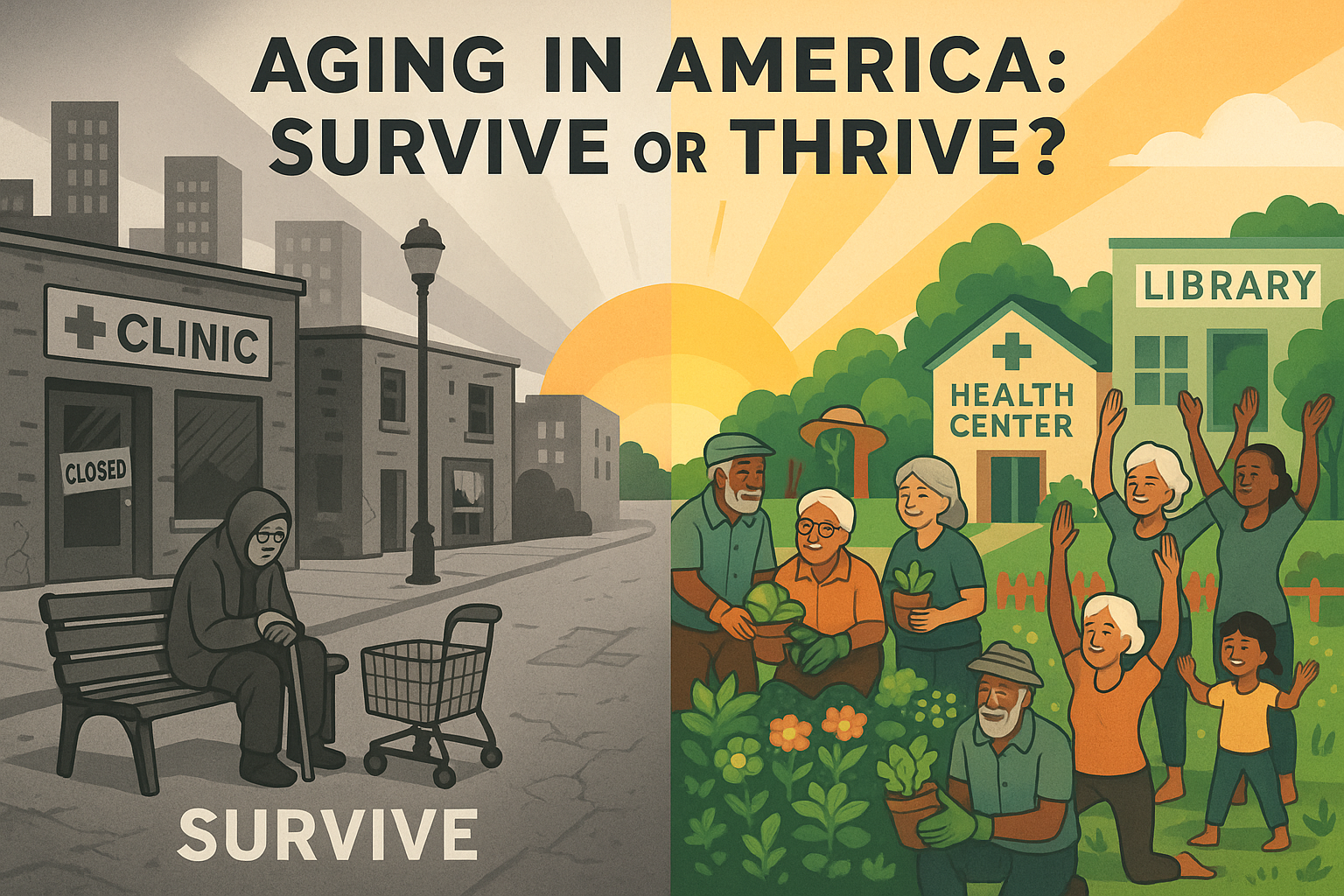
New documentary on aging in America highlights continued challenges, opportunities

There’s a new documentary about aging, Aging in America: Survive or Thrive, that is airing on PBS for the month of May, which is Older Americans Month. The documentary marks the 50th anniversary of the publication of the Pulitzer-prize winning book “Why Survive? Being Old in America” by Dr. Robert Butler.

While the number of Americans over the age of 65 has more than doubled during the last five decades, in part due to medical breakthroughs, the financial stability of older Americans continues to erode. The documentary notes that older people are the fastest growing group of homeless people in America. Older homeless people may find themselves in that situation for the first time in their lives, after a job loss or medical emergency. The film highlights one such case in which a woman, who was a nurse, ended up living in a moving van for almost a year after being diagnosed with cancer and spending her life savings on treatment.

There’s also a touching segment about a wife caring for her husband with Alzheimer’s in Wyoming, and the challenges of dementia care in an isolated rural environment with limited medical services.

The documentary highlights the organizations that are doing commendable work in addressing the needs of the older population in their communities. From providing meals to companionship and aging in place assistance, these organizations provide critical services to older Americans.

America’s preoccupation with youth hasn’t changed much in the 50 years since Dr. Butler noted that bias in his book. The field of geriatrics continues to struggle to attract new doctors. We don’t have nearly enough care workers to tend to our rapidly expanding older population.

Filmmaker Neil Steinberg said in a Next Avenue interview that he wants to encourage people to “rethink aging” after watching the documentary.

“We need to give people the opportunity to live their later years in dignity,” Steinberg said.

Illustration created via ChatGPT.

Leave a comment

Filed under Awareness & Activism