Today Mom would have been 88 years old. My mother and I shared a birthday month which always made July special to me. Now it’s a little bittersweet, but I still carry the memories of how my mother tried to make my birthday special each year and how I did the same by making her handmade cards and crafts. What my gifts lacked in artistic talent they made up for in love.
Even though my mother and I were born in the same month and the same astrological sign, we were opposites in personality. I write about those challenges in The Reluctant Caregiver. But one thing we shared was a love of creativity and the arts. Over her lifetime my mother learned how to play the guitar and took dance lessons. She made fabric art wall hangings. I’m grateful to have inherited a love of creativity as well, as it can make the world a better place during challenging times.
Dr. Elaine Eshbaugh offers wise words and compassionate insights once again on her blog, When Dementia Knocks. There are many ways family members can react to a loved one’s dementia diagnosis. Some people will embrace the fuzzy blinders of denial, while others will go into overdrive in an attempt to protect their loved one from cognitive decline for as long as possible. While the latter is noble to a certain extent, it can place an intense and unrealistic burden on the caregiver, as Eshbaugh points out in her blog post. Alzheimer’s is a progressive disease; while there may be some steps you can take to stave off decline for awhile, they won’t work in every person and eventually, the disease progresses. When a loved one declines after a period of relative stability, it’s not the fault of the caregiver. It is simply the nature of the terrible disease.
Be kind, especially to yourself and your role as a dementia caregiver.
Summer has just started and this week it’s supposed to be in the high 90s here in Atlanta. I’ve lived here since 1997, and know that hot, long, and humid summers are to be expected. But as one gets older, one needs to take extra precautions against the heat. This applies to our pets as well.
Each year, I write at least one blog post dedicated to summer safety tips. It’s heartbreaking to think that in our modern age, people die because of the heat. For dementia caregivers, extra thought should be given to not only protecting loved ones from the heat, but also finding indoor activities that are stimulating and finding ways to still spend a bit of time outdoors.
Hydration: I’m always blown away by the fact that some people don’t drink water. I consistently drink water throughout the day and would feel unwell if I didn’t. Older people often don’t drink enough fluids, and dementia can complicate matters further. To make water less boring, there are flavored waters and sparkling waters. Unsweetened varieties are available for those who need to keep their blood sugars in check. Another fun solution are Jelly Drops. Hydrating foods like watermelon count as well, so consider that as a tasty option.
Cooling options in the home: In certain parts of the country, such as where I live in Atlanta and where I used to live in Texas, air conditioning is considered a must-have. That doesn’t mean everyone has AC, or can afford to use it. I hate to hear about cases where older people die from the heat because they were afraid to turn on their air conditioner due to the cost. It’s no joke that AC is expensive to run; there are government programs to help offset some of the costs. Cooling stations exist in some cities during extreme heat waves. Check on your elder loved ones frequently during heat waves and make sure they are living in a situation that is bearable, especially if they are in fragile health.
Adapting favorite activities: If you live in an area that experiences extreme heat, those long and hot sunny days can begin to feel like a prison. This is especially true for loved ones with dementia, who may become restless if their outdoor activities are limited. There are a few things you can do to adapt. One thing I do with my senior dog is take walks early in the morning, where it might be humid but at least the sun isn’t broiling us. There aren’t as many shopping malls as there used to be, but if you still have one in your area, walking around the air conditioned mall can be a nice indoor activity on a hot day. My parents used to do this for exercise. Some recreation facilities have indoor walking tracks; swimming pools could be another option to cool off. Instead of hitting the golf course on a dangerously hot day, consider an indoor golf simulator facility like Topgolf. Museums offer a stimulating activity in a cool environment.
Caregivers should learn the signs of heat-related health issues so they can spot them quickly in those they care for and seek timely treatment.
I admit I dread the summers, because of the oppressive heat and the mosquitoes. But what I do enjoy about summer is the extended daylight and iced coffee. If you are not a fan of summer, try to find one thing to enjoy: maybe it’s an ice cream cone or a dip in the swimming pool. Hopefully you can share some of these simple joys with your elder loved ones you care for, and make happy memories this summer season.
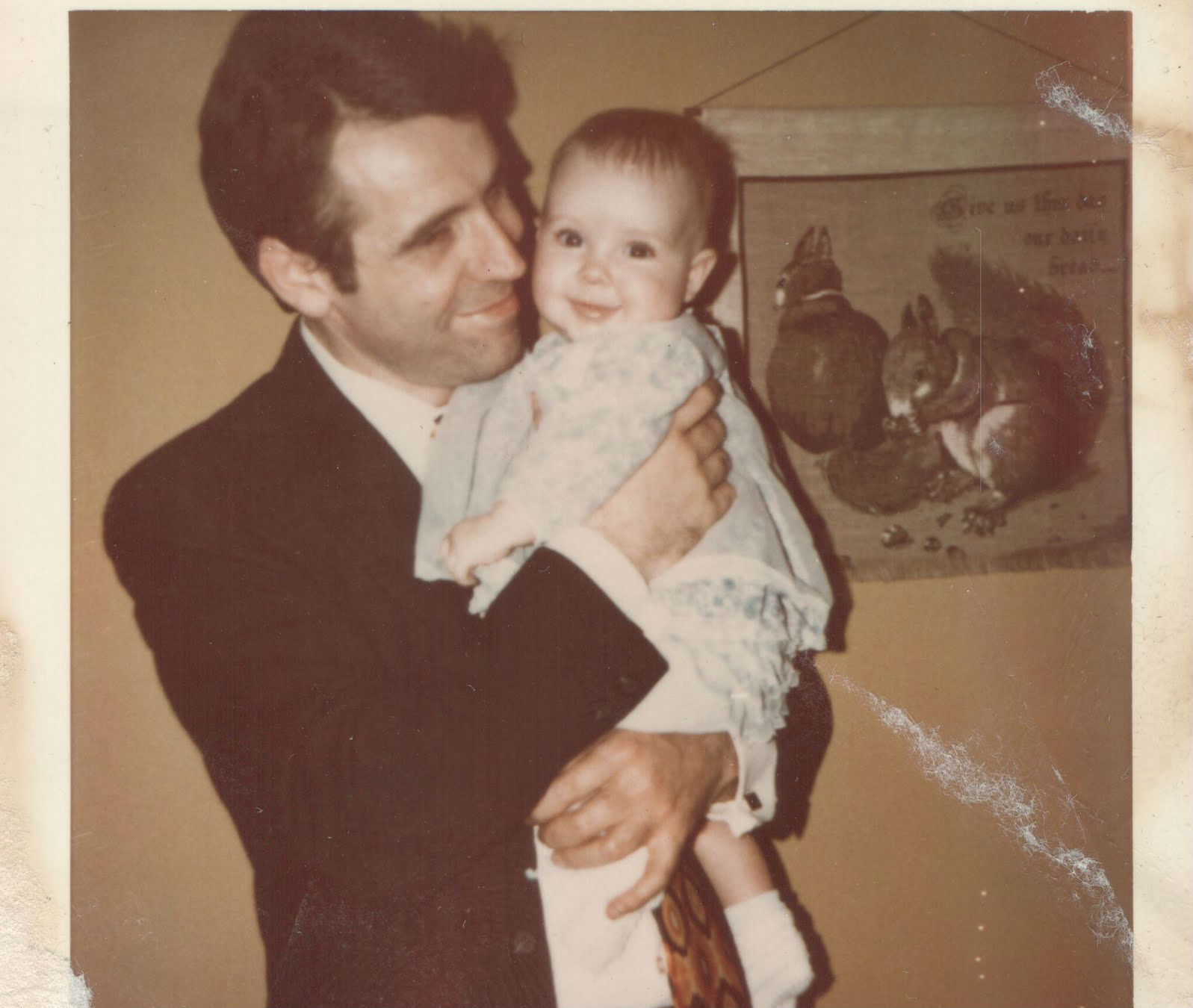
Thinking of Dad today and what it would be like to take a long walk in the park with him and discuss all of the troubles happening in the world right now.
Hope you get to spend quality time on this Father’s Day with your fathers or those who serve as father figures in your life.
There’s a new documentary airing on PBS called, Caregiving. Actor Bradley Cooper served as an executive producer and at the beginning of the film, he discusses the emotional impact caring for his father had on him.
The bulk of the film focuses on average Americans who are faced with a healthcare crisis in their family and how they attempt to navigate America’s broken healthcare system to access essential services. When that fails, caregivers are forced to take on the burden all on their own. I definitely could relate to many of the challenges these caregivers faced, from job loss to the extra stress of being a sole care provider. I also like that the film showcases stories of care recipients and caregivers who are a variety of ages. Caregiving is not just for the young and the old; any of us can be faced with an unexpected health issue that we are not prepared for and will upend our lives.
While the stories shared in the documentary are sobering, there are moments of triumph and a historic overview of care in America, and how advocates over the decades have made a real difference in how care services have evolved. There’s no question that more resources and support are needed, especially as we grapple with a rapidly aging America. There are some positive developments at the state level, with funding programs for paid leave being approved by voters but nationally, even though Americans in polls claim to support additional care funding, they often don’t vote in their best interest.
Politicians claim they can’t stomach the cost of programs like paid family leave, yet studies (and common sense) shows that the longer you can support an elder aging in place at home, the more reasonable the cost compared to having Medicaid pay the expense of a nursing home. Meanwhile, family caregivers provide billions of dollars in free labor each year, to fill the gaps the government refuses to cover.
Caring Across Generations is featured prominently in the Caregiving documentary, which I’m glad to see, as I’ve participated in events with them in the past. I appreciate their practical yet compassionate approach to caregiving issues, and their focus on being inclusive, as caregiving is something that touches all of our lives at some point.
I hope you get a chance to watch the documentary. I’d love to hear your thoughts.
I came across a new service for seniors and their family caregivers that is getting ready to launch. I’ll admit it caught my eye because it has my name! Joy Calls is an AI-powered call service that performs virtual wellness checks.
A smart feature of the service is that even though Joy is an AI-powered persona, the high-tech is contained in a familiar package: a telephone call. No special equipment or training is required to use the service. Joy calls your loved one, checking in on things like medication, hydration, diet, and mood. Your loved one’s responses are summarized and provided to the caregiver.
The concept is designed not to replace family caregivers but virtually augment the monitoring of their loved ones, potentially extending their ability to age in place safely. A price hasn’t been set yet, but according to Onscreen, the company producing Joy Calls, the service is expected to cost in the range of $10-40 per month.
It’s an intriguing concept, and I will be interested in how well the service works and if it can meet the needs of seniors and family caregivers. I’m curious to see how the service handles sensitive information and if it can reduce the risk of AI hallucinations, otherwise the calls could go off the rails. And thinking of my mother, how will Joy handle a senior who is, to put it politely, verbose? Will she interrupt and try to get the call back on track? I felt helpless at times trying to keep my mother focused on the topic at hand, so I hope Joy Calls is up to the challenge.
It’s hard to believe that today marks 10 years since my mother’s death. The moment my mother took her last breath is still crystal clear in my mind, even though I can recognize the considerable amount of time that has passed. Considering the turmoil that has engulfed the world over the last decade, I have to say Mom had impeccable timing when she exited this world.
As I was writing this blog post, Maria Shriver’s Sunday Paper hit my inbox. In it was an article, Want to Have No Regrets When You Die?, which was written by Diane Button, a death doula. She shared an encounter she had with one of her dying clients, who told her, “I am not yet ready to die. I’ve spent my whole life caring for others, and honestly, I don’t even know who I am.”
This really resonated with me as it’s one of the cornerstones of my caregiver advocacy, to support the needs of family caregivers and making sure they don’t lose their own voice. Writing is one effective way of maintaining your identity, and can help process the complex emotions that caregiving triggers. One of my goals with publishing The Reluctant Caregiver was to encourage other caregivers to release the guilt and shame they felt during their caregiving experience.
Button shared a simple yet powerful, “I am …” writing prompt that anyone can use to connect with themselves. The prompt could also be used in an audio format if that’s one’s preference. Button suggested that it’s an exercise that one can revisit, then review prior answers to see how your sense of self has transformed over time.
Here’s what I came up with to mark this somber anniversary:
I am resilient. I am learning. I am determined. I am evolving.
Feel free to share your “I am” creations in the comments section. I’m working on a project that includes writing prompts for caregivers. More to come soon.
This May marks 10 years since my mother’s death. It’s hard to believe that my mother has been gone that long.
Because of the timing, Mother’s Day has become another day of mourning for me. The last Mother’s Day my mother was alive, she was less than two weeks from dying. I was very aware of my mother’s impending death but my mother, the eternal optimist, was less certain. What message to write in the card your mother will receive on her final Mother’s Day? I agonized over the few lines, settling on a message of gratitude and acknowledging that I would support her through her journey from this world. She appreciated the card and especially the flowers that I bought her, but I think no matter how gentle I broached the subject, my mother was still resistant to recognizing her own mortality.
May 2015: My mother reading the card on her last Mother’s Day.
Since my mother’s death, I’ve joined those who find the incessant marketing around Mother’s Day tiring and virtually inescapable. A few thoughtful companies offer opt-out emails for holiday promotions, but mostly it’s Mother’s Day ads everywhere, from TV commercials to website ads and smartphone messages. Of course I’m pleased that people who have living mothers get to dote on them, but every ad is yet another reminder of the most difficult period of my life. Getting through the day only makes me one day closer to the anniversary of her death, May 21.
Writer Anne Lamott posted her annual Mother’s Day message on Facebook for those who dread the holiday. For those of you who may be struggling with feelings of grief and longing this Mother’s Day, I hope you find some solace and recognition in her words.
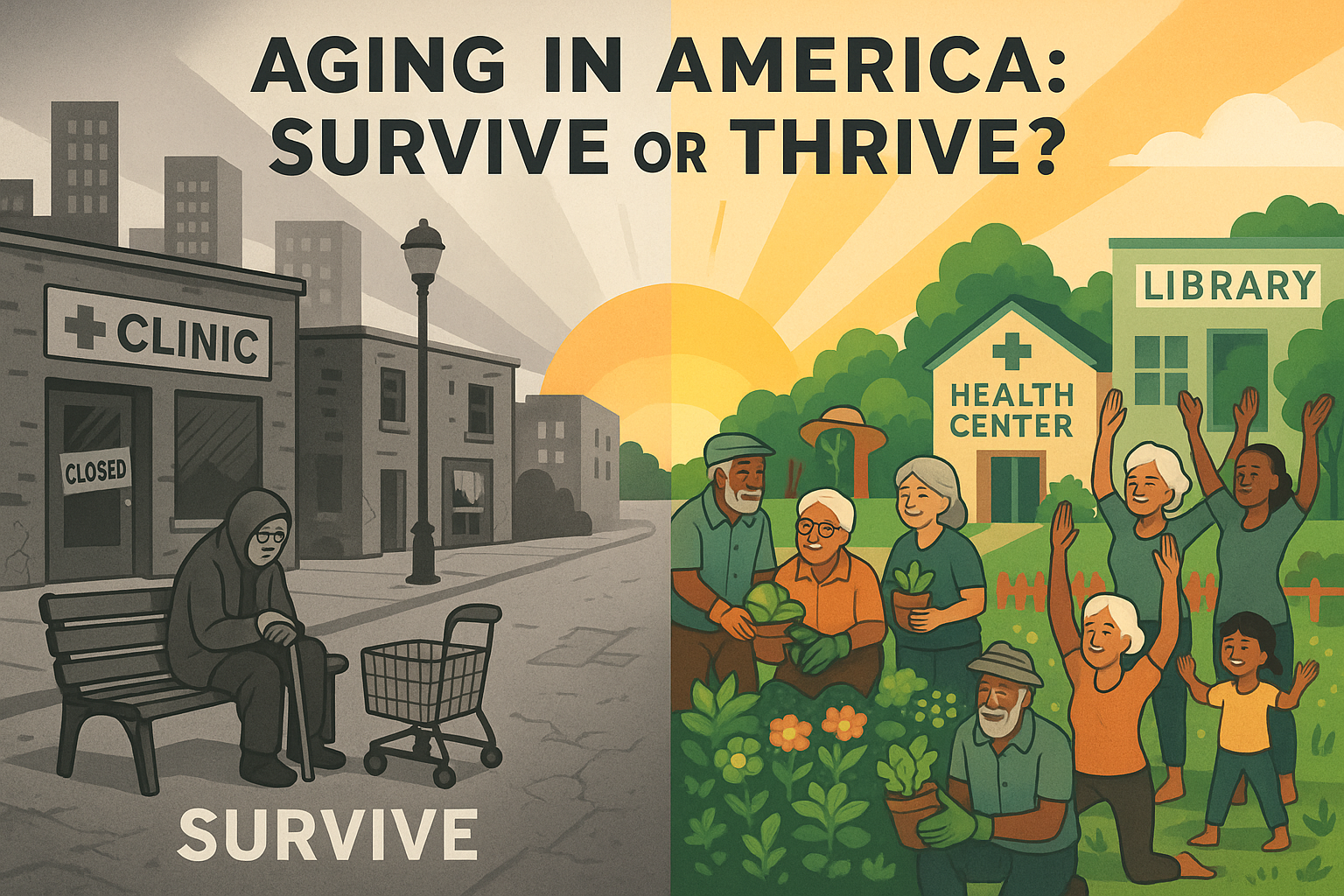
There’s a new documentary about aging, Aging in America: Survive or Thrive, that is airing on PBS for the month of May, which is Older Americans Month. The documentary marks the 50th anniversary of the publication of the Pulitzer-prize winning book “Why Survive? Being Old in America” by Dr. Robert Butler.
While the number of Americans over the age of 65 has more than doubled during the last five decades, in part due to medical breakthroughs, the financial stability of older Americans continues to erode. The documentary notes that older people are the fastest growing group of homeless people in America. Older homeless people may find themselves in that situation for the first time in their lives, after a job loss or medical emergency. The film highlights one such case in which a woman, who was a nurse, ended up living in a moving van for almost a year after being diagnosed with cancer and spending her life savings on treatment.
There’s also a touching segment about a wife caring for her husband with Alzheimer’s in Wyoming, and the challenges of dementia care in an isolated rural environment with limited medical services.
The documentary highlights the organizations that are doing commendable work in addressing the needs of the older population in their communities. From providing meals to companionship and aging in place assistance, these organizations provide critical services to older Americans.
America’s preoccupation with youth hasn’t changed much in the 50 years since Dr. Butler noted that bias in his book. The field of geriatrics continues to struggle to attract new doctors. We don’t have nearly enough care workers to tend to our rapidly expanding older population.
Filmmaker Neil Steinberg said in a Next Avenue interview that he wants to encourage people to “rethink aging” after watching the documentary.
“We need to give people the opportunity to live their later years in dignity,” Steinberg said.









![Pageflex Persona [document: PRS0000038_00069]](https://memoriesproject.files.wordpress.com/2014/02/reluctant-caregiver-cover.jpg)






 The Memories Project