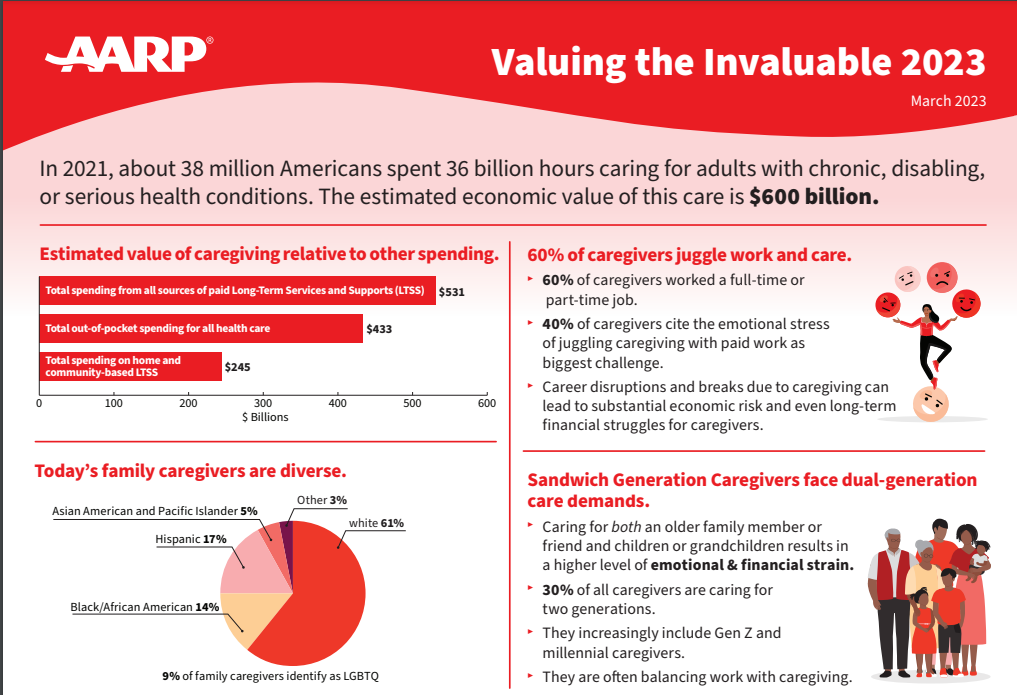
Friday was National Caregivers Day, but why just celebrate one day a year? Let’s keep the support flowing all year long.
AARP compiled a nice, actionable list of things one can do to support your caregivers in your life. I appreciate the “what that looks like” suggestions under each support method. It can be difficult for one to know how best to support a caregiver, so these practical options are so useful. For example, under “demonstrate support” there are suggestions like help a caregiver get organized, do research, help with housework, yardwork or other errands, and bring a meal or provide a meal delivery service.
The key in supporting caregivers is making sure the onus isn’t on them to ask for help. As a former caregiver, I know how hard it can be for some of us to ask for assistance. But I always appreciated when someone stepped up and helped me on my caregiving journey.
In the essay, Sarah Romanelli describes a situation that will be familiar to many caregivers: “being held hostage” by a broken care system that breaks down as one becomes more fragile. In Romanelli’s grandmother case, she was too weak for rehab and too dependent to return to assisted living, who sent her back to the hospital. The family was forced to crunch numbers and develop a care plan, which involved at-home care.
The family moved the grandmother to an apartment close to family and hired 24-hour care. That cost a whopping $16,200 per month, but was still cheaper than securing a space in a long-term care facility. Keep in mind that care facilities may require families to pay out-of-pocket for private caregivers if a resident is deemed to need around-the-clock monitoring. This happens quite often for residents with dementia.
Romanelli says her grandmother received wonderful end-of-life care, but she knows that their family’s solution is not feasible for most people. My father also got passed around to various facilities and ended up being sent far away from my mother, because it was the only memory care facility with an opening. At over $4,000 a month, it quickly depleted my family’s modest resources. But 24-hour care would not have been feasible in my parents’ rural community due to staffing shortages, and definitely would have been more expensive.
Bottom line, no matter what care option you choose, it will be expensive. I want people to have the choice of dying at home, and not bankrupt their family in the process.
If you’ve been online over the last few months, you’ve probably come across discussions about ChatGPT. The conversational AI-powered (artificial intelligence) tool developed by OpenAI is the latest tech fad that some experts claim could take over our jobs in the future. (If you are interested in working with images instead of words try the related DALL-E.)
You may have seen some of the program’s capabilities: it can write articles, essays, jokes and songs, debug software code, and create resumes with some input from the user. Users can have a conversation of sorts with ChatGPT while refining their requests and the tool can ingest those new points and update its responses in real time.
As someone who enjoys exploring new tools but retains a healthy amount of skepticism about such tools taking over the world, I’ve spent some time testing out ChatGPT, focusing on how the tool could potentially be of aid to caregivers.
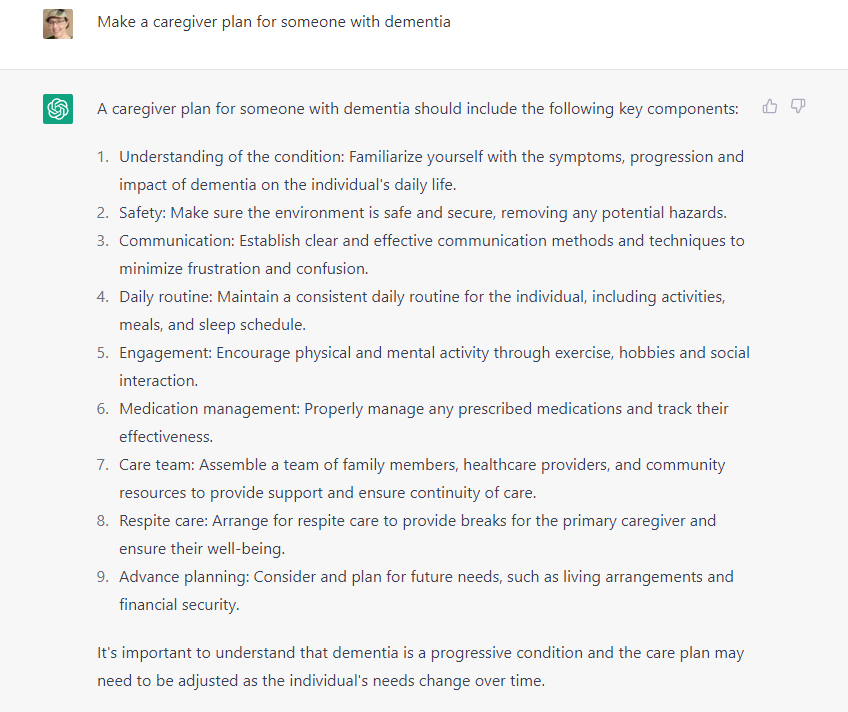
My main takeaway is that while ChatGPT can adequately provide information on a vast amount of topics, the responses are mainly generic and middling in quality, like someone reciting an encyclopedia entry. Your mileage will vary if you are asking a question on a highly technical topic or asking it to generate code for a website. But when asking for caregiving advice such as making a caregiver plan for someone with dementia or tips on aging in place, it regurgitates acceptable but basic advice that can be found across the internet. You can see a couple of examples below:
The glaring issue for me is that there is no attribution with ChatGPT responses. That could be important when you are seeking medical advice such as dementia caregiving tips. Are the pointers it is offering come from a dementia expert like Teepa Snow or a low quality resource? At this point, the responses could be used as a decent starting point, but the user would need to do additional research outside of the ChatGPT system to verify, augment, and personalize the information. Google and other search engines are seeking to incorporate attributes of such AI-based tools into their own programs which would offer a more conversational way to search for information.
I’m going to continue to explore the uses of ChatGPT and how it might be useful for caregivers. If you’ve used the tool, I’d love to hear your feedback.
Dementia caregivers who are juggling careers and care duties will appreciate how director Alex Berg depicted the caregiving experience with empathy and accuracy in his short film, “Ruth.” The film was released in 2022 but is receiving renewed interest due to an Alzheimer’s Association interview with the director that was published this month.
In just 9 minutes, “Ruth” beautifully depicts the frustrations and joy of a mother with dementia and her middle-aged daughter who is trying to balance career demands with caregiving. Berg told the Alzheimer’s Association that his grandfather was an inspiration for the project. The confusion and repetition of questions is something many dementia family caregivers will relate to. The frustration that bubbles over for the daughter is also familiar. “I wanted the daughter-caregiver in the film to be just as central as the mother character, going through personal challenges of her own, ones that don’t go away just because she is a caregiver,” Berg said.
The acting and direction is heartbreakingly beautiful. Family caregivers will finally feel seen after viewing “Ruth.”
Highlighting the challenges that come with caring for a family member in which you have a difficult relationship dynamic is an issue that is important to me. I discuss my own challenges when caring for my mother in my book, The Reluctant Caregiver.
Lori Grinker has created a moving, powerful photo essay, “All the Little Things,” which is about caring for her mother Audrey. The mother and daughter faced a trifecta of challenges: Audrey was already dealing with dementia when she was diagnosed with cancer at the beginning of the COVID-19 pandemic. Grinker and her mother had always had a strained relationship, but the pandemic delayed a move into an assisted living facility, so mother and daughter lived together for three months. Grinker not only captures images of her mother, but of objects in her mother’s apartment. Those objects sparked memories and discussions that allowed the pair to open up the lines of communication more.
One of the objects that jumped out at me was the worn baking sheet. I remember my mother having a similar favorite baking sheet that she never wanted to discard no matter how discolored it became.
Life isn’t a Hallmark movie, so one shouldn’t expect an “all is forgiven” ending. Grinker told NPR that she and her mother were able to find some love for each other and most importantly, Grinker says she no longer harbors anger for her mother’s actions. She told NPR even if she cannot forgive her mother for some things, she now understands some of her mother’s life choices better.
Audrey died in March 2021.
“My mother agreed that I could share her story so that it might become a little easier for someone else to navigate their own journey with a loved one.“ – Lori Grinker, 2022 Bob & Diane Fund grantee.
Another year is in the books. As we look back on 2022, it’s easy to focus on the negative, but I hope you will cut yourself some slack and take time to celebrate what went well this year. Finding those good moments can be difficult when one is in a challenging caregiving situation. One suggestion that I’ve seen online is to get a jar and write on a slip of paper one good thing that happened each week. At the end of the year, the jar will be filled with highlights. If you are more digitally inclined you could keep a spreadsheet or use an app. It’s a simple way to make sure you don’t overlook your achievements.
My biggest achievement in 2022 was publishing my children’s book, Slow Dog. I began the year taking a course on writing for children, where I came up with the idea but waited until the summer to get serious about the project. If I had waited any longer, the book may never have existed as I got laid off from my job just two months after it was published. Timing is everything and sometimes the universe gives you a nudge just when you need it.
I hope 2023 will bring you good health and success in what matters to you.
It has been 11 years since my father died. The weather is similar as it was on that day, a chilly rain, which in turn is typical Irish weather and reminds me of my father’s homeland.
The moment I received the call from my mother that my father was gone is forever embedded in my memory. The death of a parent is one of those world-stopping moments. It’s not something you get over, but the tide of life will continue to push you forward.
Witnessing the devastation of Alzheimer’s disease first-hand in my family prompted me to become an advocate for finding effective treatments and for better support of family caregivers. I join many others in those causes and I’m grateful for the connections I’ve made through the years.
Sharing your dementia caregiving stories is important and I hope you will continue to do so, whether it’s through a blog or other outlet. I know it’s not always easy to share such personal details, but putting a real face on a disease that has long been kept behind closed doors is essential in raising awareness and building public support for better treatments and services.
My father mattered and so do your loved ones. When those difficult anniversaries come, embrace the good memories and use the tough ones to inspire you to push for change.
Caregivers can experience additional stress around the holidays on top of an already challenging routine. That stress is often triggered by expectations: from others and ourselves on how a holiday should be celebrated. Family traditions are something to be treasured, but when caring for an ill loved one, those traditions can quickly become burdens.
One of the more difficult aspects of family caregiving is adjusting one’s expectations when it comes to holiday celebrations. My family struggled with these changes as my father’s dementia progressed and again when my mother was recovering from cancer. When a loved one has dementia, they may not recognize that it’s a holiday. They may feel overwhelmed and extra disoriented if their routine is disrupted and extra people are in the home. Big family celebrations and travel may no longer be a good option.
It’s okay not to feel the joy that the season may bring others if you are going through a difficult time. But in order to avoid a completely miserable experience, it can help to adjust expectations. Focus on what matters most to you and the small, simple things that can bring you joy during the holidays. If there is something that is particularly meaningful, seek out the support you need to make that happen, whether it’s attending a religious service or a holiday-themed event.
While nice, the gifts or a fancy dinner isn’t what makes the holiday season special. It’s spending time with loved ones. The traditions may change, but the love remains.
There have been a series of layoffs in the media world recently and I find myself once again without a job. The last time I joined the ranks of the unemployed was when I quit a new job to take care of my mother when she was diagnosed with colon cancer just six months after my father died. I am fortunate this time around to have received a severance package that will keep me afloat temporarily while I look for new opportunities.
So many people, especially family caregivers, don’t have such a safety net when they face a job loss. I wanted to share some lessons that I learned while I was an unemployed family caregiver and a few resources for family caregivers who find themselves in challenging financial circumstances.
Unemployment is one of life’s most stressful events, and it’s even more so for those who are the primary caregivers for a loved one. Before tackling the financial challenges, make sure you have the emotional support you need. High levels of sustained stress can trigger physical symptoms, so don’t ignore your own health needs during this difficult time.
Reassess your family budget and be prepared to make some difficult cuts. Are there any expenses that could be reduced or eliminated? With many family caregivers already living paycheck to paycheck, this might feel like an exercise in futility. But reviewing your budget is essential as it will help determine what financial assistance programs you may qualify for.
Take a thoughtful approach to your job search. Being unemployed can leave one feeling desperate and willing to take the first job offer that comes along, but that can end up backfiring. Unemployment provides an opportunity to reconsider your work priorities. List your job requirements, which might include a minimum salary level, remote work, flexible schedule, etc. Highlight which are must-haves and refine your job search to meet those requirements. For example, as my mother dealt with health complications that delayed her recovery, I turned to freelance work instead of looking for another full-time job. In that moment, family caregiving took precedent and I didn’t want to begin another full-time job only to have to quit again if my mother had further medical issues. The downside was that I had to utilize my parent’s limited financial resources to help pay my own bills during that period. When my mother became more medically stable, I began my full-time job search in earnest.
It won’t last forever: I spent over a year in what I called “severe underemployment” in which I picked up several low-paying freelance gigs to help pay the bills because I couldn’t find anything better at the time. Finally I found a job through a former colleague that turned out to be an ideal fit and allowed me to work with a fantastic team.
But be prepared for further hiccups: I learned this lesson the hard way: the universe isn’t going to give you a break because you are a caregiver. Home repairs, the car breaking down, or more substantial events like divorce and illness may occur. For example, as I’m still reeling from being laid off last month, I’m having to deal with a pricey veterinary bill because my dog is sick.
Happy Thanksgiving to those who celebrate. In addition to food, family and football, today is a day to show gratitude.
I’d like to give thanks to all of the caregivers, from family members to those in the care workforce. I’d like to express gratitude especially to those caregivers who feel invisible, unappreciated and overworked. You matter and you deserve more support. There are many people working hard to implement changes to better support caregivers. It’s been an uphill battle and will continue to be so, but caregiver advocates, many of us former or current caregivers, are a tough and dedicated bunch.
Let the caregivers in your life know how much their efforts mean. Thank you to all of those who have supported me on my caregiving journey, from following this blog to buying my books and sending encouraging notes and comments.