Today marks six years since my mother’s death. I have to say that Mom had an uncanny sense of timing for her departure from this earth. The world has faced a series of challenges over the last several years that has left a path of death, destruction, and fractured relations that I’m glad my mother did not have to live through.
Now many of us find ourselves teetering between anticipation about establishing a new normal while mourning the losses that have piled up. And of course there are those like myself, mourning pre-pandemic losses of loved ones. It’s an odd mix of emotions; one may feel guilty about experiencing the joy of reunions while others have yet to bid a formal farewell to their loved ones while the pandemic rages on in India and other parts of the world.
My mother was the eternal optimist, to a fault in some cases, as I write about in The Reluctant Caregiver. I am more of a realist with pessimistic tendencies, but I do believe that the best antidote to the last several years of chaos and upheaval is by embracing whatever brings us joy. Give yourself grace and let go of whatever pain you can. My mother and I had a difficult relationship in ways because of our contrasting personalities. With the passage of time, I now can better focus on her positive attributes, including those I embrace in my life, such as her love of animals and nature, her sense of humor, and being kind to those in the service industry.
I hope you are able to find some sense of peace during this unusual period of grief and renewal.
A recent study found that the spread of a key marker for Alzheimer’s develops in four distinct patterns, each presenting with a specific set of symptoms. The findings could help provide more targeted treatment for Alzheimer’s in the future.
An article in Genetic Engineering & Biotechnology News offers a good overview of the study. Researchers focused on the spread of the tau protein in the brain, which has long been a key marker for Alzheimer’s. Studying the PET scans of approximately 1,600 individuals in relation to tau pathology, researchers found four distinct patterns:
Variant one: Found in 33 percent of cases and primarily affects the memory. The tau spread was mainly found in the temporal lobe.
Variant two: Found in 18 percent of cases and targets executive functioning. Tau spread was in the rest of the cerebral cortex.
Variant three: Occurring in 30 percent of cases, this variant targets the visual cortex, leading to a variety of visual processing issues.
Variant four: Found in 19 percent of cases, this variant spreads in the left hemisphere, leading to issues with one’s language ability.
I thought these were intriguing findings. Of course more research is needed in this area to confirm the findings of this study and learn more about the variants. But these finding could eventually lead to better, more targeted treatment for the specific variants of Alzheimer’s disease.
The COVID-19 pandemic has left thousands of Americans motherless this year. One model shared in a study published in JAMA Pediatrics suggested the number of children who lost a parent due to the pandemic could be as high as 40,000, a staggering amount in just a year’s time span. On the other end of the spectrum, adult children grieve their elder mothers who died during the pandemic, some who must grapple with the extra pain of not being able to properly say goodbye.
Having lost both of my parents, I do find that Mother’s Day is harder for me emotionally than Father’s Day. I believe this is because my mother died in the month of May, just a couple of weeks after the holiday. My last memories of her before she became bedridden was reading her Mother’s Day card and admiring the fresh flowers I bought for her. Even though this year will mark six years since her passing, those bittersweet memories are still the first to surface when I’m reminded of Mother’s Day via the endless online ads and TV commercials.
I found this essay by Carol Smith on grief and the myth of closure to be compelling and moving.
For those whose mothers are still alive and perhaps will be seeing in-person for the first time in months due to the pandemic restrictions, I am so thrilled for you and I hope you have a wonderful reunion. We know now more than ever that each moment with loved ones is precious.
If you have a friend who may be grieving the loss of their mother, reach out and offer support in whatever way is meaningful to them. It can be a lonely holiday for those whose mothers are no longer alive, and acknowledgment from caring souls can mean so much.
May has arrived, and with it, a swirl of varied emotions. The world is beginning to open back up, which of course is a good thing. Now that I’m vaccinated against COVID-19, I’m also beginning to venture back out. There’s a strange mix of novelty in doing the most mundane of tasks, but humans are resilient and adaptable and a “new normal” will be established.
There is hope in the air, but May is also a month of loss for me. It will be six years since my mother died, and my beloved cat Nod crossed the Rainbow Bridge last May. Watching the Kentucky Derby yesterday made me think of my mother. Watching the race was the last happy moment we had together.
Many families are experiencing bittersweet reunions with their loved ones who have been isolated in nursing homes during the pandemic. Of course they are thrilled to visit their family members in person, and some can now hug and hold hands with their loved ones. But the toll the past year has taken cannot be denied. This moving New York Times photo essay captures the raw mix of emotions sparked during these long-awaited reunions.
Best wishes to those of you reuniting with your loved ones. If we’ve learned anything over this last year, it’s how precious those moments are and how we can never take them for granted again.
I had a strange experience this week that reminded me of one of my favorite stories in Chicken Soup for the Soul: Living with Alzheimer’s & Other Dementias. This collection also includes a story I wrote about my father called “French Toast.” The story that I find so delightful is “The Bird,” about a woman with Alzheimer’s who is living with her adult daughter. One late night the mother wakes her daughter up and announces that there is a bird in the house. The daughter is skeptical, as most dementia caregivers would be, because hallucinations and other visual disturbances are not uncommon. But it turns out that the woman with dementia is correct and there is a real bird fluttering around the house!
I’ve been hearing strange noises coming from the house alarm system. It was intermittent, maybe every few months or so, but the noise sounded somewhat like chirps or squeaks. Sometimes I wondered if I was imagining things, and felt silly for thinking about a creature being inside the alarm system. When the pandemic struck, I had a hole on the roof where rats got in repaired. Even after the rats were gone, I still heard the occasional weird noise from the alarm system. The alarm system continued to work fine, so I didn’t consider it a priority to fix, especially during the pandemic lockdown.
This week the security system had to be upgraded because it was using old 3G technology that is being phased out. I was on the fence about mentioning the sounds to the technician, on account he might think I’d lost my mind. I was shutting the back door on his request and about to mention the sounds when he removed the alarm console cover. He announced, “You’ve got lizards!”
Mystery solved! I’m still not sure how they got in from the outside but they were likely attracted to the warmth of the circuit board. The one in the photo was the larger one and a smaller companion slithered out as well. I’d be happy to let them back outside but haven’t seen them since the ordeal. My cat will probably spot them before I do. On the rare occasion I’ve seen one in the house prior to this incident, the cats would surround it but thankfully were more curious than in hunter mode.
Other than an amusing story, what I’m taking away from this is the same moral from the Chicken Soup for the Soul story. The daughter said how enlightening it was to put herself in her mother’s shoes, and imagine how it would feel to not be believed. I wondered if I was imagining things as well, and there is a relief when one receives validation. To be less automatically dismissive is a good lesson for all of us, especially when interacting with those with dementia.
UPDATE: The officers involved in the arrest of Karen Garner have been charged and arrested.
NEW: The two former Loveland Police officers involved in the arrest of Karen Garner have turned themselves in — both facing charges for the takedown of the 73-year-old woman with dementia & failing to report the use of excessive force. Follow @DillonMThomas for more updates. https://t.co/M8mLrk8i23
A second video in this case has been released, showing the police reaction back at the station. It is almost equally as disturbing. In my opinion, this isn’t a case of “gallows humor” used as a coping mechanism by those in law enforcement, health care, etc. who face daily traumas. As a journalist, I often find that dark humor in private exchanges can help buffer the pain of covering a terrible crime story. But laughing and boasting about injuring an older woman’s shoulder while making “pop” sound effects displays an utter lack of humanity and should make one unfit to serve in any role involving the public. Would any of these officers want their elder relatives treated and mocked in such a way? It also reinforces the urgent need for better training and accountability.
Case is even worse than first reported: After violently arresting woman, 73, with dementia, police laughed about it, video shows: ‘We crushed it’ https://t.co/jaYdedZfTE
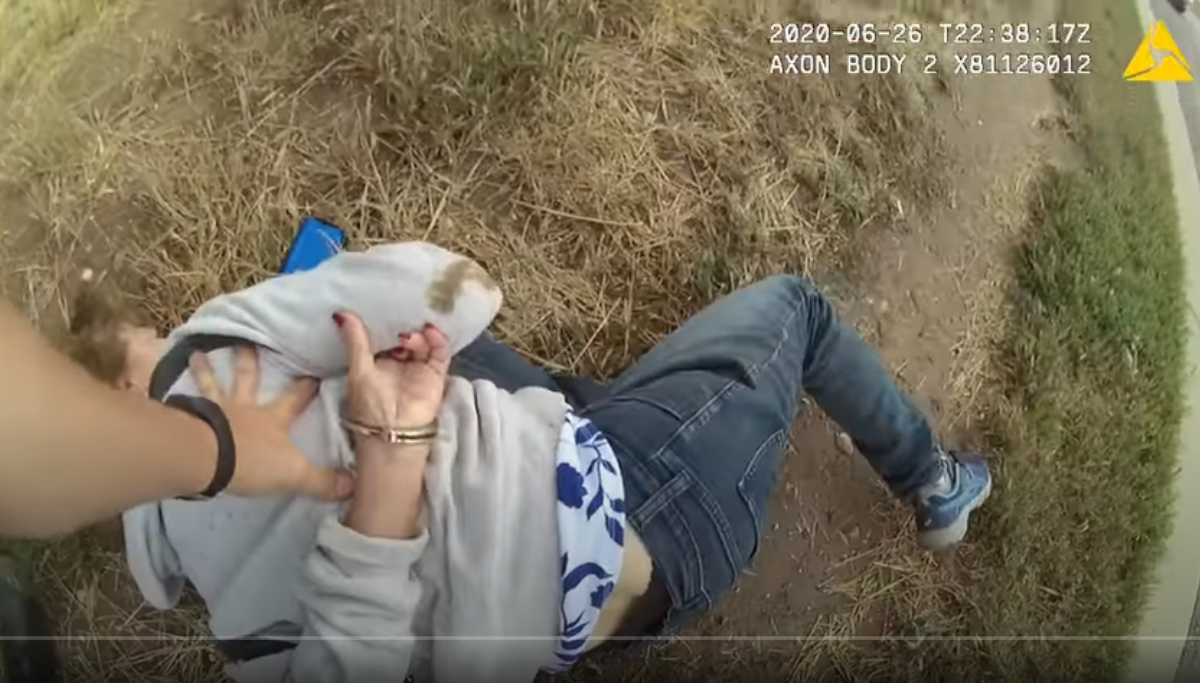
A case in Colorado involving the arrest of a 73-year-old woman with dementia for attempted shoplifting grabbed national headlines this week. It disturbed me personally because my father was in a similar situation. I believe many dementia caregivers fear this situation for their loved ones and we must do better as a community to protect those with dementia from ending up in this heartbreaking situation.
Karen Garner, 73, filed a lawsuit this week against the city of Loveland and its police officers. The incident took place in June 2020. Garner is accused of attempting to walk out of a Walmart with $14 worth of merchandise without paying. Walmart employees stopped her and were able to retrieve all items. According to the lawsuit, she offered to pay for the items at that point but the store declined, instead calling police to report the incident and offer the location in which Garner began walking. Store employees told police that the store had suffered no loss, according to the lawsuit and video of the arrest.
You can watch for yourself what happens next, as a police officer tracks down Garner. Warning: It is disturbing.
Garner is 5 feet tall and weighs 80 pounds. According to the lawsuit, her shoulder was dislocated during the arrest and she now requires assistance with daily tasks like bathing. She didn’t receive medical care until several hours later, though she complained of pain during the arrest. The criminal case against her was dropped by the district attorney’s office, while no disciplinary actions were taken against the officers until this week, when the lawsuit was filed and the video of the arrest went viral.
There is so much wrong here, and it starts way before the officers arrived. First and foremost is that America does a poor job in how it interacts with those who are mentally ill in the public sphere. I don’t know if Walmart has a blanket policy on calling police when minor incidents like this one happen in which a shoplifting attempt is thwarted, but this could have all been avoided if they had handled the situation internally. Ask if a family member can be called to pick her up and speak to them. Ban her from the store. Take a photo of her and post it in employee areas so staff know to be aware.
Police departments need better training in interacting with those with dementia and with mental health challenges in general. This arrest of Garner was a waste of law enforcement time and resources, and demonstrates the urgent need for engaged community policing.
And of course we need better resources for those with dementia. We don’t know Garner’s personal situation, if she was still attempting to live alone without regular supervision or if she wandered away. Both are common scenarios, and leave family members fearful for their loved one’s safety. With many adult day programs shut down due to COVID-19, there is likely an increase of those with dementia who feel bored and restless. While there are privacy concerns, offering identification that one has dementia could be helpful. The officer looked through Garner’s wallet about midway through the arrest. If there had been a card that said, “I have dementia. Please call this number for assistance,” the officers may have responded differently.
I thought about a similar incident with my father. I talk about the “burrito incident” in my book, The Reluctant Caregiver, and how it became a turning point in our family. He was at the stage of Alzheimer’s where his symptoms were becoming more apparent, but he still wanted to be independent. My mother sent him on an errand to pick up some items at a nearby convenience store, where they were regular customers. He picked up a couple of burritos and tried to walk out without paying. The clerk stopped him and my father got verbally agitated. Fortunately my mother was called instead of the cops and she hurried down to handle things. I believe my father would have ended up like Garner if the police had been called. Perhaps even worse.
None of this is easy. Police officers are not mental health experts, nor are store clerks. The pandemic has disrupted funding and access to community services. But it is clear in this particular case that no justice was served. I hope this case can demonstrate how broken our community services are for those with dementia and other mental health challenges and inspire solutions that are based in common sense and compassion.
Today would have been Dad’s 89th birthday. This year will mark 10 years since his passing. It’s hard to believe that much time has gone by, and how much the world has changed in just a decade.
I’ve always loved this series of photo booth shots. I wasn’t an entirely cooperative model but Dad’s beaming smile makes up for it. Dad rarely smiled in photos as he was self-conscious about his teeth, so the wide smiles in these shots are extra precious. He was definitely a proud papa.
We finally had infrastructure week in which President Biden’s infrastructure plan was unveiled to the public. One area of the ambitious plan has some people raising their eyebrows: “Solidify the infrastructure of our care economy.”
Traditionally infrastructure has referred to maintaining roads and bridges, along with other transit-oriented projects like airports and ports. Infrastructure is also often used to refer to essential services like water supply systems and power grids. All of these things are addressed in Biden’s plan. On the surface, caregiving may seem unrelated to how we typically define infrastructure. But make no mistake that care is just as essential to our wellbeing as the roads we use to travel and the electricity we use to power our homes.
As this editorial by Ai-Jen Poo and Heather McCullouch points out, we need to invest in the “systems of support for human capital” so that we can help people get back to work and revive the economy post-pandemic. Just as our roads need repair, so does the way we support citizens who are caring for family members. Biden’s plan focuses on the expansion of home and community care services, which is long overdue. So many caregivers are struggling right now, and the COVID-19 pandemic has demonstrated the need for additional support. Expanding services like childcare, elder care and care for those with disabilities would not only create new jobs, but would help family caregivers get back to work themselves.
Like most people, I want my taxpayer dollars to be spent in an efficient manner on essential programs. In my opinion, caregiving is just as essential as clean drinking water, electricity and roads. Our population, much like our physical infrastructure, is aging and in need of support. Care advocates like Poo have long championed viewing caregiving as an essential sector of the economy that deserves investment. I couldn’t agree more.
This week, I had to say goodbye to my rescue dog, Magee. I cared for him just shy of two years. They were challenging but rewarding years. He had been abandoned by his former owners at a boarding facility so his past was unknown, but he had health issues that were difficult to identify. We made great strides in securing a diagnosis (leishmaniasis) and just beginning treatment for this rare (in the U.S.) parasitic condition when out of the blue, cancer struck. A very aggressive tumor began growing on his eyelid, and in just weeks, was bulging across half his lower eye, bleeding and causing him great discomfort. It was confirmed to be melanoma. Removing the eye was an option, but melanoma, especially as aggressive as this was, typically comes back soon.
Putting a dog like Magee through major surgery and the required aftercare would not have been a good quality of life for him, as he had an anxiety behavior in which he would attack himself when he became stressed out. After his last vet visit, he experienced one of the worst episodes I’ve seen since I adopted him. This behavior continued over the ensuing days. (He had been on various medications to address his anxiety but none had worked well.) To put him through so much stress to buy a short amount of time before the cancer likely came raging back … it was an extremely difficult choice but I opted not to let his suffering continue.
I thought about my father, and how his dementia made him a poor candidate for recovery from surgery. He couldn’t understand that he needed to eat even if he wasn’t hungry to regain his strength and that he needed to follow the instructions of the physical therapist to get safely out of bed and walk. Instead he wasted away and became bedridden. My mother had a slow, grueling recovery from her cancer surgery, only to have it come back about a year and a half later. As caregivers know, rarely does a major procedure go off without a hitch. In my mother’s case the complications (blood clots) were life-threatening and required multiple medical interventions.
As I champion for people, quality of life is important for pets as well. It’s tricky because animals tend to be willing to put up with a lot more than people are, and our pets seem to focus on the happy moments. Dogs especially would live with us forever if they could. They trust us with all of their heart to make the right decision for them and we have to trust ourselves in the same way.
I never expected to have to say goodbye to two pets during this most difficult of years. Before Magee’s passing, I had began a new writing project, collecting the various things I’ve written about the pets I’ve had and my experience fostering dogs. Being a caregiver for animals can be just as intense as it is with humans, and I want to share my experience with those who also are grieving the loss of their beloved pets and agonizing over the medical care choices they made for them. What we see on social media, the smiling photos and the happy updates, are just one part of the story. Caring for a pet with health issues can be exhausting, frustrating, and depressing. It can also be rewarding and teach us valuable life lessons. If we could love ourselves the way our dogs love us, the world would be a better place.
Over a half-million deaths later, Americans may finally be ready to have more frank discussions about death. It is long overdue, and it pains me that it took a deadly pandemic to raise awareness, but perhaps it can be an important legacy of those who we’ve lost over the last year.
I’ve long championed the need to have “the talk” with elder loved ones, and how my parents’ refusal to discuss their end-of-life wishes created unintended but very real consequences. You can read more about my challenges in my collection of personal essays, The Reluctant Caregiver.
The pandemic showed us what many of us don’t want for our deaths: to be alone with no loved ones present, to be hooked up to machines, to die in a hospital instead of at home, to not be given a proper funeral or farewell ceremony. Hopefully we will take time to reflect upon these tragic, lonely deaths and take action now to better articulate what we would like the final phase of our life to look like.
Some may want to consider a death doula. Practically speaking, death doulas are helpers in all aspects of end-of-life care, from the bodily aspects of the dying process to spiritual concerns. They can assist with logistical issues, such as whether a client would prefer to die at home or in a hospice facility, and help coordinate burial and funeral plans. Doulas can serve as a comforting presence for both the dying and their grieving family. While it may seem awkward to bring in a stranger to what is considered a private family affair, having a compassionate, but clear-eyed presence can be a great benefit in an emotionally-charged setting. To learn more about this option, the International End of Life Doula Association offers a Doula Directory.
If you have not done so already, I hope you will take this time to think about how you’d like your end-of-life care to look and document those wishes. Encourage your loved ones to do the same. The coronavirus pandemic denied many the opportunity for a “good” death but by being more open in discussing a previously taboo subject, we can hopefully move towards a better end-of-life experience for all.







![Pageflex Persona [document: PRS0000038_00069]](https://memoriesproject.files.wordpress.com/2014/02/reluctant-caregiver-cover.jpg)






 The Memories Project